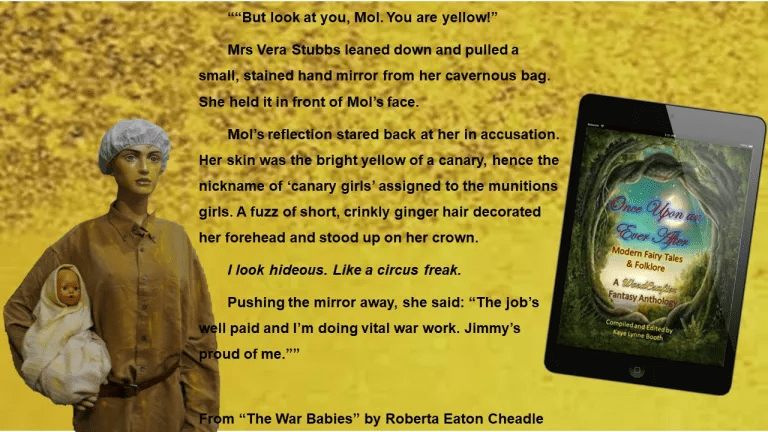
Patty Fletcher of Patty’s World blog has kindly hosted today’s stop on the “Once Upon an Ever After” Book Blog Tour featuring my short story, The War Babies. This story was inspired by the ‘canary’ girls who worked in the munitions factory in the UK during WW1 and Hans Christian Anderson’s short story, The Storks.
Thank you for hosting, Patty.
Welcome to the WordCrafter “Once Upon an Ever After” Book Blog Tour
Before I begin Day two, Kaye has a word or two to share.
Welcome to the WordCrafter Once Upon an Ever After Book Blog Tour, where we’re launching Once Upon an Ever After: Modern Myths & Folklore with guest posts from contributing authors about their story inspirations, reviews and an interview the anthology and WordCrafter Press with me, Kaye Lynne Booth. So, stick with us by following the schedule below, to learn more about this mystical new anthology and its authors. Check back daily, as I’ll be adding the links as they go live.
Tour Schedule
Monday – August 22 – Opening Day Post – Writing to be Read – Intro. & Guest Post – Sarah Lyn Eaton
Tuesday – August 23 – Patty’s World – Review & Guest Post – Robbie Cheadle
Wednesday – August 24 – The Showers of Blessings – Guest Post – Olivia Merchiston
Friday – August 26 – Zigler’s News – Review & Guest Post – Lyndsay Elizabeth Gilbert
Saturday – August 27 – Closing Post – Writing to be Read – Guest Post – A.E. Lanier
Digital Giveaway
For a chance to win a free digital copy of Once Upon an Ever After, just leave a comment to show you were here. Follow the tour and comment at each stop for more chances to win. Three copies will be given away in a random drawing. (Yep. I literally draw the names out of a hat.)
This anthology was by invitation only, which means I invited the authors because of specific stories, which caught my imagination. The result is a unique collaboration with a wonderful group of authors who have been an absolute pleasure to work with.
My Thoughts…
I must say, Kaye’s words of “A wonderful group of authors” is right on the mark. The stories in this anthology are quite amazing.
Today, I’ll be reviewing Robbie Cheadle’s War Babies. Before I do, here’s a word from Robbie.
Robbie’s Thoughts in her own words…
The theme for this short story collection was a little daunting for me at the time I received the notification about this anthology, Once Upon an Ever After. I am not a person who can necessarily write to any prompt as I need to be inspired. I have written some modern fairy tales loosely linked to a fairy tale which could be called the inspiration for the story, but the mood must be upon me to do that.
I wanted to write a story about the British women who worked in munitions manufacturing trinitrotoluene shells during the First World War. They were nicknamed ‘Canary Girls’ because exposure to TNT is toxic and repeated expose turns the skin an orange-yellow.
These Canary Girls may not have been fighting in the trenches, but the job they did was fraught with danger. The factories where the munitions were manufactured were targets for enemy fire and were often bombed. In addition, they risked personal injury if they tapped the detonator too hard when they fitted it into the top of the casing.
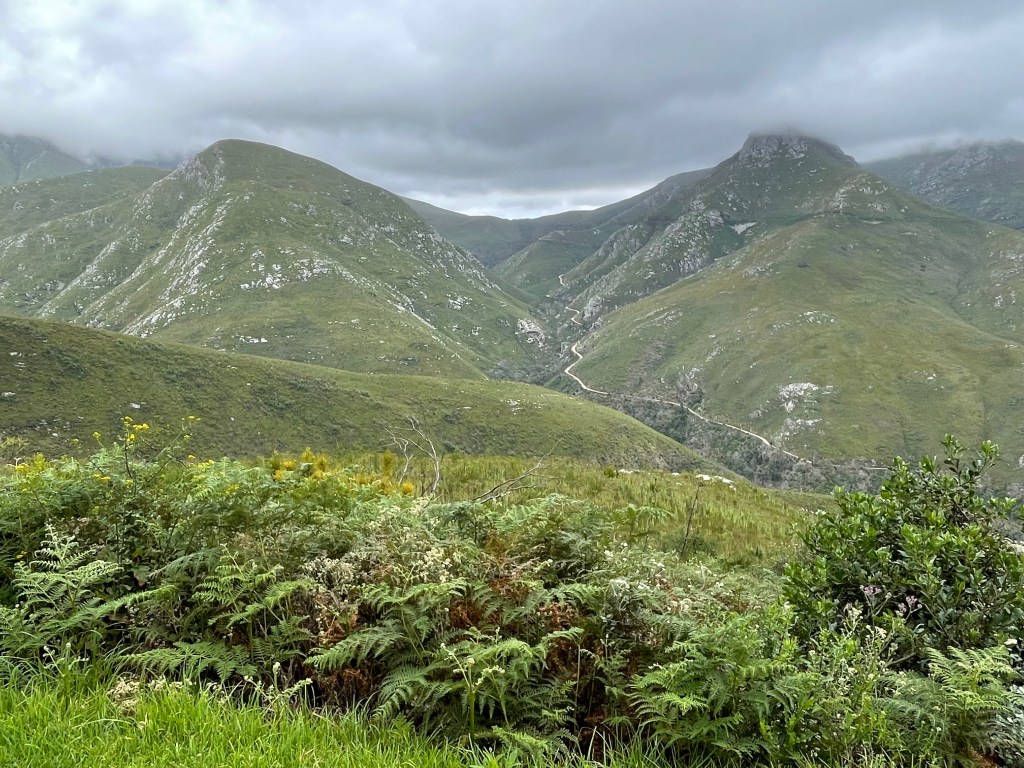
I liked this post so much I decided to share a few of my photographs of beautiful mountains with unusual formations and features. All these pictures are from places in South Africa.
The above pictures are of Ghost Mountain in KwaZulu Natal.
These two rock formations are from Golden Gate Highlands National Park.
These two pictures are of the Outeniqua Mountain Pass
These pictures were taken near Fugitives Lodge.
The three rondavelsBlyde River CanyonBourke’s potholes
These are a few of the wonderful books I’ve read over the past few months.
Reading Lady Chatterley in Africa
What Amazon says
Recently widowed, Mary Merskine heads out to a mountain lodge in Africa hoping to come to terms with the death of her husband, George. However, there are deeper issues surrounding his death that don’t make this easy and her search is hampered by ex-pats and the local staff of the lodge who bring a new set of challenges to her life. Amongst all these problems that arise, she must find some way of dealing with George’s death or else face returning to England and a life of misery.
My review
The book starts with Mary Merskine, an older lady from the United Kingdom, travelling by car to a guest lodge in Africa. The driver, a young man named Caiaphas, stops on the way to the lodge to purchase supplies and Mary is accosted by a scary-looking beggar who gives her a fright. The beggar asks for money and Mary does not give him any. On the driver’s return, he gives the beggar a few coins which are received with thanks. This transaction makes Mary feel uncharitable and serves as the reader’s first insight into the nature of the local people who are generous towards each other and care for their own.
The reader learns that Mary has come to the lodge to manage it while the owner, a good friend from her younger days, is away caring for his critically ill mother. It is revealed that Mary’s husband had recently died, following a long degenerative illness. She has been abused and rejected by her neighbours after his death, but the reason for this negative behaviour is not revealed until near the end of the book. Mary is also estranged from her only son.
Life at the lodge is significantly different to life in a small town in the United Kingdom. There are some wonderful things: the surroundings are beautiful and peaceful although untamed and very natural, and the food, prepared by Solomon the cook, is delicious. Mary is waited on hand and foot by the lodge staff, including a young woman called Esther, who has a young baby. On the negative side, Mary’s closest female neighbour, Joyce, is a selfish, competitive woman, who treats her staff badly and is having an affair with an overbearing boar of a man named Pieter. Mary is introduced to the decadent and immoral lifestyle of Joyce and her compatriots, and it is a shock to her, especially as she is still overwhelmed with grief and loss.
Mary turns to a book, Lady Chatterley’s Lover, for distraction and solace. The book has a strange effect on her, and she starts acting out some of the odd experiences of the main character. These peculiar actions come to the attention of Caiaphas, who becomes attracted to Mary in a way that almost borders on obsession.
Mary needs to learn to deal with the staff at the lodge, her unpleasant neighbour and her acquaintances, as well as manage her on-going grief and fend off sexual advances by Pieter. The character of Mary was interesting as she professed to love her husband and find it difficult to face life without him, but I didn’t get the impression he’d ever swept her off her feet or that it had been an intensely sexual relationship. In fact, I got the impression that her relationship had been quite staid and suppressive. She carried a lot of guilt and some of that may have been due to the fact that she was not passionate about her deceased husband as well as the circumstances surrounding his illness and death. As time passes and Mary grows from her new experiences at the lodge, she seems able to loosen the bonds of her narrow view on life a little. Mary gets to a point where she is able to appreciate difference and new experiences and look at letting go of what has passed and embracing new opportunities offered in her future.
This book is beautifully written and contains many delightful descriptions, a few of which are as follows:
“She had expected the heat, but not like this. The morning sun, unhindered by clouds, coiled its tentacles around her naked forearms in a clammy embrace, welcoming her to this new, strange clime.”
“Time was a lazy think in their world. It did not adhere to a strict timetable of seconds, minutes and hours. Time would take as long or as short as it needed in their world for things to happen and they all accepted this with ease.”
“A steady rumble of sound leaked through the window of the guest bedroom, a nasal grown from one of the sleeping occupants of the room. Outside the window a dream giggled nervously, wondering whether to risk entering, worried that the snores would wake someone and catch it before it could settle in a sub conscious.”
Great book! This is a suspense/romance that will keep you on your toes as well as touch your heart! Barb
Jacquie Biggar has a wonderful gift for writing hot and extremely likable military men! by Jacqui Nelson
A woman and child in danger teaches Nick life is worth living.
ALL SHE WANTS IS TO LIVE HER LIFE
Abused, Sara Sheridan finds the courage to escape her husband. She has no interest in getting mixed up with another alpha, attitude-laden male. Especially with her ex hot on her trail.
ALL HE CRAVES IS PEACE AND QUIET
Marine, Nick Kelley prefers solitude, away from the memories haunting him. So what is it about his reticent neighbor and her child that tempts him to give it up?
UNTIL LOVE GETS IN THE WAY
Nick and Sara’s growing attraction leads them down a dangerous path as her ex-husband closes in on the new life she’s made for her daughter and threatens to blow it all apart.
My review
Tidal Falls is a fast paced and relatively short read in the typical Romance/Action style of talented author, Jacquie Bigger.
Sara Sheridon and her daughter are on the run from Sara’s abusive husband, Tom. Before escaping from her prison cum home, Sara manages to break into Tom’s office and computer and download some very interesting files. Files that associate him with some very bad but powerful people. Sara’s simple action, intended to give her some leverage over her husband in order to gain sole custody of her young daughter, backfires when she realises that the information on the memory stick would send Tom to jail and also potentially endanger his life. Sara has landed in the small town of Tidal Falls and has made some very good friends, but she lives her life in fear of discovery.
Nick Kelly has come to Tidal Falls in an effort to relax and unlock the traumatic secrets his mind has blocked out. Break through memories of his turbulent past as a Marine are making his life difficult and Nick is focused on improving his mental state and not on finding love. When he catches sight of Sara, one of his neighbours, he is instantly attracted to her and despite his best intentions not to be distracted, conspires to meet her.
When Sara and Nick’s paths cross it is a case of mutual attraction at first sight, but trouble is on the horizon as Tom has found a way of tracking his wayward wife down. Tom wants Sara and the files back and is willing to do anything to find her.
This is an entertaining book which contains the best elements of both a romance with lots of sexual tension and a little sex, and an exciting and action packed plot.
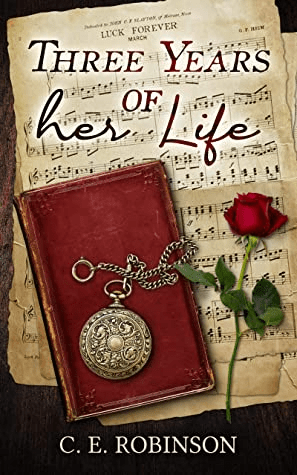
This debut novel is an indelible portrait of family love, trust, commitment, and unrelenting prejudice. A stirring tale that rides the line between historical fiction and romance., inspired by a famous musician’s hidden secret in Germany.
Three Years of Her Life, set in New England and Central Europe, is similar in concern and significant issues to bestselling America epic books of the Great Depression, The Great War and the U.S. South. People and places focused, the novel’s heartwarming and heart wrenching themes mark history in unsettled times.
A mystery woman’s photo, in question, is in famous grandfather’s gold pocket watch for over fifty years. It devastates Elizabeth’s estranged grandmother, and she convinces Elizabeth to find the link. At a loss how, Elizabeth’s on track to be a nurse not a detective, she gets help from Erik, the doctor who captures her heart. He becomes obsessed with uncovering her grandfather’s secret, and discovers more in Germany than the family can take. Now he shares a family heritage. When Elizabeth tries to stand up for Erik and her grandfather, it backfires.
Complicating her own life, Elizabeth falls into an entanglement with her guitar teacher. It’s only a longer-for connection to musicians, her absent father and dead grandfather, but it causes uncertainty. She’s now torn between two very different men. And what happens if and when she lets one of them go? Erik tips the balance for Elizabeth’s decision. He proves his character by risking his life transporting East Berlin hospital patients to the West through the Berlin Wall. But, what if border guards trap him in East Berlin? Unbeknown to Elizabeth, before Erik leaves on the mission, he sets up her future. And, he’s dead serious about the plan.
My review
The title of this book is quite relevant to the storyline as this novel is all about how quickly life can change for either the better or the worse.
The reader first meets Elizabeth as a young girl who has just come out of a failed romance and is quite heartbroken. Despite this emotional setback, Elizabeth is preparing to start training to be a nurse and this is the first indication to the reader of her strength of character. In the first chapter, Elizabeth’s demanding and dictatorial grandmother is also introduced and some of the difficulties Elizabeth faced growing up around this difficult older woman are revealed. It is clear that life hasn’t been plain sailing for Elizabeth. The visit with her grandmother is not a particularly happy or loving one but Elizabeth receives a gift of her grandfather’s pocket watch. The gift comes with a price tag though. Inside the case is a picture of a young woman with a suggestive inscription. Elizabeth’s grandmother is suspicious that her husband, who passed two years after she divorced him, was having an affair. She tasks Elizabeth with finding out who the woman was. This conversation is difficult for Elizabeth who greatly admired her talented musician grandfather.
Elizabeth starts her training and her life progresses. She meets a wonderful Jewish doctor, Erik, whom she becomes romantically involved with, but she never forgets about the unknown woman in the pocket watch and her aim to discover who she was. Erik undertakes to help her with this investigation which leads to Berlin in Germany.
This story intrigued me as it contained a lot of different but complimentary elements that I liked including romance, family drama, and a dollop of interesting history.
Elizabeth’s character is a complex one. She has grown up with a dominant grandmother whose husband was always away on tours for his music career and who felt let down by him and eventually divorced him. Her own musician father and left her and her mother when she was a young girl. Elizabeth lacks trust in men who have always let her down. These trust issues cause an emotional barrier for her when it comes to her own romances and she is not able to entrust her heart and life to a man. This aspect of Elizabeth’s character sets the stage for a great deal of turbulence in her relationship, especially since her boyfriend’s Jewish mother is not accepting of a non-Jewish perspective wife for her son. On the other side, Elizabeth’s grandmother and father are not accepting of her Jewish boyfriend so there are difficulties on both family fronts.
I enjoyed watching Elizabeth’s character grew although some of her decisions and reactions were a bit frustrating. They were not necessarily unrealistic in the situation, but they were so obviously poor decisions that I wanted to give her a good shake a few times.
The investigation of the woman in the picture starts off very slowly while Elizabeth’s romance builds and suffers several highs and lows, but it does take off in the second half of the book and becomes quite exciting.
The format of this book is not standard as the focus shifts from a romance to an exciting adventure. Some people might not like this mixture but I didn’t mind and thought the various elements of the romance led well into the circumstances of the adventure.
I would recommend this book to people who enjoy family dramas with a lively adventure included to keep the storyline spicy and move the romance along.
Welcome to Thursday Doors, a weekly feature allowing door lovers to come together to admire and share their favorite door photos from around the world. Feel free to join in on the fun by creating your own Thursday Doors post each week and then sharing your link in the comments below, anytime between 12:01 am Thursday morning and Saturday noon (North American eastern time).
My husband, youngest son, and I went on a four-day adventure from Saturday to Tuesday. It was a long weekend here in South Africa and we decided to make the most of it. Our road trip included a visit to a small town called Groot Marico which is the primary setting for the short stories written by South Africa’s most famous short story writer, Herman Charles Bosman. Groot Marico has a literacy centre in his honour with a replica of the original farm school where he taught. From Groot Marico, we went on to Tau Game Lodge in the Madikwe Game Reserve. This proved to be the most amazing place for animal sightings we have visited to date. For those of you who have an interest in such things, there is also a spa you can visit. I spent 7 1/2 hours a day on game drives and 3 hours eating so there wasn’t time for a spa visit.
I am starting backwards with our trip and featuring Tau Game Lodge first. My reason is that I want to record some YT video’s of Bosman’s poetry and a short story to share when I feature Groot Marico and I haven’t started with that project yet.
Entrance to the Tau Game Lodge concession
We arrived to early to check-in to our rooms, so we sat at our table on the platform above the waterhole and watched the animals.
View through the door out to the viewing platform
The watering hole was teaming with animals. The following pictures are my attempt at taking artistic pictures (thank you for the idea, Rebecca Budd).
A giraffe framed by the branches of a treeAn elephant with two giraffe behind it. The giraffe’s long necks are crossing over which I thought was rather interesting.Elephants drinking and submerging in the waterA herd of Wildebeeste drinking – not as artistic but what an experience!
This is my video of a giraffe drinking. It is a very awkward undertaking for giraffes.
This is a short clip of the Wildebeeste coming to drink at the watering hole:
This is a short video of an elephant bathing. It went right under the water which was pretty amazing to watch:
Welcome to Thursday Doors, a weekly feature allowing door lovers to come together to admire and share their favorite door photos from around the world. Feel free to join in on the fun by creating your own Thursday Doors post each week and then sharing your link in the comments below, anytime between 12:01 am Thursday morning and Saturday noon (North American eastern time).
I am going on an adventure from 6 August to 9 August and won’t be around much.
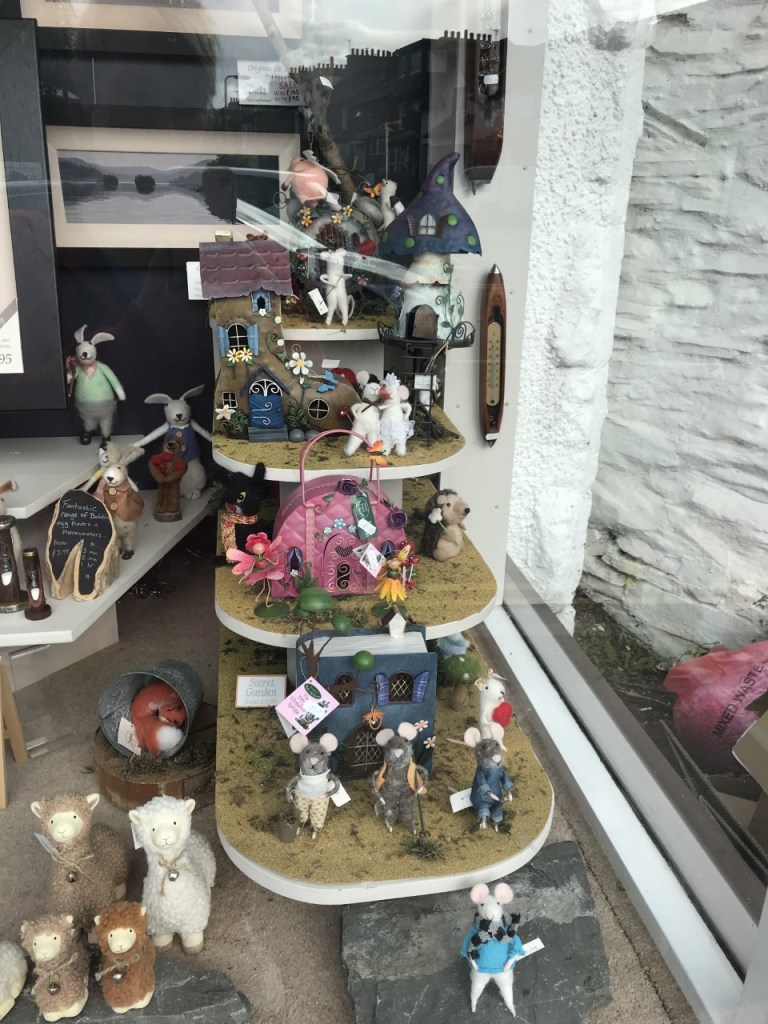
I am leaving you with this picture of some little fantasy houses I took through the window of a shop in the Lake’s District in the UK. I thought they were adorable and love the tiny doors and windows.
Did you know that Charles Dickens re-wrote the ending of Great Expectations?
He made this change after he’d submitted the final chapters to the printers in June 1861. He was apparently persuaded to make the change by a close friend who felt he should end the book in a way that left the reader hopeful that Pip and Estella might get together. It is recorded that Dickens was reluctant to make this change but was eventually won around to the idea of a more conventional ending that he had originally written.
The initial ending depicts Pip accidentally meeting Estella on the streets of London. Estella has lost her first abusive husband to death, but has remarried. Pip recounts this chance meeting as a once-off and there is not expectation by the reader that the two will ever get together. Pip does express a sense of satisfaction and peace that time has softened Estella and made her kinder.
The published ending depicts Pip accidentally discovering Estella in the abandoned garden of Satis house (Miss Havisham’s house that burned down) when he returns to visit Joe and Biddy after many years abroad. Estella has been widowed after an unhappy life with her abusive husband. In the final lines of the novel, Pip comments ambiguously that he “saw the shadow of no parting from her.”
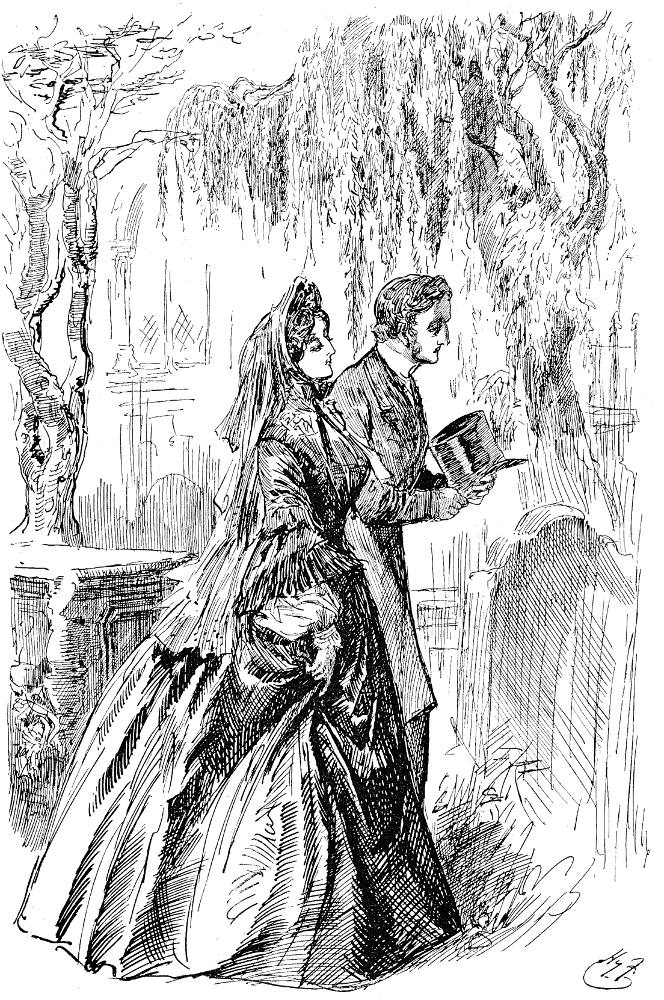
Harry Furniss 1910 13.7 cm by 8.9 cm (5 ⅜ by 3 ½ inches), framed
This ending leaves the reader with the impression that Pip and Estella might finally be together but the nature of Dickens’ writing and the use of the word shadow hints at possible mists to come.
The misty marshes near Pip’s childhood home in Kent is an important setting in this book and is used as an instrument by Dickens to symbolize danger and uncertainty. Pip initially meets Magwitch the convict in the graveyard on the marshes on a misty evening and that has significant implications for his future. The search for the convicts by the police also happens in the mist as does Orlick’s kidnapping of Pip. The day Pip travels to London after receiving news of his great expectations is also depicted as being misty, as is the night when Magwitch arrives at his door later in the book.
The hint at shadows and mist in the closing paragraphs with Estella in the garden at Satis house could thus easily hint at further turmoil to come for Pip.
From another perspective, by the end of the novel, the reader is aware that Pip misreads situations and makes incorrect assumptions so the idea that this could be just another wistful idea or ‘expectation’ is not fully expelled.
Personally, I felt that the original ending would have been better and would have given Pip a real chance to move on with his life and find someone better and nicer than Estella. I did not like her even if she was a product of Miss Havisham’s upbringing.
What do you think? Which ending do you think is better for this novel? Do you think Pip and Estella get together based on your reading of the original ending?
Welcome to Thursday Doors, a weekly feature allowing door lovers to come together to admire and share their favorite door photos from around the world. Feel free to join in on the fun by creating your own Thursday Doors post each week and then sharing your link in the comments below, anytime between 12:01 am Thursday morning and Saturday noon (North American eastern time).
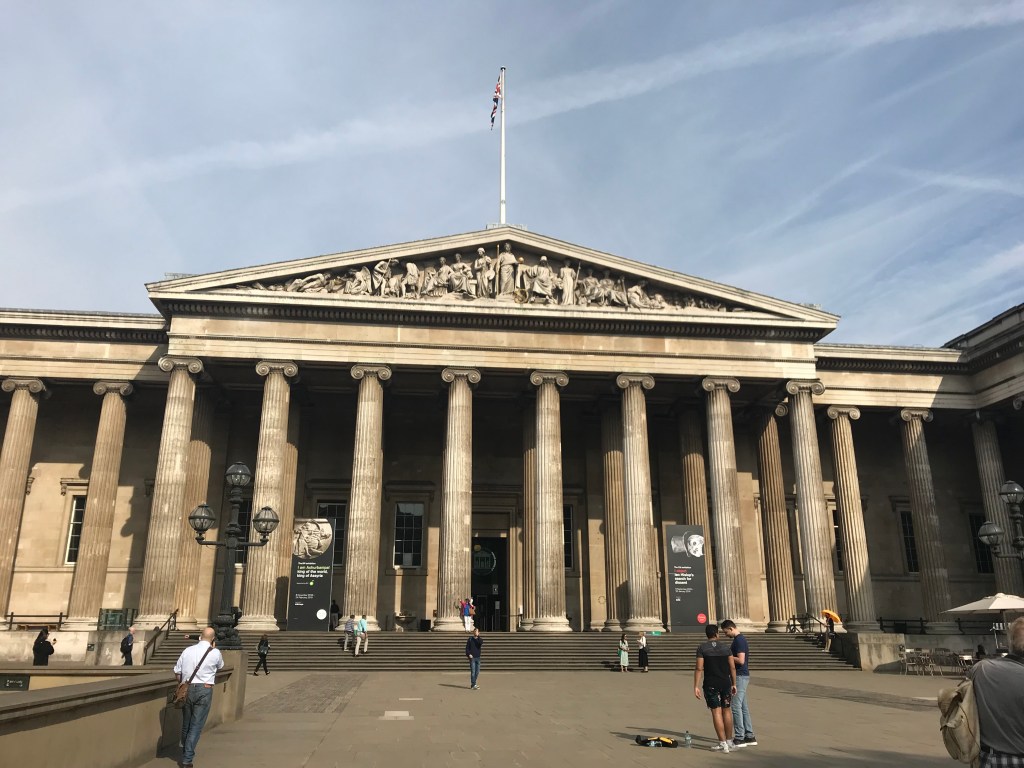
In 2018, Terence and I travelled to London on our own for two days before travelling on to Budapest. We spent a good 5 hours at my favourite museum. Many wonderful and mysterious historical objects lie behind these doors.
These are a few of my favourite things in the British Museum.
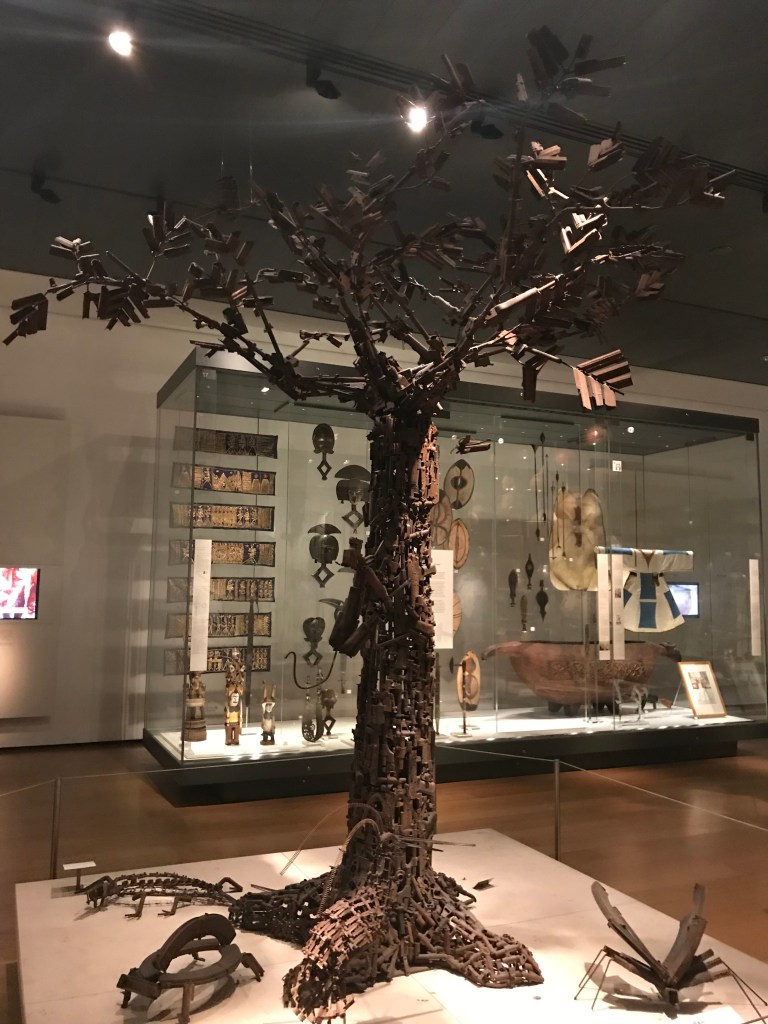
Tree of life – Museum of the World
The Tree of Life is a sculpture created by four artists in Mozambique. The Tree of Life was constructed from 600 000 guns and other weapons that were used during the civil war in Mozambique. After the war ended, citizens were encouraged to hand over guns to the authorities in exchange for ploughs, bicycles and sewing machines. These decommissioned weapons were cut up and provided to the artists.
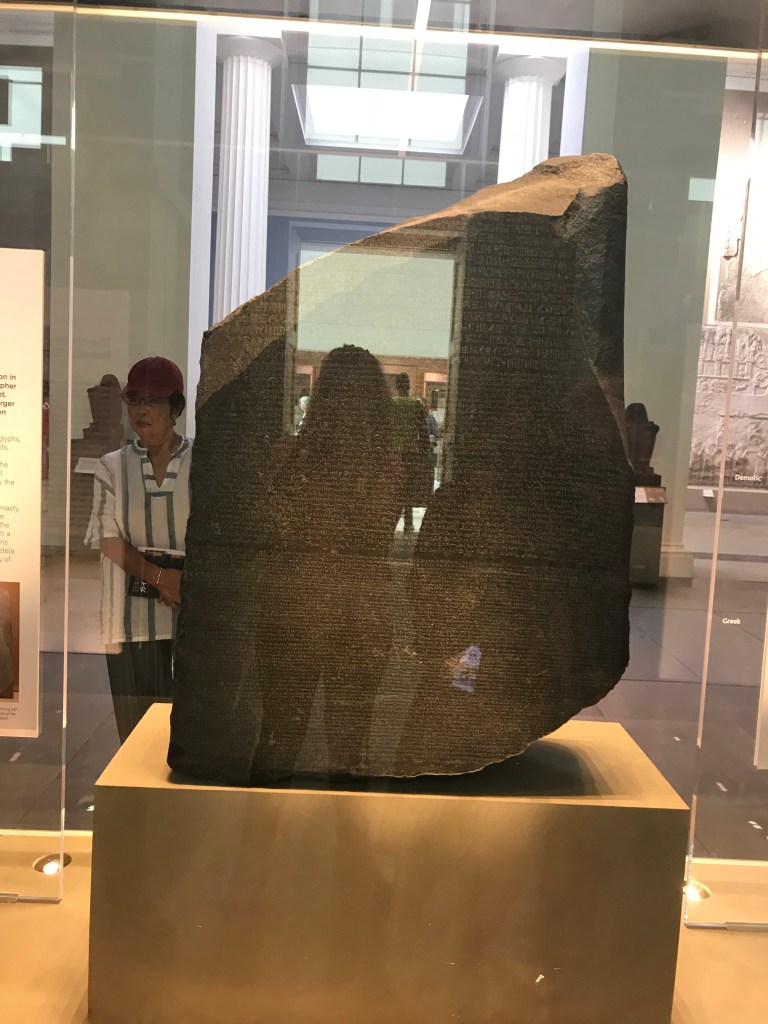
The Rosetta Stone
The Rosetta Stone is one of the most important items in the British Museum. When it was discovered, nobody knew how to read ancient Egyptian hieroglyphs. Because the inscriptions say the same thing in three different scripts, and scholars could still read Ancient Greek, the Rosetta Stone became a valuable key to deciphering the hieroglyphs.
You can find out more about the Rosetta Stone by listening to this podcast:
The Holy Thorn Reliquary
What the British Museum says about the Holy Thorn Reliquary:
“This reliquary was made to contain a thorn, supposedly from the Crown of Thorns that was placed on Christ’s head before the Crucifixion. The armorial enamelled plaques in the base show that it was made for Jean, duc de Berry (1340–1416). The Crown of Thorns itself was a French royal relic, housed in its own chapel in Paris. Individual thorns were detached to make precious reliquary jewels.”
I’m going to end this post by sharing my favourite song from the Sound of Music: My Favourite Things
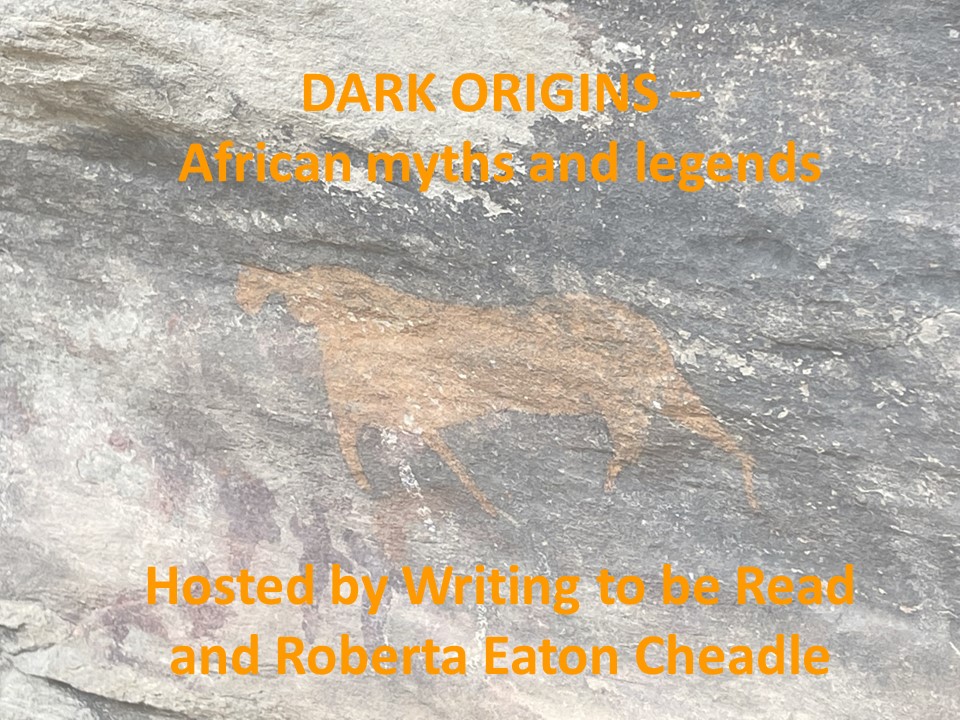
This month’s Dark Origins, African Myths and Legends post on Writing to be Read discusses the origins of the legend of the Flying Dutchman. I’ve also included a reading of the story. Thanks for hosting Kaye Lynne Booth.
In the late Middle Ages, the spice trade from India and the so called Silk Road from China were of economic importance to Europe. After Constantinople fell to the Ottoman Empire in 1453 the European overland trade routes were disrupted and they needed to find a sea route to India and China.
Christopher Columbus attempted to find a sea route to India by travelling westwards. He discovered the Americas.
Portuguese explorer, Diogo Cão, explored the African coast south to present-day Namibia, and, in 1488, Portuguese explorer, Bartolomeu Dias, discovered the Cape of Good Hope. In 1498, Vasco da Gama headed an expedition which led to the Portuguese discovery of a sea route to India. This route around the Cape of Good Hope (current day Cape Town) came into use by the European East India Companies.
The Cape of Good Hope was also known as the Cape of Storms because of…
We left Pip in London, living between the homes of his tutor, Matthew Pocket, and Matthew’s son, Herbert Pocket, who is initially his mentor on becoming a gentleman and later becomes Pip’s best friend. Pip’s initiation by Herbert into the manners and behaviours of a gentleman are depicted in the scene below:
Caption from this snippet on YT: Based on “The Great Expectations” by Charles Dickens. I think this scene alone encompasses how most of us nowadays imagine middle-class Victorian London. The conversation goes on, but I wanted to share the smallest and, in my opinion, most representative moment.
Pip becomes extravagant and self-absorbed as a result of his new found wealth, and leads his friend, Herbert, along the same path getting them both into debt.
Miss Havisham summonses Pip to her home and he discovers that Estella has returned from abroad and is moving to London to live with a suitable older woman and her daughter and be launched into society. The underlying understanding is that Estella is now going to carry out Miss Havisham’s revenge plan and break as many male hearts as possible.
Pip is tasked with meeting Estella at the train station and taking her to her new home. The complex love/hate relationship between Pip and Estella continues, with Pip firmly believing Estella is destined to be his wife. Estella starts a flirtation with Drummle, Pip’s nemesis, and it causes tension between the two men, but Pip tolerates it because of his belief that Miss Havisham first wants Estella to break hearts and fulfil her ambition of revenge on men as a larger unknown mass, before Pip and Estelle can be married and find personal happiness.
Pip comes of age (21 years old) and has a meeting with Mr. Jaggers, his guardian and his benefactors lawyer, about his ‘great expectations’. He leaves Mr. Jagger’s office with a sum of GBP 500 on which he most live until his benefactor is revealed to him. Pip is ashamed that he’s led Herbert into an idle life of extravagance and decides to invest a chunk of this money into helping Herbert find a ‘business opportunity’. He does this with the help of Mr. Jagger’s assistance, Mr. Wemmick, but without Herbert’s knowledge.
Herbert grasps the opportunity and works hard to improve himself while Pip continues with his life of idleness and luxury.
One windy, cold night when Herbert is away for work purposes, Magwitch arrives at Pip’s lodging and Pip finally comes to realise that Magwitch is his benefactor and not Miss Havisham.
This clip from the original movie is not exactly how I imagined the initial meeting between Pip and Magwitch taking place based on my reading of the book. I think Pip handled it better in the book than the depiction in this scene, but here it is anyway:
Pip is devastated because he believes this will make him unacceptable as a marriage partner for Estella, but he soon learns she has decided to marry Drummle.
Magwitch, as a convict deported for life, has risked his life returning to England. The sentence if Magwitch is caught is death by hanging. Pip and Herbert work together to make a plan to save Magwitch and get him out of England. They are of the opinion that Magwitch’s arch enemy, Compeyson, is aware he is back in England and is assisting the police in an attempt to have him arrested.
The great plan is eventually put into operation, but it goes wrong and Magwitch is instrumental in the drowning of Compeyson and is arrested and put in jail. He was injured during the altercation with Compeyson and is dying. Magwitch undergoes a new trial and is given the death sentence.
In the meantime, Pip has worked out that Mr. Jagger’s servant is Estelle’s mother and Magwitch is her father. Just before Magwitch dies, Pip tells him that his daughter is alive and a beautiful lady and that he – Pip – loves her. This is a pivotal moment in the book as by showing kindness to Magwitch, a criminal, and calling his daughter a lady despite being the daughter of a convict, he illustrates that he no longer thinks of social position in a black and white way.
All of Magwitch’s property is forfeited to the state so Pip is left penniless. He becomes very ill after Magwitch dies and only escapes arrest for debts because of his ill health. Joe comes to London to nurse Pip and he recovers. The whole experience teaches Pip the value of his relationships with Joe and Biddy and Pip’s internal conflict is resolved by his giving up his social aspirations to reunite with the people who have helped and cared for him.
Pip goes abroad to work with Herbert and learns to live on his income.
Next week, I’ll discuss the ending of this book as it is a little controversial. Dickens rewrote the ending and both are known. Many critics believe the original ending was the better one.
A few interesting quotes from the second half of Great Expectations:
“Out of my thoughts! You are part of my existence, part of myself. You have been in every line I have ever read, since I first came here, the rough common boy whose poor heart you wounded even then. You have been in every prospect I have ever seen since – on the river, on the sails of the ships, on the marshes, in the clouds, in the light, in the darkness, in the wind, in the woods, in the sea, in the streets. You have been the embodiment of every graceful fancy that my mind has ever become acquainted with. The stones of which the strongest London buildings are made, are not more real, or more impossible to displace with your hands, than your presence and influence have been to me, there and everywhere, and will be. Estella, to the last hour of my life, you cannot choose but remain part of my character, part of the little good in me, part of the evil. But, in this separation I associate you only with the good, and I will faithfully hold you to that always, for you must have done me far more good than harm, let me feel now what sharp distress I may. O God bless you, God forgive you!”
“So, I must be taken as I have been made. The success is not mine, the failure is not mine, but the two together make me.”
“Do you want to be a gentleman, to spite her or to gain her over? Because, if it is to spite her, I should think – but you know best – that might be better and more independently done by caring nothing for her words. And if it is to gain her over, I should think – but you know best – she was not worth gaining over.”
“My name is on the first leaf. If you can ever write under my name, “I forgive her,” though ever so long after my broken heart is dust pray do it!”
“O Miss Havisham,” said I, “I can do it now. There have been sore mistakes; and my life has been a blind and thankless one; and I want forgiveness and direction far too much, to be bitter with you.”
Welcome to Thursday Doors, a weekly feature allowing door lovers to come together to admire and share their favorite door photos from around the world. Feel free to join in on the fun by creating your own Thursday Doors post each week and then sharing your link in the comments below, anytime between 12:01 am Thursday morning and Saturday noon (North American eastern time). If you’d like to join Thursday Doors, you can do so here: https://nofacilities.com/2022/07/21/more-from-old-wethersfield/
Last week, for Thursday Doors, I wrote about the impact of doors on my life and how I see my mind as a passage way full of closed doors behind which I store all my thoughts and ideas about life, work, religion, people, and, of course, my writing. There are doors into my children’s writing ideas, doors into my poetry writing and doors into my adult writing. Doors also play a significant role in my books.
The cover of my first poetry book, Open a New Door, also features a door. I took this picture through the doorway at the game lodge where Terence and I got engaged in 2000. We took the boys there for the weekend and enjoyed revisiting it very much.
The inspiration for this title and cover came from my favourite Broadway show, Mame, featuring Angela Lansbury and Beau Arthur. When I was a very little girl and before my youngest sisters (numbers 3 and 4) were born, I used to play my mother’s collection of LP’s on her old record player. Often I used to dance and sing with sister number 2. We would dress up in mum’s theatre dresses, hats and scarves and make up shows to the music. We even performed them occasionally for the farm employees and I performed at school a few times when my dad could be persuaded to bring the record player to school and I would dance and sing for the class. I loved to sing and always had a place right at the front in the school choir.
My purple Quality Street song from Mame was called Open a new door. You can listen to it here:
This is one of the first poems I ever wrote. It’s not my best poem, and I wrote it when I thought all poetry was rhyming verse, but I still love it. It reminds me that there is more to life than my daily hamster ball.
Who’s really free
The sky is dark, coloured an unrelenting grey
Outside it’s damp and dreary, a dismal day
I gaze out of the window, splattered with rain
I stretch – an attempt to ease my physical pain
The lines of traffic extend for miles each way
A depressing sight that fills me with dismay
The landscape is blurred, shrouded by a soft mist
An addition that gives the scene a threatening twist
Tall buildings adorn the horizon, shabby and bleak
Tiny ants dart inside, refuge from the rain they seek
***
A ray of sunshine, creeps through a gap in the cloud
It gleams bright and bold, of its success quite proud
An arrow formation of birds crosses my line of vision
The rain and the cold have forced a flight decision
Such a contrast from my world, confined and cramped;
The birds, completely free, from this land have decamped
They roam, unfettered, across an unrestricted, spacious world
As I watch, my toes in my smart shoes, are tightly curled
I turn away abruptly, back towards the bright, artificial light
I quell any questioning thoughts invoked by this compelling sight.
By Robbie Cheadle
My book, A Ghost and His Gold, also features numerous doors; some opening, some closing, but all signifying change. Here is a short teaser:
“The muffled rapping penetrates Pieter’s thin early morning sleep. He stirs and rolls over. The insistent rapping continues, forcing his reluctant consciousness upwards, towards full awareness. Sitting up quickly, he awakes fully, sudden fear acting like a bucket of cold water. The blankets drop away from his body and the frigid iciness of the early June morning chases away any remaining vestiges of sleep.
Over the past months, fear has eaten into his mind’s core like a malevolent caterpillar. Fear of the future. Fear of the soldiers. Fear of losing his farm. It’s been there, rotting his brain matter, ever since the declaration of war in October the previous year. The injury he sustained early this year exacerbated its effect until his mind is a worm-infested apple, brown and soft inside. He takes some deep breaths, determined to prevent the poison from spreading and affecting his reactions. Poor reactions could result in his death and that of his family.
He stares into the total blackness, trying desperately to see, while his body reacts to the biting cold, with gooseflesh breaking out on his torso and arms.
Who can be knocking on my door at this time of morning? It can only be bad news.
Next to him, his wife, Marta, starts to stir as she too responds to the intrusion.
“Pieter, are you awake?” The piercing voice competes with the wind that rattles the slats of the wooden blinds, and whistles under the ill-fitting front door.
Something’s wrong.
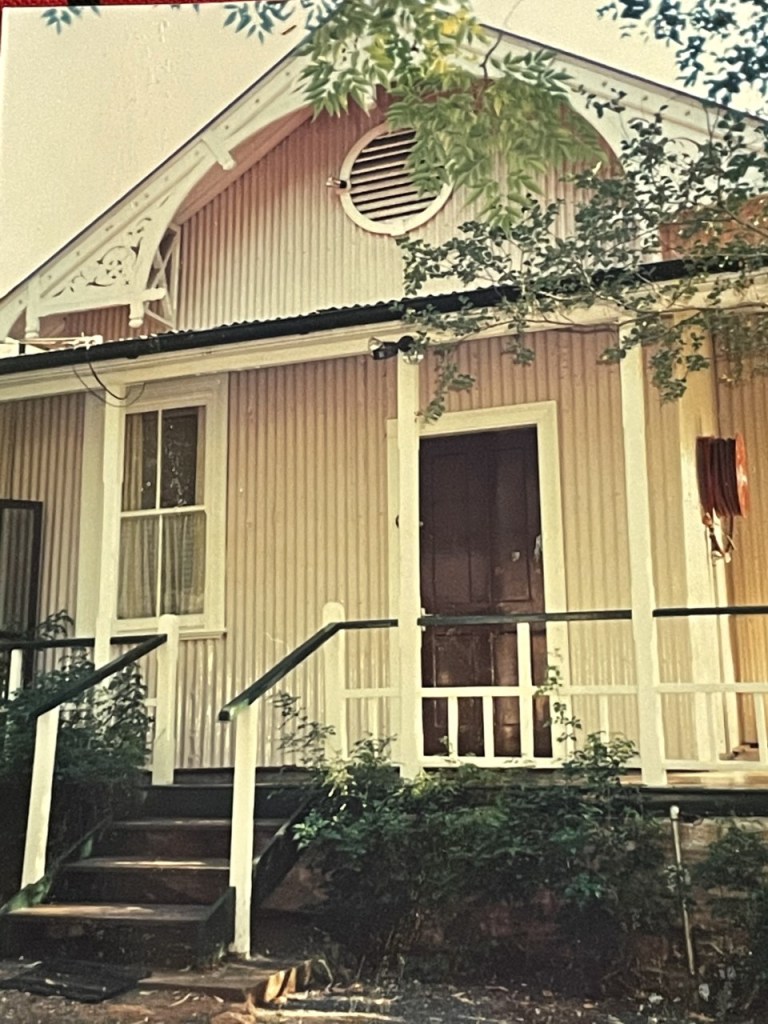
This is a picture of the front door of the farm house that inspired A Ghost and His Gold. It is purported to be haunted by the ghost of a man who became my Pieter van Zyl.























 roberta-writes.com