Here is another entry into the U.L.S., the Underground Library Society by Robbie Cheadle, a long-time member of this unofficial group. I am honored that Robbie Cheadle has written another entry–this one on The Picture of Dorian Gray by Oscar Wilde.
To Robbie: thank you!
The Picture of Dorian Gray by Oscar Wilde
Overview
The Picture of Dorian Gray is a gothic novel written by Oscar Wilde and first published in April 1890.
The book opens on with painter, Basil Hallward, a sensitive soul, painting a portrait of a young man of extraordinary good looks called Dorian Gray. Basil’s friend, Lord Henry Wotton is observing Basil adding the final touches to the painting and comments that it is Basil’s best work.
Lord Henry takes an interest in Dorian, a remarkably good looking but shallow young man, and sets about influencing him with his believes that beauty and the pursuit…
This book is close to my heart as the 62 syllabic poems are all devoted to southern African wildlife and nature conservation. My intention with this book is to share information about African animals, birds, insects, and other creatures and to highlight their plight in the face of the Sixth Mass Extinction and climate change. This book also includes my short story, The Nutcracker, which also highlights these themes.
The cover
Blurb
Do you rely on Earth for your survival?
Lion Scream is a graphic collection of poetry and prose. The book portrays the author’s experiences with South African wildlife and the growing impact of the Sixth Mass Extinction and Climate Change on the natural environment.
Lion Scream There is no jungle Only acres of smooth stumps There is no jungle No habitat, no food source Hopeless lion screams tonight
Editorial review of Lion Scream
“In this reflective collection of syllabic poetry, poet Roberta Cheadle weaves words, emotions, and images as she recounts her soul-stirring journey around South Africa in 2022. She highlights the plight of the animals in the face of the Sixth Mass Extinction, during a visit to Ukutula Lodge & Game Reserve. Lion Roar is a poetic and photographic roadmap to the heart & soul of South Africa with highlights about the increasing impact of global warming on humanity and the greater planet. A must read!” —Colleen M. Chesebro, Author of Word Craft: Prose & Poetry, The Art of Crafting Syllabic Poetry
I am grateful to Colleen from Unicorn Cats Publishing Services for her help with editing and preparing Lion Scream for publication. You can find out more about Colleen’s services here: https://colleenmchesebro.com/my-services/
Terri’s prompt for this week’s Sunday Stills is as follows:
This week’s Sunday Stills theme is “out of this world” which can be described as something extraordinary looking, food that tastes super-delicious, or things that might look otherworldly. My examples show images depicting things that are odd, cosmic, celestial, or a bit alien. Many are from my archives and have been shared before.
This prompt fits in beautifully with my new children’s book idea. Dinah in Chocolate Land is about Alice in Wonderland’s cat, Dinah, and her visit to Chocolate Land where meets several cats, all of whom have unusual adventures.
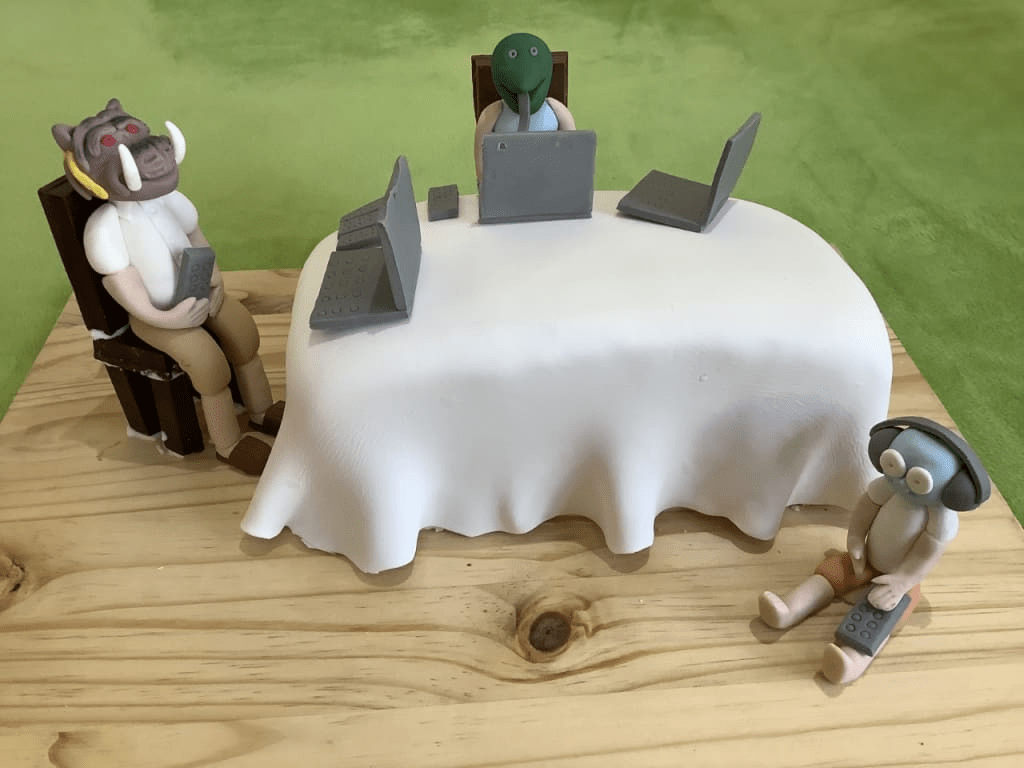
I must admit I am delighted this Vocal challenge came along as I’ve been meaning to start writing this new book for some time. This challenge gave me the inspiration to get started. The story will include a selection my my cake and fondant artwork which are all ‘out of this world’.
The Chocolate Land characters are also ‘out of this world’. Below are Sir Chocolate and the Roundy Twins, Professor Smartie, Sylvia the Alien, the Man on the Moon (made of cheese), four Moon Babies, a surprised Taylor Red, and on of the Nougat Clowns.
Here are a few of the Chocolate Land Homes:
I made Greg a hummingbird cake for his twentieth birthday last weekend. I used a new marbled cream cheese icing technique which came out very well.
According to New York University: “The Cricket on the Hearth was the most popular of Dickens’s Christmas Books, which he wrote both to support his large family and to generate readers’ sympathy and charitable giving, often through characters who are poor, suffering, and/or physically disabled.”
This story is set within a small family comprising of John Peerybingle, a carrier, his much younger wife, Mary but called Dot, and their baby. The baby’s nanny, Tilly Slowboy, lives with them. A cricket chirps on the hearth and acts as a guardian angel to the family.
The story starts with with a setting of domesticity where the reader meets Dot who is filling the kettle in anticipating of her husband’s arrival home after a long days work. There is a lengthily and entertaining description of the kettle, which Dot struggles to fill, carry over to the hearth, and set it upon the fire.
The purpose of the scene would appear to be to demonstrate the happy character of Dot who is quickly restored to good humour despite her struggle with the cantankerous kettle. The kettle submits and starts to behave, entering into a singing challenge with the cricket as indicated by this quote:
“And here, if you like, the Cricket DID chime in! with a Chirrup, Chirrup, Chirrup of such magnitude, by way of chorus; with a voice so astoundingly disproportionate to its size, as compared with the kettle; (size! you couldn’t see it!) that if it had then and there burst itself like an overcharged gun, if it had fallen a victim on the spot, and chirruped its little body into fifty pieces, it would have seemed a natural and inevitable consequence, for which it had expressly laboured.”
John soon arrives home to this scene of domestic bliss, bringing with him a selection of parcels that he is either to deliver or which will be collected from his home. Dot soon comes across a spectacular wedding cake and learns that the local miser, Mr Tackleton, is to be married to her young and beautiful school friend, May.
Dot is clearly upset by this news and not long afterwards, John remembers and elderly man who travelled on his cart with him, and rushes out to bring him inside. The elderly gentleman asks if he can lodge with the Perrybingles for a few days. It quickly becomes evident that the elderly man’s presence had disturbed Dot greatly and her behaviour is quite unusual that evening.
The Perrybingle’s are also great friends with Caleb Plummer, a poor toymaker who works for Mr Tackleton, and Caleb’s blind daughter, Bertha. It is disclosed that Mr Plummer also had a son, Edward, who’d travelled to South America some years before and never returned. May was the sweetheart of Edward and is being compelled to marry Mr Tacklton by her overbearing and anxious mother.
The night before the wedding, Mr Tackleton tells John that his wife is cheating on him and manages to show him a secret scene in which Dot embraces the mysterious stranger.
The rest of the story is devoted to untangling these threads and restoring all parties to harmony and love.
This story is quite removed from Dickens’ usual stories filled with social criticism, current events, and other topical themes, and is, in his own words, it is “quiet and domestic […] innocent and pretty.”
The most interesting social theme in the story is Dickens’ description of Bertha, the blind daughter of Caleb Plummer. Caleb has mislead Bertha from birth, describing the hovel in which they live as being charming, and his selfish and tyrannical employer, Mr Tackleton, as being kind at heart. Poor misled Bertha has fallen in love with her father’s depiction of Mr Tackleton and is heartbroken by his engagement to May.
It is important to note that Bertha’s portrayal and love for Mr Tackleton are dependent on the assumption at the time of writing of this story that blind women did not marry. This belief arose due to the Victorian anxiety that disabilities like deafness and blindness were hereditary. Writers of the day liked to place blind women in courtship plots with the express intention that these courtships would not culminate in marriage.
According to New York University’s commentary on The Cricket on the Hearth: “Dickens’s representation of Bertha Plummer as tragically removed from the world of courtship participates in stereotypes about blindness and femininity that linger into the twentieth century. His extension of Bertha’s blindness to a cognitive dullness is an example of the sociological phenomenon of “spread,” in which one disability is assumed, without evidence, to produce impairment to other physical and mental functions.”
I did not know about this stereotyping of blind women, so this was new information to me.
“It was pleasant to see Dot, with her little figure, and her baby in her arms: a very doll of a baby: glancing with a coquettish thoughtfulness at the fire, and inclining her delicate little head just enough on one side to let it rest in an odd, half-natural, half-affected, wholly nestling and agreeable manner, on the great rugged figure of the Carrier. It was pleasant to see him, with his tender awkwardness, endeavouring to adapt his rude support to her slight need, and make his burly middle-age a leaning-staff not inappropriate to her blooming youth. It was pleasant to observe how Tilly Slowboy, waiting inthe background for the baby, took special cognizance (though in her earliest teens) of this grouping; and stood with her mouth and eyes wide open, and her head thrust forward, taking it in as if it were air. Nor was it less agreeable to observe how John the Carrier, reference being made by Dot to the aforesaid baby, checked his hand when on the point of touching the infant, as if he thought he might crack it; and bending down, surveyed it from a safe distance, with a kind of puzzled pride, such as an amiable mastiff might be supposed to show, if he found himself, one day, the father of a young canary.”
Terri’s Sunday Stills challenge is birds. I love birds and here are a few of my photographs:
This is Eleanor – She is sitting on her favourite tree stumpIf I remember correctly, this is a HammerheadMy fondant Roc from Sir Chocolate and the Sugar Crystal Caves story and cookbookBird cake I made for Mr Fox (hubby’s) birthday some time ago. It features an eagle on its nest, a peacock, a barnowl, a green Knysna loerie, and a woodpeckerFondant woodpecker
This month, my Dark Origins post delves into the evolution of Valentine’s Day and the link between Geoffrey Chaucer and this celebration of love. Thanks for hosting, Kaye Lynne Booth.
Modern Valentine’s Day is celebrated as the day of lovers. People give each other chocolates and flowers as gifts and often do something special with their partner.
Valentine’s Day did not start off as the cutesy day filled with candy and cuddles we know, it’s origins were dark and bloody.
Lupercalia
The date of 14 February coincides with the ancient Roman festival of Lupercalia which was celebrated annually on the 15th of February. The aim of the festival was to purify Rome and promote health and fertility and certain rites or observances were undertaken to achieve this aim.
These rites took place in the Lupercal cave, the Palantine Hill (the centremost of the seven hills of Rome which has been called “the first nucleus of the Roman Empire”) and the Forum. All of these locations were central to Rome’s foundation myth about the founding of Rome and the earliest history…
This is my first post for the challenge and features an analysis of A Christmas Carol.
About A Christmas Carol
A Christmas Carol tells the story of an elderly miser, Ebenezer Scrooge, who is visited by the ghost of his deceased business partner, Jacob Marley, on Christmas Eve. Jacob Marley is described as having a pigtail and a waistcoat, tights and boots and looking much the same in death as he did in life except that he is transparent and bound in chains which are locked around his midsection. Marley has come to warn Scrooge that he will be visited by three spirits over the course of the evening, The Ghost of Christmas Past, The Ghost of Christmas Present and The Ghost of Christmas Yet to Come.
Marley and Scrooge were the same in life, mean and selfish and obsessed by making money. Marley died unrepentant of his sin of greed and now wanders the world, a spirit dragging heavy chains forged by what he valued in life – wealth and money. Scrooge is on the same path, but is being offered a change to change his ways and redeem himself before he dies.
Quote: “You are fettered,” said Scrooge, trembling. “Tell me why?” “I wear the chain I forged in life,” replied the Ghost. “I made it link by link, and yard by yard; I girded it on of my own free will, and of my own free will I wore it.”
Marley’s Ghost. Ebenezer Scrooge visited by a ghost. Colour illustration from ‘A Christmas Carol in prose. Being a Ghost-story of Christmas’, by Charles Dickens, With illustrations by John Leech.
Each of the three ghosts is a metaphor for the memories that shape our characters in life.
The Ghost of Christmas Past is the first of the ghosts to visit Scrooge and symbolises the experiences and memories that have moulded him into the callous and selfish man he is when the story starts. The head of this ghost glows represents memory.
The Ghost of Christmas Present is the second ghost to visit scrooge and is a metaphor for generosity, empathy, and the Christmas spirit.
The Ghost of Christmas Yet to Come is the last ghost to visit Scrooge and is a metaphor for death and the legacy of our lives that we leave behind when we die.
A Christmas Carol is an allegory as it features events and characters with a clear and fixed symbolic meanings. Scrooge is the antithesis of the spirit of Christmas and represents greed, selfishness, and a lack of goodwill towards his fellow men.
A Christmas Carol includes social commentary although this is not the central theme of the story. There are various statements made by Scrooge that relate to the Poor Laws that governed the lower classes during Dickens’ lifetime. Some examples are as follows:
“If these shadows remain unaltered by the Future, none other of my race,” returned the Ghost, “will find him here. What then? If he be like to die, he had better do it, and decrease the surplus population.”
Scrooge hung his head to hear his own words quoted by the Spirit, and was overcome with penitence and grief.
“Man,” said the Ghost, “if man you be in heart, not adamant, forbear that wicked cant until you have discovered What the surplus is, and Where it is. Will you decide what men shall live, what men shall die? It may be, that in the sight of Heaven, you are more worthless and less fit to live than millions like this poor man’s child. Oh God! to hear the Insect on the leaf pronouncing on the too much life among his hungry brothers in the dust!”
“This boy is Ignorance. This girl is Want. Beware them both, and all of their degree, but most of all beware this boy, for on his brow I see that written which is Doom, unless the writing be erased. Deny it!” cried the Spirit, stretching out its hand towards the city. “Slander those who tell it ye! Admit it for your factious purposes, and make it worse. And bide the end!” “Have they no refuge or resource?” cried Scrooge. “Are there no prisons?” said the Spirit, turning on him for the last time with his own words. “Are there no workhouses?”
Ignorance and Want are two hideous and emancipated children that the Ghost of Christmas Present shows to Scrooge before he disappears. Ignorance and Want are allegorical characters who have no personalities and only symbolise Scrooge’s own ignorance and want. The spirit warns everyone to be wary of both of them. Want represents the plight of the poor in Victorian society and Ignorance represents societies ignorance of this plight.
Tiny Tim, the disabled young son of Scrooge’s employee, Bob Cratchit, is a symbol of what must be prevented in society, namely, the disease and dependence that comes from poverty and industrial exploitation. Tiny Tim represents the value of human beings outside of the contribution they make to caretakers or society.
The message of A Christmas Carol is that those who are generous and kind will be rewarded on Earth as well as in Heaven.
The novella has a happy ending and Scrooge sees the error of his ways and undertakes to change his behaviour going forward. He seizes the second chance he is given.
I enjoyed A Christmas Carol as a lovely and inspiring Christmas story. Dickens’ idea about selfish and greedy actions and behaviours during a person’s life forging chains they must carry with them in the afterlife is a concept that has always fascinated me. I remember reading a similar idea, except the chains were described as burdens, in Enid Blyton’s The Land of Far Beyond which I read as a child. I never forgot that story and I tracked this book down about ten years ago and I acquired a hard cover copy.
The visits of the three ghosts were entertaining and insightful and each of them also made their points well. The representations of goodness in the forms of Bob Cratchit and his family and Cousin Fred were interesting contrasts to Scrooge and the ghost of Marley.
Have you read A Christmas Carol? Did you enjoy it? Let me know in the comments.
Welcome to Thursday Doors! This is a weekly challenge for people who love doors and architecture to come together to admire and share their favorite door photos, drawings, or other images or stories from around the world. If you’d like to join us, simply create your own Thursday Doors post each (or any) week and then share a link to your post in the comments below, anytime between 12:01 am Thursday morning and Saturday noon (North American eastern time). If you like, you can add our badge to your post.
I must admit that it was the story challenge on Vocal that led this week’s Thursday Doors post. I have been thinking of posting about The Castle of Good Hope for a few weeks and I’d done a little research about it. I have visited this castle a few times, but I have never taken many pictures as it was before I was into photography and took pictures of everything.
My research revealed some interesting spirits that are believed to haunt the castle and one of them, Governor van Noodt who was a Governor of the Cape Colony while it was under the administration of the Dutch East India Company, caught my attention. I had already decided to write a story about the legend of the Governor and when the challenge to write a story from the perspective of wall was announced, I thought what better than to share this story from the perspective of the walls of the Castle of Good Hope.
The Castle of Good Hope is known locally as “The Castle”. Its Dutch name is “Kasteel de Goede Hoop” and is a bastion fort built in the 17th century in Cape Town, South Africa. The Castle was originally located on the coastline of Table Bay but, following reclamation, the fort is now located a short distance inland within the Central Business District. The Castle was declared a historical monument (now a provincial heritage site) in 1936. Following restoration work in the 1980s, it is considered the best preserved example of a 17th century architectural structure in the entire world.
History
In 1652, the Dutch East India Company (DEIC) settled on the shores of Table Bay to establish a refreshment base for ships en route from Europe to East Asia and to maintain its monopoly over the Spice Trade. Built by the DEIC between 1666 and 1679, the Castle of Good Hope is the oldest existing colonial building in South Africa. It replaced an older fort called the Fort de Goede Hoop which was constructed from clay and timber and built by Jan van Riebeeck, the first Commander of the Cape.
During 1664, tensions between Britain and the Netherlands rose amid rumours of war. That same year, Commander Zacharias Wagenaer, successor to Jan van Riebeeck, was instructed by Commissioner Isbrand Goske to build a pentagonal fortress out of stone. The first stone was laid on 2 January 1666. Work was interrupted frequently because the DEIC was reluctant to spend money on the project.
On 26 April 1679, the five bastions were named after the main titles of William III of Orange-Nassau: Leerdam to the west, with Buuren, Katzenellenbogen, Nassau, and Oranje clockwise from it.
When a terrorist blows up an Inner Circle line train between Liverpool Street and Aldgate at around 8.50 am on 7th July 2005, it leaves seven people dead and many others injured, some badly. In the horrific explosion one of those injured is journalist Ian Grosvenor. Also trapped and wounded is a young mother and artist, Serena Mason. Among the ‘walking wounded’, Ian becomes a reluctant hero by helping other passengers and carries Serena from the train, before collapsing.
Ian and Serena slowly recover from the worst of their injuries, both physical and mental, but are haunted by the memory of each other and what they suffered on that dreadful day. The desire to trace and discover how each fared grows stronger with time, until it becomes almost an obsession.
In all, three trains and a bus were blown up, killing and injuring young and old alike. It was ‘an act of indiscriminate terror’ affecting Britons and non-Britons, Christians, Muslims, and those of other or no religion.
This story covers more than the young couple’s aftermath traumas and recovery; it reveals a dark family secret, and highlights the importance of the love and support of families and friends in times of need. It also illuminates the ever present ‘ifs’, ‘buts’ and ‘coincidences’ which weave in and out of all our lives, and the wonderful power of humour.
Will Ian and Serena ever find each other? And if they do, will they find happiness?
My review
The idea of terrorism on a plane, train, or any other enclosed space is frightening to me. Passengers are trapped and cannot escape the blast and debris. Ian Grosvenor, a journalist, and Serena Mason, an artist with a young son, are victims of such an attack on the Inner Circle line train. The event leaves both of them seriously injured, with even greater post traumatic stress disorder. Ian saves Serena’s life by pulling a seat off her and carrying her to safety.
Both Ian and Serena struggle to put the events of that day out of their minds and both cling to the idea of the other person, Ian wondering how the auburn haired woman he saved is faring, and Serena wondering about her gentle spoken savior. Ian’s attempts to trace the unnamed woman fail and he gets on with life as best he can. With the support of his strong minded sister, Sally, Ian gets a good job working for a men’s magazine and meets good-time-guy Scott, the photographer. Scott encourages Ian to travel and have a good time, but Ian is not able to completely escape his traumatic memories.
I enjoyed the character of Ian very much. He was a kind and considerate person, and did his duty by helping other passengers and saving Serena despite his own injuries and trauma. Ian’s bad experience with a selfish and grasping ex-wife left me rooting for a good outcome for him with his new relationship. I enjoyed the details of Ian and Scott’s work trip to Spain and their meetings with the various interviewees. I learned a bit about Spain in the process.
Serena also has an unfortunate past when it comes to relationships and is divorced from her son’s father. The accident leaves Serena’s face badly scarred and the subsequent plastic surgery has left her with some scars and badly damaged confidence in her appearance. Although it takes her longer, Serena does manage to pull her life back together and get a good job illustrating children’s books. Serena is supported by her father and three good female friends. The descriptions of the impact of the facial scaring combined with the trauma of the incident is well described in the book and very relatable. Serena’s difficulties with her teenage son also put you on her side as she struggles, unsupported by her selfish ex-husband, to keep him on the right track with regards to schooling and behaviour.
This book is an interesting look at the psychological impact of a random terrorist event on the survivors and I enjoyed it very much. There are a few minor editing issues with the book, but they did not bother me or detract from the story.
Three in one! Yes, that is rather a lot and unusual for me but I ran out of posting days this week and these three challenges go together so well that I couldn’t resist. Here it goes!
Terence and I went out for lunch yesterday to celebrate our 22nd wedding anniversary. Our eldest son is turning twenty on 24 February. I’ve had to start telling people he was ten when I married Terence – haha!
Anyhow, we went to a lovely restaurant called Whippet which is close to home. It was our first outing since Terence became ill on 26 December last year, so I let him chose the venue. We sat outside, despite pouring rain, in roof veranda enclosed by lattice wood covered with vines, all things that have grown. I also consider that we have grown our marriage over the years, not to mention our two gorgeous sons and Queen Push-Push.
Entrance to Whippet, it is rather an attractive doorThe door into the outside enclosure with more things we growThe roof and part of the walls of the outside enclosure with lots of things we growMy meal, an olive pita bread with chicken and avoTerence’s meal, a burger with so many chips – certainly enough to make him grow – hehe!
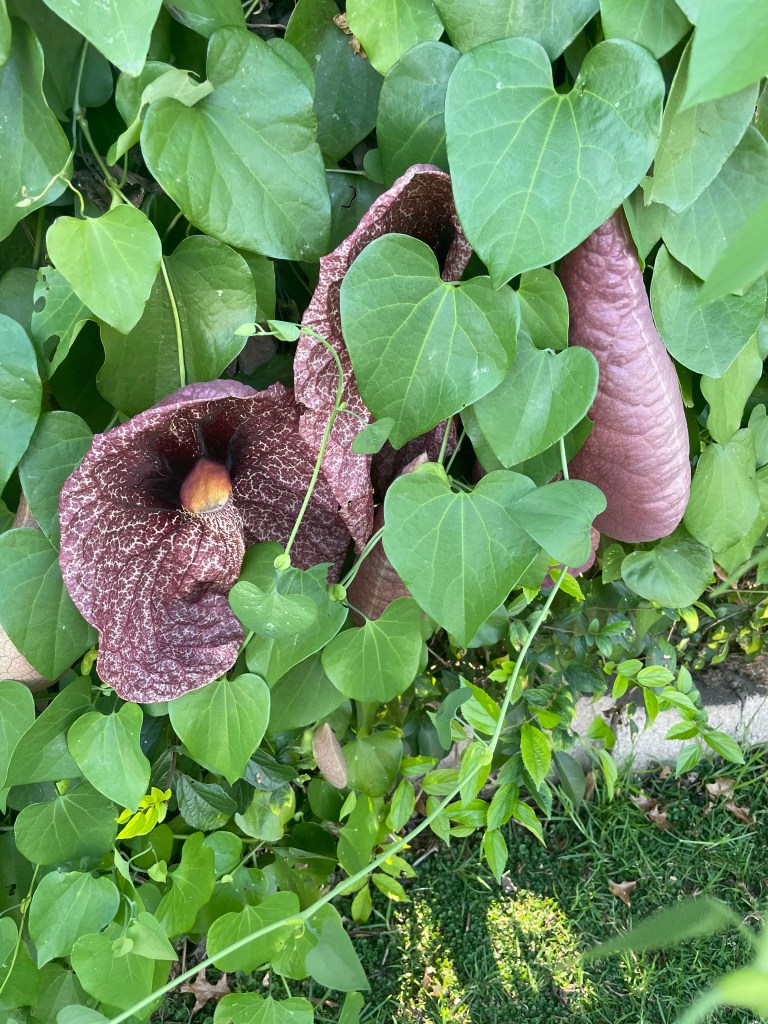
These are plants my mom and I grew in our garden:
I haven’t included any fondant flowers in this post. If you would like to see two of my best examples of cakes with fondant flowers, Resa has included pictures in this most marvelous post she created about Michael and my Sir Chocolate books series. Thank you, Resa: https://graffitiluxandmurals.com/2023/02/09/sir-chocolate-childrens-books-by-robbie-and-michael-cheadle/. If you don’t know Resa you really should. She has a most marvelous blog which is like visiting Wonderland. I really recommend you go over and have a look at her public art and other posts.
This week’s challenge is a photo prompt. I’ve asked my friend, and photographer, Terri Webster Schrandt, from secondwindleisure.com to share her photos with us for inspiration. Terri runs a weekly photo challenge called Sunday Stills. Check it out HERE.