My son, Michael, had to do a project on gender based violence (“GBV”) in South Africa for a project at school. I am sharing it here as I thought it was very insightful and well researched.
What is GBV?
GBV encompasses any type of violence that is caused by the exploitation of unequal power in relationships between genders.
GBV in South Africa includes instances of sexual, physical, mental and economic harm inflicted by one party, usually a man, on other parties, usually women and/or children in private or in public.
The perpetrator may or may not know the victim depending on the circumstances. Some examples of GBV in partner/marriage relationships include threats of violence, manipulation and coercion of the victim.
South Africa has one of the highest rates of GBV in the world. GBV in South Africa includes rape, murder of women, and domestic abuse. Key statistics on GBV quoted by Ballard Brief:
“The rate of murders on females in South Africa is approximately 24,6 per 100,000 females which is nearly six times the global average;
Although there is enacted legislation and general government action in South Africa, the instances of rape have only decreased by 6% since 1996;
Approximately 28% of South African males have admitted to at least one rape and of that number, 46% are repeat offenders.
According to an article in the Sowetan Live entitled ‘Eastern Cape accounts for most GBV cases with twice national rate’, the Eastern Cape has emerged as the leading province for cases of GBV.
Abrahams said while cases of femicide had decreased since 2017, the caseload for the police was still very high.
Professor Naheema Abrahams from the South African Medical Research Council said the following about GBV in the Eastern Cape at the Presidential Summit on Gender-Based Violence and Femicide in Midrand in October 2022: “The Eastern Cape unfortunately is our province that has more than twice the national rate [of femicide]. About 22,000 women were killed in 2017 compared to 14,000 in KwaZulu-Natal. Limpopo doesn’t have as many cases, but the number is still higher than the global average,” she said.
Abrahams said there had also been anecdotal evidence, which showed the murder of women post 2017 had increased, similarly to that of children compared to 2021.
This finding is further supported by an article in the Daily Maverick dated 03 December 2019 entitled ‘Murder, rape and robbery: Eastern Cape women and children under siege’. The article introduces it’s topic as follows:
“Shocking statistics released by the MEC for Safety and Liaison in the Eastern Cape has shown an alarmingly high incidence of crimes against women and children in the province, coupled with a dismal conviction rate — but activists say that government should stop doing the same thing over and over and expect different results.”
The articles continues to say: “From April 2018 to March 2019 2,695 children were raped in the Eastern Cape and 375 were sexually assaulted, 4,082 women were raped and 432 sexually assaulted. The total number of crimes against women and children, including murder, attempted murder, assault and robbery was more than 29,000 — almost 1,000 more than the previous year.
Of cases opened with the police, MEC for Safety and Liaison in the Eastern Cape, Weziwe Tikana, said there were 399 convictions in cases where children were raped and only 40 convictions for the 153 children murdered during the same period.”
Reasons for GBV in South Africa and effect on society
The three main reasons for GBV in South Africa are as follows:
Gender inequality rooted in patriarchy.
Many cultures and religions in South Africa promote male superiority and treat it as the norm.
Patriarchal attitudes lead men to believe they are entitled to sex with women and that dominating a woman demonstrates their masculinity.
Poverty
Women and girls living in poverty are more likely to be sexually exploited including trafficking and prostitution.
An inability for women to leave abusive relationships due to a lack of financial and other resources.
Lack of implementation of protective laws
The Daily Maverick article quotes various people about the situation of GBV in the Eastern Cape.
“Pastor Neville Goldman has been working with the police to fight crime in Nelson Mandela Bay’s gang-ridden areas.
“I will tell women that I can get them a job today, but they don’t want to take it because they want to be at school when the children come home — they fear their kids will be raped on their way home.”
Similarly, a counsellor, who asked not to be named, said:
“We hear the girls talk on a Monday morning. They will tell each other that they were raped, but they never report it. It is like they have given up hope that something will be done,” she said.”
The effects of GBV on society are as follows:
GBV is a human rights violation which undermines the victim’s sense of self-worth and self-esteem. It effects both physical and mental health and can lead to self harm, isolation, depression, and suicidal attempts.
GBV destroys the victim’s physical and psychological integrity. Victim’s don’t feel safe and secure in their environments and are unable to function normally in their families, communities and societies as a result.
GBV is discriminatory and results in affected women and children being marginalized and feeling helpless and inferior. GBV undermines the natural and normal roles of for both men and women in society.
GBV is an obstacle to gender equality and serves to cultivate a heteronormative society. Gender equality allows both genders to play meaningful roles in society and to enjoy equal opportunities and equal visibility.
GBV is under-reported and there is often impunity for perpetrators. Societal suppression of exposing GBV from others makes it difficult to denounce and for the victims to seek help. The children of abused women are impacted psychologically and often form the impression that this behaviour is normal or justified. This becomes an enabler for a culture of violence and GBV.
GBV has a high economic cost. It costs society because medical, psychological, police, and justice services are required to deal with the fall out. In addition, victims of abuse usually underperform at school and work and are frequently unemployed.
Restorative intervention programme and collaborative action
The following steps and programmes will help to reduce GBV in the Eastern Cape and South Africa more generally:
Government must implement laws to address GBV. In January 2022, President Cyril Ramaphosa implemented laws aimed at reducing GBV through a victim centred focus. The laws are there, but they need to be better enforced.
South African could follow the approach of the UK where there are law enforcement officers that deal only with domestic violence and who checkup regularly on the victims and perpetrators. This makes the perpetrators think twice before abusing their victims.
Protection orders need to be enforced better so that abusers can stalk their victims and continue to abuse them. Community members could assist with this be reporting stalking to the police and helping to protect victims.
Funding must be provided to support victims with shelter, medical, legal, and psychological resources.
There need to be more homes for victims of abuse where they can remain long term so they don’t have to return to the abuser due to having no-where to live. The Daily Maverick article stated the following: ““I think we only have four shelters in Port Elizabeth. But also, women can’t stay there for an extended period of time because shelters do not have money. If they have nowhere else to go, they are often forced to go back to their abusers.
“We are basically pushing women back to situations they have been in before — and got hurt,” Ziehl said.”
Victims need to be empowered through upliftment and education, so they are able to gain meaningful employment and support themselves and their children. Churches and other societies already try to provide some of these services, but they need more funding. Corporates and businesses can assist by providing pro bono training on how to use computers, how to type, and other useful skills.
Victims need to be provided with counselling and rehabilitation. Funding needs to be provided for this. Churches, schools and other social organisations need to educate people about the roles of men and women in society. Sexist attitudes need to be strongly discouraged and there needs to be continuous strong messaging that girls are as good as boys and deserve the same opportunities and treatment as men and boys. Children, in particular, need to be taught about respect and equality. Children need to understand that violence is never an acceptable solution to problems and issues.
There need to be crisis centres that provide immediate help to victims of rape and GBV. Police, judges, and counsellors must be trained to properly manage and deal with cases of sexual assault and GBV. Medical treatment must be provided to victims and a place in a shelter provided if necessary.
In January 2022, we went on a road trip from Johannesburg in Gauteng Province to Knysna in the Western Cape. These pictures are from our drive through the Eastern Cape to a village called Nieu-Bethesda.
Interestingly, it was very wet that particular summer and the Eastern Cape was exceptionally green. The copious rain following a drought caused a plague of locust which we drove through.
Picture caption: A stretch of scrub land with the Sneeuberge (Snow Mountains) in the distance.Picture caption: A cactus plant in flower. I thought the pink flowers were pretty. Picture caption: Rock formation made of shale. You can see the different layers to the rock in the picture.Picture caption: all the small silver specks in the sky are locusts. At first I thought they were white butterflies but, unfortunately, that wasn’t the case. The locusts are very destructive.Picture caption: Sign post to Ganora Guest Farm. It is also a working farm and children can bottle feed the lambs. Ganora also has bushmen paintings and Karoo fossils which the guests can view.Picture credit: Man-made reservoir and windmill at Ganora Farm
Tanka Tuesday
Colleen’s challenge this week is to write a tanka poem. I wrote two poems about drought. The first is a shadorma and the second is a tanka poem. Shadorma is my new tanka poem – haha! I say this because all my syllabic poems were tankas originally. I was obsessed with this form. Now I am obsessed with shadorma. You can join in Colleen’s challenge here: https://wordcraftpoetry.com/2023/04/25/tankatuesday-weekly-poetry-challenge-no-317-4-25-23/
Picture caption: Cake art depicting a giant tap in a desert surrounded by cacti
Thank you to author, Dan Antion, for including a review of Poetry Treasures 3: Passions in his 2ReviewTues post. I am delighted that this anthology is featured together with Grief Songs by poet and author, Elizabeth Gauffreau. Dan has recently published three books in the Dreamer’s Alliance series. I’ve read the first book and it is excellent so do take a look around while you are there.
April is poetry month, and between following poets who have been participating in NaPoWriMo, as well as the poets who show up in my normal blog feed, I’ve read a lot of poetry this month. In addition, I was thrilled to read two books of poetry this month. It’s great timing because I wanted to review two books of poetry for this monthly feature. I say monthly, now that I’ve managed to complete three months in a row. OK, enough about me, let’s get to the books.
Grief Songs: Poems of Love & Remembrance – Elizabeth Gauffreau
When I first saw the title of this wonderful book, I was hesitant. Grief is an individual thing. I wasn’t sure it was something I could read about without feeling like I was intruding. I also wasn’t sure if Liz’s grief was compatible with mine. Selfish? Indeed, grief is personal—isn’t it?
Alice in Wonderland is one of my favourite childhood books. I love it so much, I have seven different copies, one of which is vintage.
The book, Alice in Wonderland, starts with a young girl, Alice, sitting on a bank and watching her sister read a boring book with no pictures or conversations. Seeing a white rabbit passing by, she follows it down a rabbit hole. The rabbit walks and talks and has a pocket watch. Alice falls down and down the rabbit hole, all the while having an interesting conversation with herself, and ends up in a large entrance hall. There is a small door beyond which is a beautiful world, but Alice is to big to pass through it. She experiments with eating and drinking various items until she is finally small enough to gain entry to Wonderland.
Wonderland is a strange and mysterious world filled with unusual…
Here are a few photographs from my travels in South Africa:
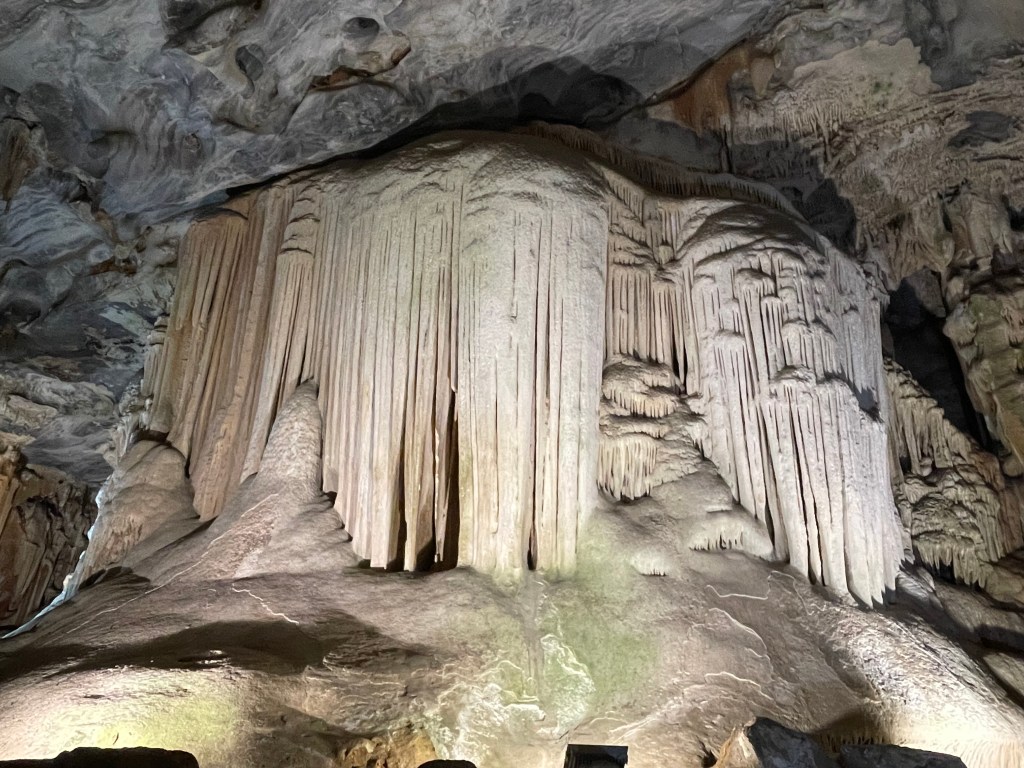
Cango Caves, OudtshoornWaterfall at Tsitsikamma National ParkSunset at Madikwe National ParkJohannesburg street lined with jacaranda treesField of flowersOne of my Save the Planet cakes depicting a fish with a face mask wrapped around its tail and choking on a plastic glove
A few days before we were due to fly to the UK for Christmas in December, we decided to cancel our trip. The weather was terrible and there were lots of strikes happening. The most crucial of those strike actions for us was the NHS as Michael had just recovered for three months of chronic illness and two operations. My mother is also 84 and I didn’t want to risk going somewhere where healthcare could be an issue in a crisis. Instead, we went to Welgevonden Private Game Reserve from 19 December to 22 December. It was all planned so I would be home in time to host Christmas Eve at our home.
I haven’t written about this trip, although it was amazing. The reason is that Terence started getting sick with headaches on 23 December, the day after we got home. His illness, which culminated in him being admitted into intensive care in hospital on 4 January with meningitis, put a huge shadow over this holiday. I just didn’t feel like revisiting anything in the lead up to that dreadful few weeks when he was in such a bad way in the hospital. The doctor says he’s made a full recovery and finally I am able to share a bit about this trip.
The link to my poem for a Vocal challenge is below.
Entrance to our roomView of Welgevonden from our bedroomBedroom showing the large doors
We saw some wonderful game at Welgevonden and I also wrote several new poems that are included in my new poetry collection, Lion Scream.
Here are a few of the large animals we saw.
ElephantWhite lionessCape buffaloA large insect called a corn cricket greeted us one night. It was waiting on the door step. They jump …A large lizard sunning itself on a rock
My poem on Vocal: The Watcher
I wrote an epistolary poem for a Vocal challenge. It is a letter to a Game Ranger from The Leopard in the Tree. You can read it here: The Watcher
Colleen Chesebro interviews Kaye Lynne Booth, publisher and co-editor of Poetry Treasures 3: Passions. A link to my recent Meet the Poet post is also included in the post. Thank you, Colleen, and happy birthday.
Picture of bunches of tiny yellow blossoms on a large treePicture of a large white toadstoolPicture of a baby loerie that has just learned to fly in the branches of our olive treePicture of white and dark pink cosmos with a beePicture of a small green caterpillar with a red stripe down its back on one of my succulentsI like this picture of a yellow wild flower and a dandelion growing between the pavers