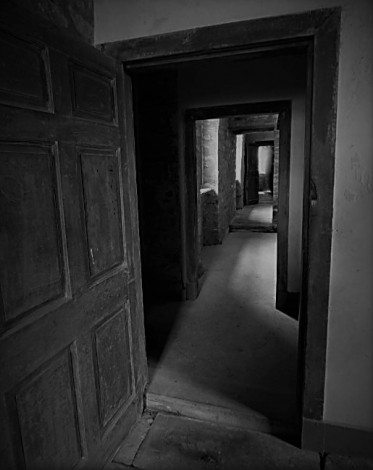
#Writephoto – Castle

Sue Vincent’s prompt this week is castles which fitted in nicely with parts of my forthcoming horror book, Through the Nethergate. This is an extract about a castle in …. Slovakia.

“A few hours later, the dark outline of an abandoned and ruined castle, shrouded in thick evening mist, came into view. It looked forbidding with thick foliage, stained black in the moonlight, surrounding the base of its broken walls. In the gloom, the dark grey moss patterning sections of the remaining light grey, stonework looked like splodges of blood and gore.  As the coach lurched to a halt on the thick grass in front of the castle, the spirits of the numerous girls who were murdered there started to gather. They stood silent and forlorn in the eerie light of the moon, which bathed their transparent forms with silvery light and created strange and mysterious shadows.

Lucifer rummaged under his seat and withdrew a thick coat.

“Take this, you’ll need it,” he said, handing it to Margaret. She took it gratefully and put it on straight away. The night air was piercingly cold. The party exited the coach and Lucifer marched towards the gathering, holding tightly onto Margaret’s wrist.

From a distance the ghosts looked like delicate waifs, but as the occupants of the coach ventured closer, Margaret could see the evil and twisted expressions on their darkly beautiful faces and splatters of blackness down the fronts of their thin white gowns. The moonlight itself seemed to quiver at the horrible sight and take refuge behind a mass of clouds.”

TTNG 15

You can join in Sue’s challenge here: https://scvincent.com/2019/07/11/thursday-photo-prompt-castle-writephoto/

#Bookreview – The Quarry Bank Runaways: The Journey to London of Thomas Priestley & Joseph Sefton in 1806

book reviews

What Amazon says

“Child apprentices in very many cotton mills continued to be treated like slaves well after the Slave Trade Acts of the 19th century.”

“Pauper child apprentices from workhouses were not even paid after working 12 hour days and for 5 or 6 days a week, mill owners counted the profit!”

In the early 19th century, when it was the policy of many of the poorhouses and workhouses to deter paupers from applying by making the conditions inside harsh and unpleasant, two boys set out on a journey to Hackney Workhouse in London. Their starting point was in the pleasant Cheshire countryside, where they were apprenticed to the cotton mill built by Samuel Greg in 1784. Children as young as 9 would be employed there, as scavengers, piecers, mule doffers or can tenters. These jobs could be just as unpleasant and difficult for a poor child as those we may have heard of, such as chimney sweeps and match girls.

Quarry Bank Mill was some 200 miles north of London and the boys had to sneak out unnoticed and then attempt to walk all the way. It was likely that these enterprising travellers took advantage of the drovers’ roads and the newly developed “motorways” of the times – the canals. Perhaps they were lucky enough some days to hitch a lift; their general direction of travel taking them to Beartown, the Potteries, Dunstable Downs and eventually to London. Whatever challenges they encountered along the way archive evidence shows that they made it.

Runaway apprentices had become a problem for society during the years of the Industrial Revolution – so what had prompted Thomas and Joseph to do such a hazardous thing? What happened to them on their long journey? Did they receive any help? Or were they chased relentlessly wherever they ran, since what they were doing was illegal in the eyes of the authorities?

This is the story of their adventure and it concludes with the events in the Middlesex courthouse, known then as the Old Sessions.

My review

I was introduced to the writing of G.J. Griffith through the second book in this series, Mules, Masters & Mud, which I thoroughly enjoyed. I found this first book to be equally entertaining and interesting and I found myself even fonder of the main characters, Joseph and Thomas, as teenagers in The Quarry Bank Runaways.

Joseph and Thomas are both indentured apprentices to Quarry Bank Mill in the early 19th century, having spent the later part of their short childhoods in a workhouse in London after their mothers fell on hard times. The boys vividly recall the journey from London to the mill near Manchester in the bank of an enclosed wagon with a lot of other children. The paupers were bumped around and arrived battered and bruised and, although their master, Mr Greg, is one of the better mill owners as far as treatment of his workers was concerned, life does not improve for the apprentices after their arrival.

Following an accident in which Thomas loses a finger, he is desperate to travel to London to visit his mother. Joseph decides to accompany him and take advantage and visit his own mother. The two boys make a plan and manage to escape the mill and set off on the long and arduous journey by foot to London. Their determination to visit their mothers during a time of physical challenge seemed very natural to me and the mill owner was unkind to disallow the journey. Mr Greg’s refusal of Thomas’ request to have leave of absence from the mill highlighted the fact that workers were treated as commodities at that time in history and had no rights whatsoever.

The story tells of the boys journey and the various people they meet along the way. Many are kindly and do their best to assist the runaways, but others attempt to exploit them for their own personal gain.

The detailed depictions of life during the early years of the industrial revolution and the awful work conditions and related health issues in various walks of life from mill workers to bargemen to potters to charcoal burners is well researched and fascinating. The reader is also given a brief glimpse into the lives of a retired night watchman, a magistrate and a scullery maid as well as the harsh laws impacting the lives of people forced to enter the workhouses.

The dialogue is written in various dialects which some readers may find a bit challenging, but I quickly got used to it and thought it added to the authentic feel of the time and the story. I would recommend this book to readers who enjoy delving into history and how people lived in the past.

Purchase The Quarry Bank Runaways: The Journey to London of Thomas Priestley & Joseph Sefton in 1806

The benefits of short stories

For the last eighteen months, I have been dabbling in writing short stories. Last year, two of my horror short stories were published in Dark Visions, an anthology of horror short stories edited by Dan Alatorre. Earlier this year, I was invited to contribute three short stories to a murder mystery anthology, Death Among Us, edited by Stephen Bentley. This book has recently been published as an ebook on Amazon.

During the past few months I have written an additional four short stories for two other anthologies which will be published during the course of this year. This exposure to anthologies has made me realise how popular short story collections are, particularly those which have a number of contributors thereby allowing the reader to experience a  variety of writing styles.

I have read a large number of short story collections since I had my first child in 2003. I believe that many other people like to read short stories for the same reasons I do, the most important being they are short and quick and easy to read.

We live in a time when more and more demands are placed on workers. Technology has made our lives easier in many ways but it has also broken down the concept of leaving work and being unavailable. Modern workers are generally expected to be available 24/7 through the mediums of cell phones and emails. Most modern mothers are obliged to work and help support the family and this combination has resulted in less time for reading and other pleasures. How can a reasonable person resolve this problem and still enjoy a good story? The story gets shorter, with a compact and concise story line.

The digital age has also resulted in people having shorter concentration spans and an expectation of instant gratification. Most younger readers do not appreciate the long drawn out descriptions included in many classic novels written by famous people like Charles Dickens and the Bronte sisters. They want short, sharp stories which lots of punch in a short period of time. Short stories also fit the bill for the modern reader in this regard.

Novellas, short novels and short stories abound on Amazon and they are popular, I can see that from the numbers of reviews they have. I know that I check the length of a book before I purchase it and I rarely undertake a book that is more than 300 pages unless it is a classic (and I mainly listen to classics as audio books) or it is a Stephen King book (because Stephen King makes very paragraph count even in a 1 200 page book).

What do you think about short stories? Do you like to read them as stocking fillers when you are busy?


Greg promotional material 2 Updated

Dark Visions 2

#Poetry – Dear God, I’d like to negotiate

IMG_0525

Dear God

I’d like to negotiate

a reasonable exchange

My good health

for that of my son

I’ll take on his asthma

I know how it works

each breath is a struggle

through lips often tinged blue

I think my request’s fair

after all, it was you

who entrusted this child

into my tender care

and he came encumbered

with the duty of care

that accompanies health deficiencies

I’m willing to accept

his biofilm too

the one that developed

due to an enclosed sinus

I’m sure you remember

as it caused us such pain

and it wasn’t really fair

to do that to a child

but I’ll put it behind us

If you’ll consider my deal

As for his eyesight

damaged by cortizone

worsened by bad genes

I’d rather he had

my 20/20 vision

I want him to see

each leaf on each tree

and not to bear a burden of worry

he’ll loose what little he’s got

I’m his mother, you see

and I’ll willingly sacrifice

everything I have

for this lovely young man

I call my son.

by Roberta Eaton


#Writephoto – Span

“Pieter stood up and stretched gently, trying not to escalate the ache in his ribs to an unbearable pain. The 30 000 Kruger pounds he’d been given should be safe until he could come back for them.

With a sign of relief, Pieter made his way to the barn which housed his covered wagon. Mosiko and Mhlopi arrived and assisted him with inspanning the oxen in preparation for the trek to his brother’s farm which was quite a distance away from any major cities or towns.

We will be safer there.

The other farmworkers were sent to round up his cattle and goats, a tedious task which would take two to three hours.

Pieter checked the yokes, skeis and strops for each pair of oxen. He did not want his animals to be damaged in any way during the journey. Next he checked the trek chain, wooden wheels and spokes and the iron tyres covering the rims of the wheels. He filled the water barrel and hung it under the wagon with the cages filled with chickens.

When he was satisfied that the wagon was ready for the journey, Pieter spoke to his farmworkers: “The British soldiers are coming. Mosiko and Mhlopi will come with me and lead the oxen. Feile and Kleinbooi will help me to drive the cattle. The rest of you must take your women and children and go back to your villages until the danger has passed.”

As he dismissed his farmworkers and told them to travel safely, bitterness burned in his heart like acid.

My farm is lost to me now. It is time for me to assess the future for me and my family.

The wagon was loaded with farm equipment, seeds, kitchen utensils, bedding and clothing. Lastly, Marta and their two little girls, Renette and Suné, wearing their button-up boots and carrying their rag dolls, climbed into the wagon. Mosiko, who assumed the position of voorloper when the family trekked, took his place at the head of the oxen to lead them. Mhlopi, the driver, would walk next to the oxen. Mhlopi cracked his shambok and the heavily-loaded wagon lurched down the rutted track that lead away into the bush veld.

He smiled down reassuringly at Marta from his position on his horse next to the wagon. “Willem and Sannie will be glad to see us. We can help them around their farm until we decide what to do next.”

An extract from A ghost and his gold which explains the meaning of inspanning a team of oxen in historical South Africa. This post was written for Sue Vincent’s weekly photo challenge which you can participate in here: https://scvincent.com/2019/07/04/thursday-photo-prompt-span-writephoto/ 


#Bookreview – Carrie by Stephen King

book reviews

What Amazon says

An unpopular teenage girl whose mother is a religious fanatic is tormented and teased to the breaking point by her more popular schoolmates and uses her hidden telekinetic powers to inflict a terrifying revenge.

My review

Carrie, by Stephen King, is one of his shortest novels. It is also the King novel that had the greatest impact on me from a philosophical point of view as King expresses viewpoints about teenagers, and how they form themselves into social groups of different status, which are true and chilling. His unerring ability to strike to the core of teenage human nature and their driving need, as a group, to hunt in packs and to be accepted by one another, as well as their intolerance of difference, is frightening to read.

Carrie has been a social outcast since her first day at primary school when she gets down on her knees, as she has been taught to do, and says prayers before lunch. From that moment, Carrie is labeled “weird” and a “religious freak” and she has no hope of ever redeeming herself, no matter how hard she tries. Carrie is the product of a single parent home and her mother is willing to abuse her daughter, mentally and physically, in order to ensure she complies with her rigid and extreme religious views. Carrie is caught between trying to please a mother she does love, despite her abusive behaviour, and attempting to be accepted by her peers at school. We discover early on in the book that Carrie isn’t an ordinary girl, but possesses some rather extraordinary powers. Her mother has had a taste of her powers in the past and is extremely frightened that they  are gifts from the devil.

When Carrie becomes the victim of a school girl bullying event which involves the majority of her fellow students, one of the student’s, Sue, is so overcome by guilt, she decides to try and make amends for her bad behaviour. Sue convinces her boyfriend, Tommy, to take Carrie to the prom instead of her so that she can have a lovely evening to remember. Surprisingly, Tommy agrees and this starts of chain of events that quickly spiral out of control.

I am a great fan of Stephen King’s older works and I really enjoyed this book and the movie by the same name. I am not quite sure Carrie fits exactly into the horror book mold but it is certainly a gripping and fascinating story.

Purchase Carrie by Stephen King

#SOcS – Fore/for/four

From the diary of Jennifer Saunders

21 July

John left this morning to return to his work in the MidWest. The flooding and tornadoes have come to an end, but he is needed to help with the first stages of the clean-up operation. The scenes of destruction in Missouri, where he is headed, are too awful. One survivor has lost seven members of his family, including his four young children and his wife. The children were at home with their mother when the tornado hit. All of their bodies were found outside the house, which is no longer there. The images showed pictures of an old schoolbag, a doll and a single shoe scattered about the garden, as well as items of clothing caught among the branches of fallen trees. These things are all that is left of the victims former lives.

An email popped into his inbox while he was reading the stories. It provided positive feedback from the world government about his application to join the Military and Strategic Task Group. I was happy to see the cloud of sadness, at the misery he’d been viewing, lift. It’s better if he sets off in a positive frame of mind.

“I’m in,” he said, with a huge grin. “I’m going to be at the forefront of maintaining peace in the new society under our new world government’s direction. It’s so exciting.”

I hugged him, thrilled by his obvious pleasure at this success. “I’m delighted for you, darling.”

He kissed me on the top of my head. “It’s going to mean some changes for us. The work programme is structured as four weeks away and two weeks home, which is a little more arduous for you, but the pay is fantastic. We’ll be able to buy a place of our own.”

“Don’t worry. I’ll miss you, but I’ll manage. When are you going to resign?”

I’m going to tell Andrew when I see him tomorrow. I can’t be around him with this knowledge hanging over me, it’ll make me feel like a liar. I’ll hand in my official notice on the 30th of June. I can only resign on either the 15th or the 30th of the month in terms of my employment contract. It’s all worked out well as I will finish at Climate Change Support Organisation on the 30th of September and start the new job on the 15th of October. That’ll give me two weeks to spend with you before I get back in the saddle.”

“That’s great. I’m looking forward to it already.”

“I’ve got to be admitted into the military hospital for a few days on the 15th of October. The world government is introducing identification microchips for all world citizens which will be implanted over a twelve month period starting on that date. I’ll be one of the first to receive mine. Apparently, it is a very simple procedure and they insert it into the back of your hand. I’ll also be having a minor brain surgery where they’ll insert a microchip for mental health observation and maintenance into my brain.”

“Brain surgery,” I whispered. “You didn’t say anything about brain surgery after your interview.”

“It’s nothing,” he said, waving his hand to emphasis his point. “A tiny operation to insert the chip and the benefits are huge. It will monitor my brain functioning and serotonin levels. It will also give the doctors the ability to easily administer any of the new genetic modification procedures to enhance my immunity, longevity and a wide range of genetic diseases as the technology becomes available. I have to undergo the surgery, it’s a requirement of the job.”

“Okay, that helps explain it, but it does sound a bit frightening to be having brain surgery in order to take a job.”

“Its fine, Love, stop worrying,” and with a last farewell kiss, he left to catch his flight.

This post was written for Linda G. Hill’s Stream of Consciousness Saturday prompt. You can join in the challenge here: https://lindaghill.com/2019/06/28/the-friday-reminder-and-prompt-for-socs-june-29-19/

#Writephoto – Open

From the handwritten notes of Lisa Robinson

7 July

My job is being made redundant. My boss, Prof Thompson, said the company was retrenching all the executive secretaries and replacing them with new advanced voice recorder and audio editor technology.

“Most of the scientists and researchers elected to implement the new system which will record their work and transcribe it using the speech to text technology,” he said.

Anxiety clutched my heart at his words, but I forced a smile and said: “I understand why this technology is the popular choice, it will give them a lot of flexibility with the recording process. They will have the ability to quickly start and stop their recordings, add individual notes, upload their recordings to Dropbox, GoogleDrive or Onedrive or any other cloud storage provider and download recordings by USB cable or WiFi sync to their laptops. I can see its appeal.” Lisa’s smile trembled slightly at the thought of losing her salary and having to go through the pain of looking for a new job. It was not easy with her existing skill set which were becoming obsolete in the current fast-changing job market.

“Jeff and I were talking about you, Lisa. We have been impressed by your positive attitude to learning new things and developing your career. We would like to recommend you for retraining as a data analyst by the firm if you are prepared to undergo the skills upgrading over the next couple of years. If you are agreeable to this, we thought you continue to work with our team and assist with analysing the results of our findings and collating our conclusions. You will also be responsible for assisting me with the compliance and other reports I have to prepare on a monthly basis.”

My face lit up with pleasure at the compliment. “That would be great, Prof Thompson. I would love to continue to work with Jeff and you and I would welcome an opportunity to learn new skills that will make me more employable, now and going forward.”

“That great news, Lisa. We are looking forward to working with you in your new role. Thia will contact you about enrolling in the first six-month course at the end of August. Until then, you can work as an assistance to Jacques and start learning the ropes.”

I cannot describe in words my relief and pleasure at this turn of events. The words “one door closes and another opens”, a favourite saying of my mother’s, popped into my mind.

I wonder how much of this surprising offer is Jeff’s doing. I have always known he really likes me, even though I am married. My mother would say he is sweet on me. Prof Thompson is a lovely man, but he is so ditzy, I can’t see him thinking up this scheme on his own.

This post was written for Sue Vincent’s weekly write photo prompt. You can join in here: https://scvincent.com/2019/06/27/thursday-photo-prompt-open-writephoto/

#Bookreview – Soul Swallowers by D. Wallace Peach and giveaway winner

What Amazon says

When swallowed, some souls gift insights, wisdom, a path to understanding. Others unleash power, proficiency with a sword, and indifference to death. One soul assimilates with ease. But swallow a host of the dead and risk a descent into madness.

Estranged from his family over the murder of his wife, young Raze Anvrell wields his fists to vent his rage. Then a chance at a new life beckons, and he retreats to the foothills of the Ravenwood, the haunt of unbound ghosts. He and his mentor build a freehold, a life of physical labor and the satisfaction of realizing a dream. They raise horses and whittle by the fire until the old man dies, and Raze swallows his first soul.

When his brother reaches out, open wounds begin to scar. But the tenuous peace won’t last. While those who rule the Vales yield to the lure of their ambitions, slavers of Ezar roam the countryside, hunting for human chattel. While one man manipulates the law, another heeds the souls of violence howling in his head.

Raze too listens to his soul’s whispers, and as danger intrudes on his quiet life, he has no choice but to return to his father’s world and join the fight.

***
In this completed series, epic fantasy blends with the wisdom of old souls to create a unique coming of age story of courage and honor in the midst of evil. Slavery is pitted against freedom, anger against forgiveness, and a desire to live peacefully against the necessity to take up the sword.

It’s a story of bitter estrangement and broken hearts, of deception and unfettered ambition. For Raze Anvrell it’s a journey of violence, redemption, and his soul’s growth as he transforms from a reckless youth into a man with a rich legacy of souls.

Magic, politics, love, and madness collide in this fantasy adventure. For lovers of beauty and battle, and complex characters willing to risk everything in the fight for their souls.

My review

I was attracted to this book by its unusual title. Soul Swallowers, what could that mean? I was amazed and delighted to discover that its meaning is quite literal and one of the themes of this book is the ability of the people in the author’s beautifully constructed fantasy world to physically swallow the souls of others, friends or foes, and acquire their characteristics, skills and abilities. I enjoyed how the author explored this aspect of the book and illustrated through her characters how the swallowing of souls impacted on the swallower, changing their personality if the soul was a contradiction to their own nature and causing internal turmoil. If the soul was a good fit, the swallower would benefit hugely from this process and the two souls would eventually meld and become completely harmonious. I found this concept unique and compelling.

The author has created a world in conflict and explores the possibilities for good and evil when one culture is consumed by another. Ideas and cultural policies that work well with a conqueror in this case the Ezar, are often badly transposed and their implementation manipulated for personal gain by the representatives of the conquerors and by the leaders of the conquered, who want to retain their positions of power under the new regime. The concept of slavery depicted in the Soul Swallowers and how its initial implementation by the Ezar is twisted in the Vales to the advantage of ruthless and unruly slavers clearly demonstrates this abuse of power. The uncaring attitude of the Vale leadership highlights the distrustful and back stabbing environment that emerges in such situations. As with other brilliant works of fantasy that draw analogies with real life happenings, the influences of Tolkien’s experiences in World War 1 and their influence on his series Lord of the Rings come to mind, the author has done an excellent job of creating a world which shares interesting ideas and thoughts on problems and issue that we are currently facing with integrating cultures in our current global world.

The main character, Raze Anvrell, is the son of one of the Vale leaders who rails against his father’s wishes for him to marry the daughter of a neighbouring Vale leader and bring about an alliance of their two families. When Raze discloses that he is already married, which results in the murder of his young wife, he turns his back on his family and disappears, building himself a life on a rural farm in the Vales. The growth of Raze’s character is intriguing to experience as he goes from being a bereaved, but rather spoiled young man, to developing into a kind and compassionate man who cares for the welfare of others. Raze’s path leads him to discover that you cannot always walk away from a bad system and sometimes you have to take a stand against it.

A fascinating and well written book and one I would recommend to readers of fantasy.

Purchase Soul Swallowers

Winner of last weeks giveaway for Double Blind by Dan Alatorre

Thank you to all of you who participated last week and wrote a comment. I put all your names in a hat and Greg drew out Marjorie Mallon of Kyrosmagica. Congratulations, Marje, I will be in contact with you to send you your prize.

Guest author: Robbie Cheadle – Climbing boys

I have been over at Sue Vincent’s fascinating blog, Sue Vincent’s Daily Echo, with a post about climbing boys and my short story featuring them in the forthcoming murder mystery anthology, Death Among Us. Thank you, Sue, for having me over.

About climbing boys

During the 1700s and 1800s, mainly male children often performed an occupation known as a climbing boy or chimney sweep. Many of the climbing boys were orphans, and in Great Britain many came from workhouses, and some were as young as 3 years old. As the child needed to be quite small to climb up the chimneys of the time, most climbing boys outgrew this occupation by the time they were nine or ten years old, although due to poor diet, some worked until they were as old as fourteen years.

The life of a climbing boys was dangerous as they climbed hot flues that could be a mere 7 inches square, although 14 inches by 9 inches was a common standard, and they could get jammed in the flue, suffocate or burn to death. The children developed raw, red skinless patches on their bodies from climbing up and down the stacks. These only went away when the climber developed calluses or the skin was hardened by their master applying an application of strong brine, which was placed on them in front of a hot fire.

The boys also frequently fell, and this resulted in deformed ankles, broken legs and twisted spines. Eye and respiratory problems also plagued climbing boys. The deadliest condition that affected climbing boys was called chimney sweeps’ carcinoma which was caused by the fact that soot is carcinogenic, and the boys slept under the soot sacks and were rarely washed. Chimney sweeps’ carcinoma is a cancer that results from squamous cells which form on the surface of the skin and the lining of hollow organs in the body and line the respiratory and digestive tracts. Warts on the skin of the scrotum, caused by the irritation from soot particles, developed into scrotal cancer which ultimately invaded the abdomen and killed the sufferer.

You can read the rest of this article here: https://scvincent.com/2019/06/24/guest-author-robbie-cheadle-climbing-boys/