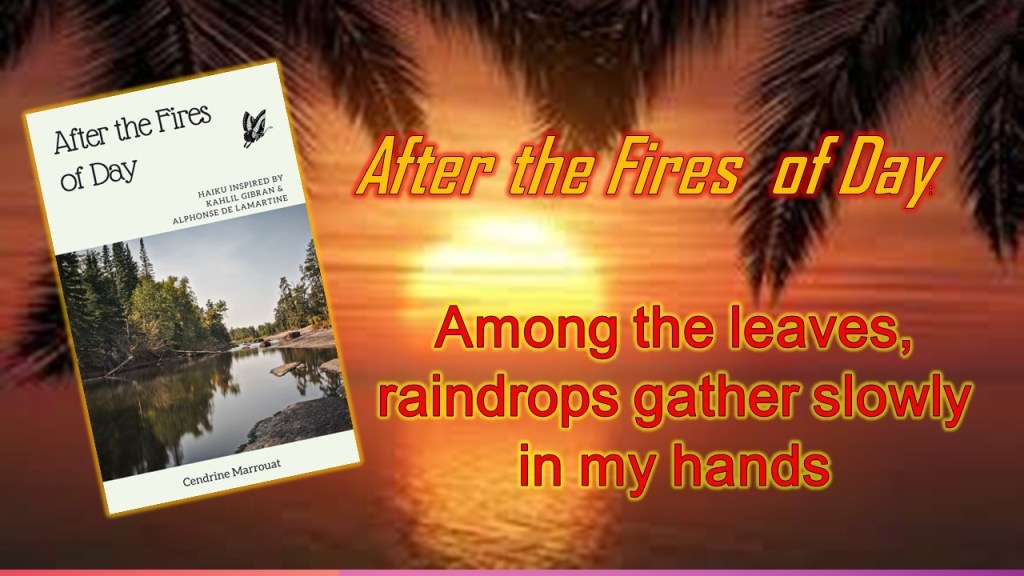
Today, I am delighted to welcome poet and artist, Cendrine Marrouat, to Robbie’s Inspiration with her new book, After the Fires of Day. Thank you to Kaye Lynne Booth from WordCrafter book blog tours for organising this tour.
You can read Day 1 of the tour here: https://writingtoberead.com/wc-book-blog-tours-2/
You can read Day 2 of the tour here: https://theshowersofblessings.com/2021/09/07/blog-tour-after-the-fires-of-day-haiku-inspired-by-kahlil-gibran-alphonse-de-lamartine-by-cendrine-marrouat/
You can read Day 3 of the tour here: https://robbiesinspiration.wordpress.com/2021/09/08/robbies-inspiration-after-the-fires-of-day-wordcrafter-book-tour/
Kahlil Gibran and Alphonse de Lamartine: Some quotes and facts + A Haiku by Cendrine Marrouat
A few weeks ago, I mentioned my new book, After the Fires of Day: Haiku Inspired by Kahlil Gibran & Alphonse de Lamartine, on social media. The responses were fantastic. However, some people did not seem to recognize the names mentioned in the title and on the cover.
A majority of people have heard or read The Prophet. But very few know Kahlil Gibran’s other books and/or the fact that Gibran was a very talented painter. And when it comes to Alphonse de Lamartine, he is virtually unknown outside of France.
Gibran and Lamartine did not just write beautiful things; they were also great thinkers. So, if you are not familiar with them, this short post is for you.
Let’s start with a few quotes.
Kahlil Gibran
You are your own forerunner, you the stranger passing by the gate of my garden.
And I too am my own forerunner, though I sit in the shadows of my trees and seem motionless.
From The Forerunner – His Parables and Poems (1920)
I AM FOREVER walking upon these shores,
Betwixt the sand and the foam,
The high tide will erase my foot-prints,
And the wind will blow away the foam.
But the sea and the shore will remain
Forever.
From Sand and Foam – A Book of Aphorisms (1926)
I WAS,
And I am.
So shall I be to the end of time,
For I am without end.
From “The Hymn of Man,” A Tear and a Smile (1914)
Alphonse de Lamartine
Sometimes, only one person is missing, and the whole world seems depopulated.
From “L’isolement (Isolation),” Méditations Poétiques (1820)
To love for the sake of being loved is human, but to love for the sake of loving is angelic.
So driven onward to new shores forever,
Into the night eternal swept away,
Upon the sea of time can we not ever
Drop anchor for one day?
From “Le lac (The Lake),” Méditations Poétiques (1820)
There is a woman at the beginning of all great things.
Brutality to an animal is cruelty to mankind – it is only the difference in the victim.
And now, some interesting facts!
Kahlil Gibran
Gibran (1883-1931) was a philosophical essayist, novelist, and artist. He is also the third most widely read poet in history, after Shakespeare and Lao-Tzu.
Also known as Khalil Jubran in English, he was born Gibrān (Jubrān) Khalīl Gibrān (Jubrān) bin Mikhā’īl bin Sa’ad. “Khalīl” means ‘friend’; “Jubrān” means ‘to console, comfort’. Gibran had to Americanize his name when he moved to Boston with his mother and siblings in 1895. His first name was also dropped around that time.
The Prophet has never been out of print since its first publication in 1923. It has been translated into 100+ languages and was one of the best-selling books in the 20th century in the U.S. alone.
Gibran’s work has influenced many artists. For example, Elvis Presley talked aboutThe Prophet his entire life. John Lennon used a slightly altered form of a line from Sand and Foam in the song Julia, which appears in the Beatles’White Album. Finally, David Bowie mentioned Gibran in the song The Width of a Circle.
In the U.S., Gibran has a plaque, garden, and public schools named in his honor: the Gibran Memorial Plaque (Boston), the Kahlil Gibran Memorial Garden (Washington, D.C.), the Khalil Gibran International Academy (Brooklyn), and the Khalil Gibran Elementary School (Yonkers, N.Y.). Lebanon also celebrates him with its Gibran Museum (Bsharri, his birthplace) and Gibran Khalil Gibran Garden (Beirut).
(To see a list of Gibran’s works, including his paintings, click here.)
Alphonse de Lamartine
Alphonse de Lamartine’s full name is Alphonse Marie Louis de Prat de Lamartine, Knight of Pratz. He was born of French provincial nobility in 1790 and died in 1869. He is considered as one of the greatest Romantic poets in history. His poetry career suddenly took off when he published his Méditations poétiques.
Lamartine was a writer, poet and statesman. He was elected to the National Assembly in 1833 and led the provisional government during the French Revolution of 1848. After being thrown out of office a few months later, he ran as a candidate for the presidential election of December 1848. He lost and retired from politics. But his work during the Second Republic led to important changes, including the abolition of slavery and the death penalty.
Lamartine experienced tragic losses in his life. Both his children died very young. Before marrying artist Mary Ann Elisa Birch in 1820, he fell deeply in love with two young women who passed away prematurely—Julie Charles (physicist Jacques Charles’s wife) and Antoniella. The latter inspired him to write Graziella, one of his most famous novels. He devoted many poems to Julie, including “The Lake.” He refers to her as Elvire.
A valley in Lebanon is named after Lamartine—the Valley of Lamartine.
Lamartine was made a Chevalier of the Legion of Honour in 1825. This is the highest order of merit in France. Four years later, he was elected a member of the Académie française.
(To see a list of Lamartine’s works in English, click here.)
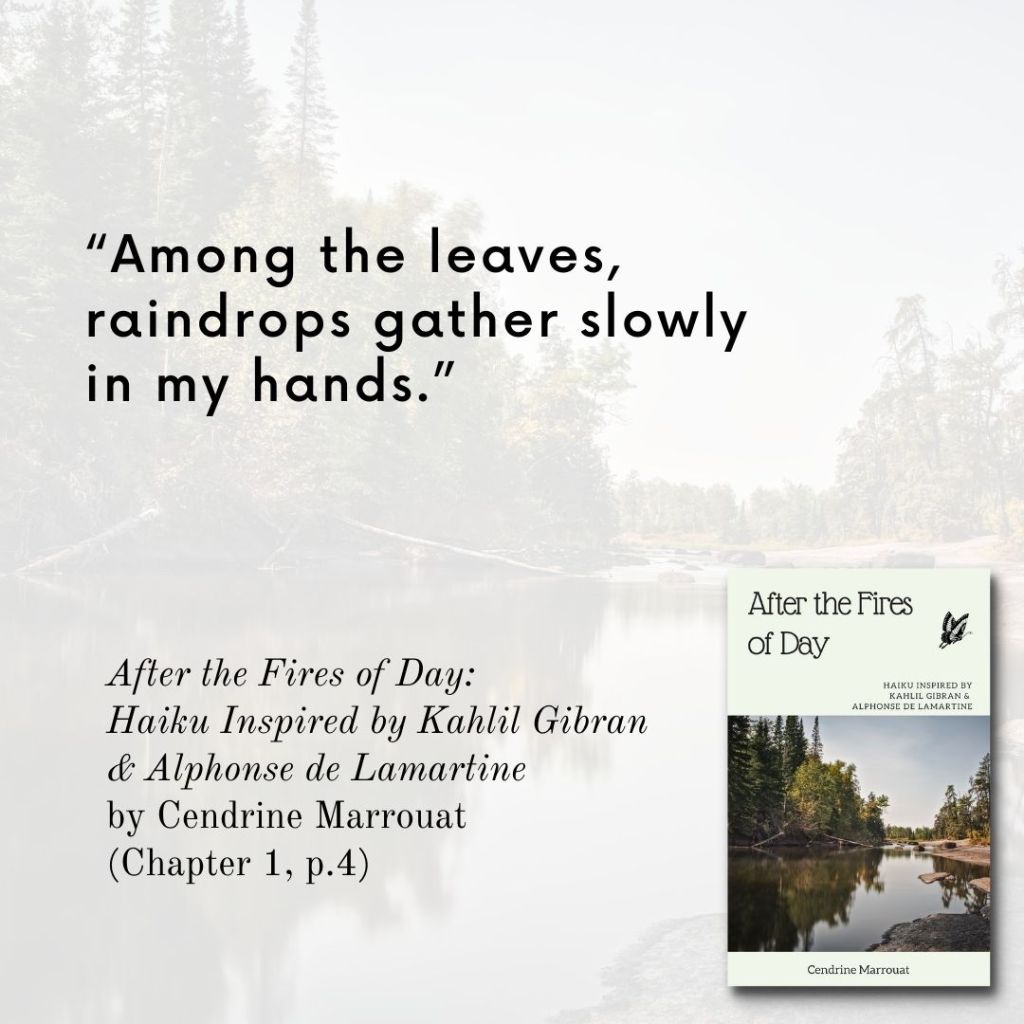
Impressive people, right? 😉 And now, to conclude this post, I’d like to share a haiku from my book After the Fires of Day: Haiku Inspired by Kahlil Gibran & Alphonse de Lamartine.
Book blurb
![After the Fires of Day: Haiku Inspired by Kahlil Gibran and Alphonse de Lamartine by [Cendrine Marrouat]](https://m.media-amazon.com/images/I/41dtKVO4i2S.jpg)
Originating from Japan, the Haiku has been a source of inspiration and comfort for people of all ages and from all walks of life for many years. This versatile poetry form is cherished around the world. Inspired by the timeless words of authors Kahlil Gibran and Alphonse de Lamartine, After the Fires of Day is an hymn to life, the emotion of the moment, and our connection to nature. Every haiku in Cendrine Marrouat’s collection is sure to stay with you for a very long time…
Book details
After the Fires of Day: Haiku Inspired by Kahlil Gibran & Alphonse de Lamartine
Formats
ebook and paperback
Release date
Release date: September 7, 2021
Availability
Everywhere books are sold, including Amazon, Kobo, Apple, Chapters-Indigo, Barnes & Noble, and FNAC. Readers are encouraged to support independent bookstores: https://creativeramblings.com/books/.
Website
Trailer
About Cendrine Marrouat

Cendrine Marrouat is a French-born Canadian photographer, poet, and the multi-genre author of more than 30 books. In 2019, she founded the PoArtMo Collective and co-founded Auroras & Blossoms with David Ellis. A year later, they launched PoArtMo (Positive Art Month and Positive Art Moves) and created the Kindku and Pareiku, two forms of poetry.
Cendrine is also the creator of the Sixku, the Flashku, and the Reminigram. Cendrine writes both in French and English and has worked in many different fields in her 17-year career, including translation, language instruction, journalism, art reviews, and social media.
Books: – Songs in Our Paths: Haiku & Photography (Volume 2) (2021)
– Seizing the Bygone Light: A Tribute to Early Photography (2021) (Co-author)
– 30 Creative Prompts to Take Your Art to the Next Level (2021) (Co-author)
– Rhythm Flourishing: A Collection of Kindku and Sixku (2020) (Co-author)
– The Auroras & Blossoms PoArtMo Anthology: 2020 Edition (Co-editor)
– The Auroras & Blossoms NaPoWriMo Anthology: 2020 Edition (Co-editor)
– The Little Big eBook on Social Media Audiences: Build Yours, Keep It, and Win (2014 – Second edition 2020)
– Blog Your Way to Success: 35+ No-Nonsense Tips for Authors and Writers (2020)
– Walks: A Collection of Haiku (All the Volumes and More!) (2020)
– Photography of Life and Living: The Black and White Book (2020) (Co-author)
– Songs in Our Paths: Haiku & Photography (Volume 1) (2020)
– Bad. Pitches. Period. 30 Flavors of Spammy Emails (2020)
– The Heart of Space (2020) – My Twitter Workbook: 20 Tips to Get Noticed and Followed (2020) (Co-author)
– My Positivity Journal: 100 Action Verbs and Affirmations for Daily Inspiration (2020) (Co-author)
– My Poetry Workbook: 20 Tips to Write Great Poems (2020) (Co-author)
– My Creative Journal: 40 Prompts to Take Your Writing to the Next Level! (2020) (Co-author)
– My Marketing Workbook: Promotional Tips For Poets (2020) (Co-author)
– Dans le silence des mots: Une pièce en trois actes (2019) – Walks: A Collection of Haiku (Volume 3) (2019)
– Walks: A Collection of Haiku (Volume 2) (2019)
– Walks: A Collection of Haiku (Volume 1) (2019)
– In the Silence of Words: A Three-Act Play (2018)
– Life’s Little Things: The Quotes (2017)
– Life’s Little Things – Les petites choses de la vie (2016)
– When the Mind Travels: A Poetic Journey into Photography (2015)
– The Little Big eBook on Blogging: 40 Traffic Generation Tips (2012)
– Five Years and Counting: A Journey into the Mind of Soul Poetry (2010)
– Project: Heartbeats and Elevation (2009) – Short Poetry for Those Who Fear Death (2006)
– And They All Rejoiced! Soul-Stirring Poetry (2006)
– Sortons des chemins battus (2006)
Contact Cendrine Marrouat
Website: https://www.cendrinemedia.com
Blog: https://creativeramblings.com
Books: https://creativeramblings.com/books
Email: cendrine@creativeramblings.com
Facebook: https://www.facebook.com/cendrinephotography/
Twitter: https://twitter.com/cendrineartist





![The One Chosen: A Diasodz Short Story (Chronicles of the Diasodz) by [Yvette M Calleiro]](https://m.media-amazon.com/images/I/51w4sz0+4cS.jpg)
![Unhinged: A Micro-Read by [John Podlaski, Nicole Patrick]](https://m.media-amazon.com/images/I/412Gj1Qzz6L.jpg)
![Turn The Light On by [Pat Garcia, 4Wills Publishing]](https://m.media-amazon.com/images/I/41GG4nLYv1L.jpg)






![Apollo's Raven (Curse of Clansmen and Kings Book 1) by [Linnea Tanner]](https://m.media-amazon.com/images/I/510l3fvsdKL.jpg)
 roberta-writes.com