Where Spirits Linger anthology published by WordCrafter Press is available for download for .99 cents today and tomorrow. My short story, Listen to Instructions, is included in this anthology which is compiled and edited by Kaye Lynne Booth.
Covid 19 brought changes to the way we do many things, including how we celebrate Halloween. Many folks may not be comfortable being exposed to children in costume coming to their door. Many parents may not be comfortable letting their children go door-to-door this year. I know of neighborhood residents who have gotten together to allow trick-or-treating only within a close-knit group, where everyone knows everyone else and they are all vacinated, and I’ve seen more haunted houses this year than ever before.
One thing that hasn’t changed though, is the love of a good ghost story or two on Halloween night. That’s why this weekend only, you can get a digital copy of Where Spirits Linger, this year’s WordCrafter paranormal anthology, to draw your ghost stories from. You’ll be captivated with the lingering spirits in these short stories, including the winning story from the 2021 WordCrafter Paranormal Short…
Welcome to Thursday Doors, a weekly feature allowing door lovers to come together to admire and share their favorite door photos from around the world. Feel free to join in on the fun by creating your own Thursday Doors post each week and then sharing your link in the comments below, anytime between 12:01 am Thursday morning and Saturday noon (North American eastern time).
Terence and I visited the South African Military Museum earlier this year. It was an interesting museum to visit and I learned some new information about South Africa’s involvement in WW1 and WW2.
The South African National War Museum in Johannesburg was officially opened by Prime Minister Jan Smuts on 29 August 1947 to preserve the history of South Africa’s involvement in the Second World War. In 1975, the museum was renamed the South African National Museum of Military History and its function changed to include all conflicts that South Africa has been involved in. In 1999 it was amalgamated with the Pretoria-based Transvaal Museum and National Cultural History Museum to form the NFI. In April 2010 Ditsong was officially renamed Ditsong Museums of South Africa and the SANMMH was renamed the Ditsong National Museum of Military History. From Wikipedia
Entrance to the museum
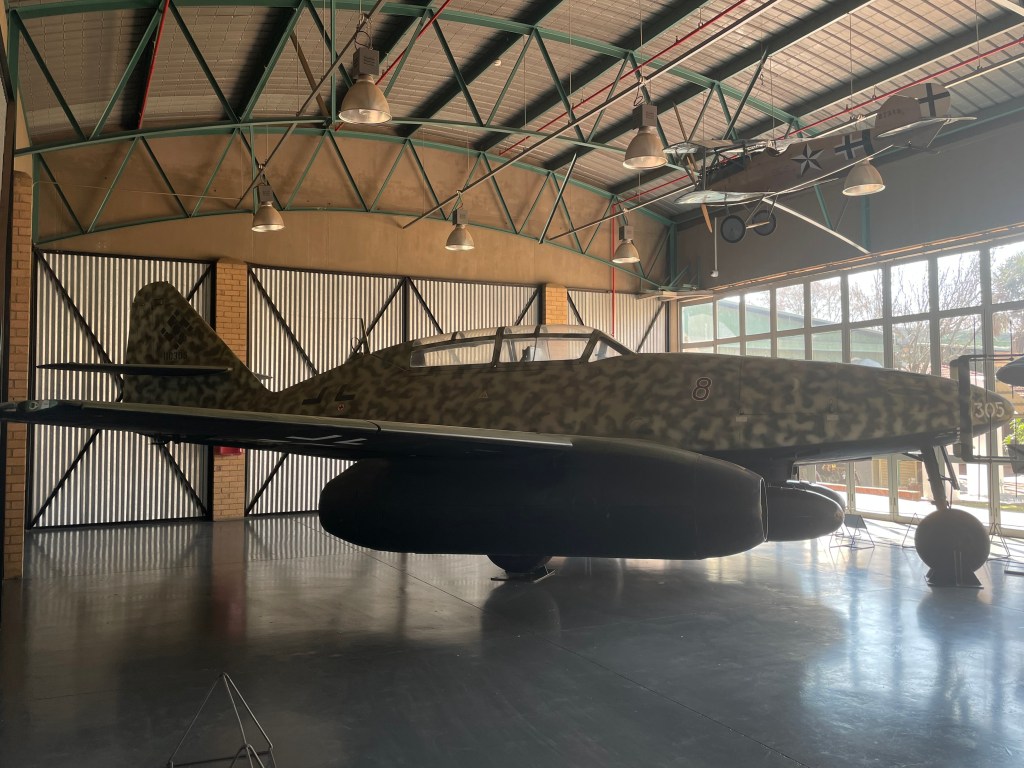
A selection of the airplanes on display in the museum:
Messerschmitt Me 262B-1a/U1 Two seater night fighter Germany 1944-1945
Messerschmitt Me 262B-1a/U1 Two seater night fighter Germany 1944-1945
All of these planes had cockpit doors although the door in the first picture is missing. That Messerschmitt Bf 109E3 was part of the fighter escort from Luftwaffe Fighter Squadron JG26 commanded by one of Germany’s most famous fighter aces – Oberstleutnant Adolf Galland. This squadron was escorting a bomber raid on Britian on the afternoon of 28 November 1940 and was intercepted over Kent by the Hurricanes of 249 Fighter Squadron RAF. In the ensuing dog-fight, this plane ran out of fuel and made a forced landing on a farm at Udimore in Sussex.
Dante and Virgil are stuck outside the gates of Dis, having been barred from entry by the fallen angels. While they are waiting to see if Virgil’s appeal to them will change the status quo, the fallen angels come back and slam the gates shut in defiance.
Virgil tells Dante not to worry as an angel from Heaven will descend to open the gates. The wait seems to be long and Dante becomes anxious, asking Virgil if anyone from the upper circles has ever made this descent into Hell. Virgil confirms that he was once required to summons a shade from the circle of Judas, deeper into Hell, so he does know the way.
During this wait, three furies appear. They threaten to summon Medusa to turn Dante to stone. Virgil places his own hands over Dante’s eyes to protect his eyes from the beast.
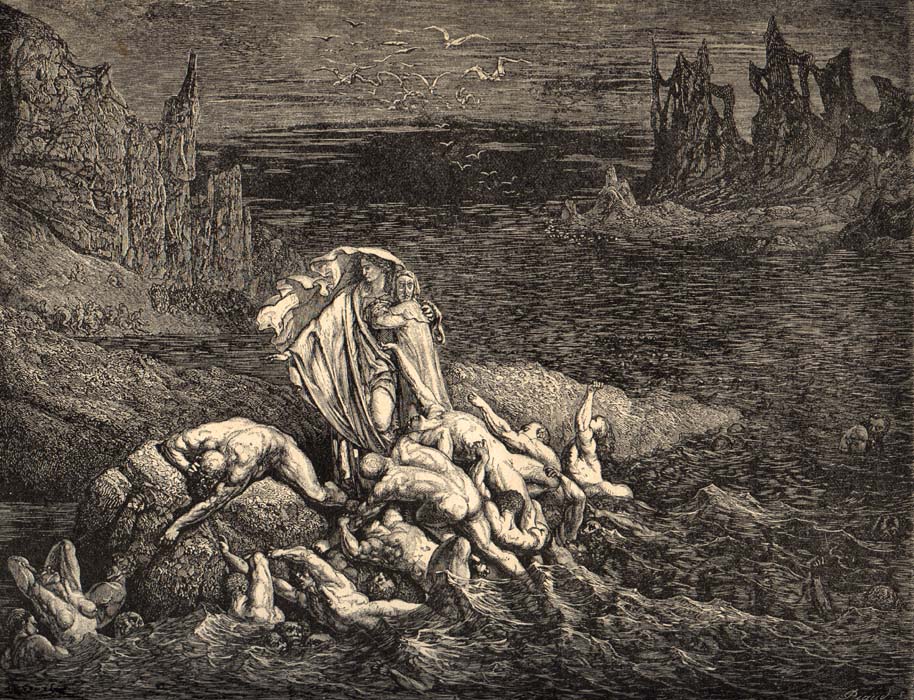
An enormous noise, like a hurricane, causes the two poets to look towards Styx. They see a figure crossing without touching the marsh. Shades rush away from him and he moves his left hand in front of him to dispel the fog of the marsh.
Dante recognizes the Heavenly messenger and Virgil asks him to bow down and remain quiet.
The angel opens the gate of Dis with his rod, and chides the fallen angels for their resistance. He then returns the way he came.
The pair enter the sixth circle and see a large graveyard with uneven open tombs. Flames burn outside the wall of every tomb making them red hot. Terrible moans and howls come from the open tombs which are inhabited by the spirits of arch-heretics of all cults and their followers.
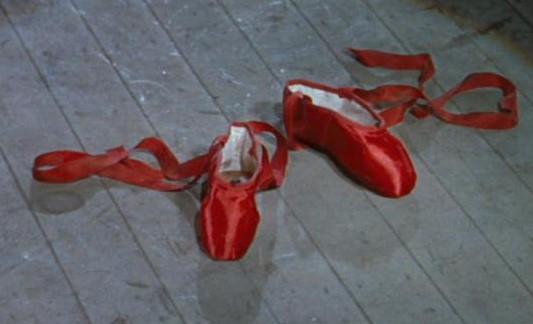
This month’s Dark Origins post features The Red Shoes by Hans Christian Anderson. This story made a big impact on me as a small girl. Thanks for hosting, Kaye Lynne Booth
Have you read the story of the red shoes? This is the one fairy tale by Hans Christian Anderson’s that I had a lot of trouble understanding as a young girl.
Karen is a little girl whose family is so poor, she has to wear thick wooden shoes during the winter that chaff her feet and make them red and raw. During the summer months, she goes barefooted. A kindly shoemaker makes Karen a pair of shoes from old scraps of red cloth. The first time Karen wears these shoes is on the day of her mother’s burial. An elderly woman driving past sees the little girl walking after the coffin and takes pity on her. She offers to take Karen into her own home and raise her.
Karen believes her good luck is attributable to the red shoes and develops a passion for shoes in…
I am over at Charles French on Words, Reading and Writing with a post about The Invisible Man by H. G. Wells. If you like stories with strong characterisations, this book is for you. It is very insightful into the personality, phycology, and behaviour of the main character. Charles has a great blog and some excellent books so do take a look around while you are there.
Thank you so much to Roberta Eaton Cheadle for creating another entry into the U. L. S., the Underground Library Society! The U. L. S. is an unofficial group of people who are dedicated to the preservation of books and in complete opposition to censorship. The idea is based on the Book People from Ray Bradbury’s Fahrenheit 451.
The Invisible Man by H.G. Wells
Background
The Invisible Man is a science fiction novel by H.G. Wells that was initially published as a series in 1897.
This book examines human nature and the temptations of immorality to humans. Essentially, the author explores how he believes people would behave if there were no consequences to their actions.
The story starts with a stranger arriving at Iping, a small town in the United Kingdom, and taking lodgings at the Coach and Horses Inn. Mrs. Hall, who runs the inn, is pleased to…
Welcome to Thursday Doors, a weekly feature allowing door lovers to come together to admire and share their favorite door photos from around the world. Feel free to join in on the fun by creating your own Thursday Doors post each week and then sharing your link in the comments below, anytime between 12:01 am Thursday morning and Saturday noon (North American eastern time).
My oldest son has reached the end of his fourteen year journey at St John’s College. I remember dropping him off on the first day at the nursery school. He was anxious and his little face was quite white, but Greg wanted to go to school and he never complained or cried. He just sat quietly and when the headmistress started playing the piano and the children started to sing, he joined in, and that was that. He started his schooling journey.
Greg has always been an enthusiastic and eager student. After a few weeks at his new school, he asked me if he could learn to play the piano. I enrolled him at a local music school and Greg took to learning music very well. He could read music fluently before he could read. He gave up his music studies at the age of 13 after passing his Grade 5 theory and Grade 5 practical London School of Music examinations. I hope that one day he will return to music.
At six, he decided he wanted to learn to read. In South Africa, children only learn to read at seven, but he was determined and I taught him. We had a slight delay as I didn’t think to teach him the alphabet first, but despite my giant error, he learned to read very quickly and was a real book worm by the age of seven, reading seven to ten children’s books a week.
Last week, he finished high school and is now writing his final examinations.
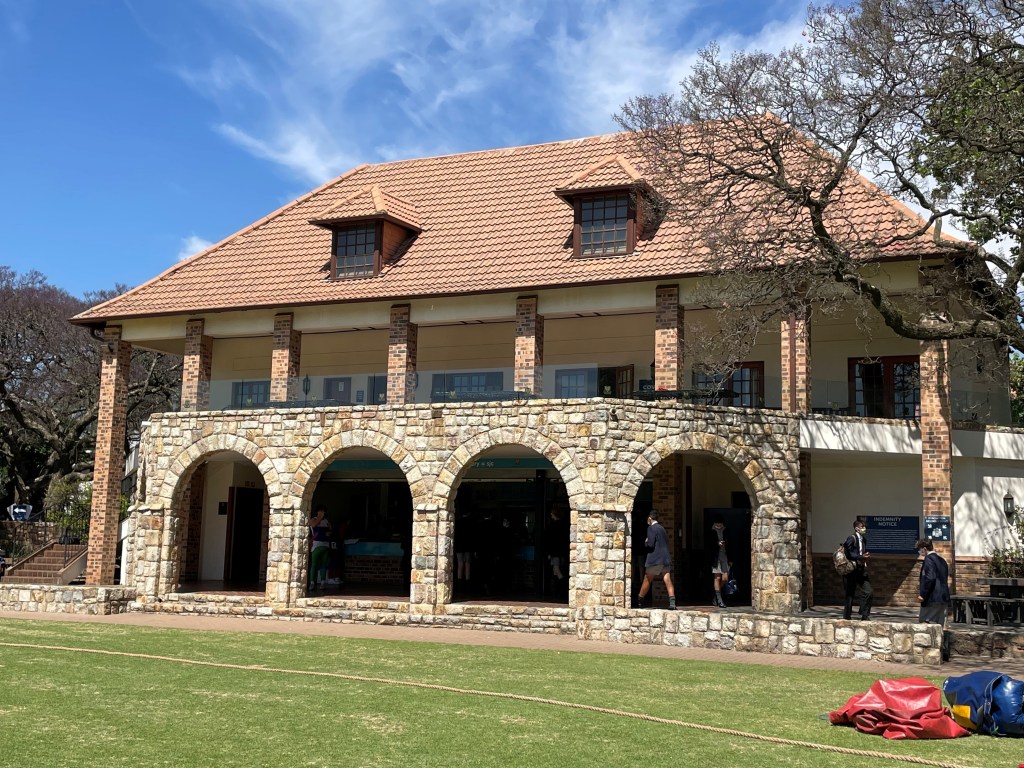
Greg attended a beautiful school and I thought I would share some pictures of the place he has been so happy for so long.
Front gate to the campus
Tuckshop
These are pictures of the main quad decorated for the valediction ceremony and service:
A Valedictory war cry – Boys will be boys!
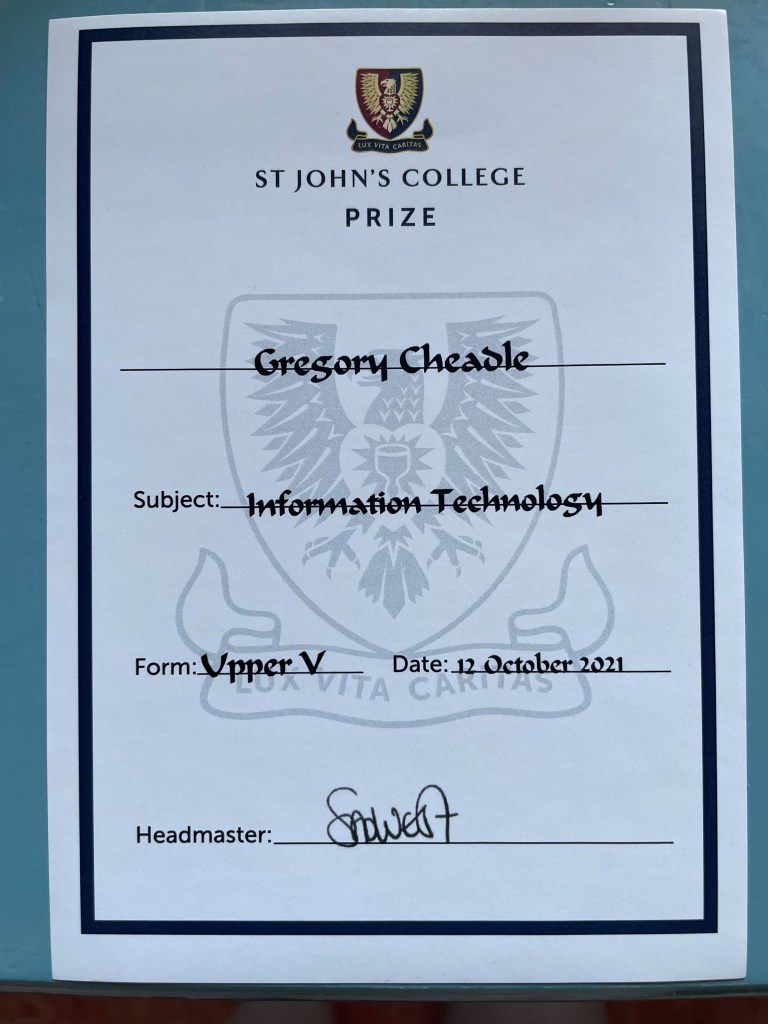
Greg received the IT award, along with two other boys, with an average for the year of 98%. He also achieved academic excellence honours.
The reading group are reading one chapter a day of this book and it inspired me to tackle Divine Comedy by Dante Alighieri in the same manner.
Canto 8
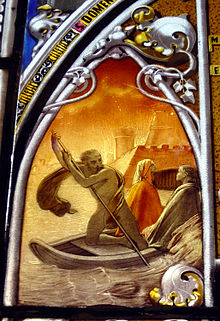
As Dante and Virgil continue around the Fifth Circle of Hell, they come to a tall tower standing on the bank, flames bursting from it’s highest point. Phlegyas, the boatman, meets the two poets but is angered when he realises they are not damned souls. Virgil argues with Phlegyas who agrees to take them across the River Styx.
During the crossing, a soul rises from the slime and confronts Dante. The soul is Filippo Argenti, a Florentine enemy of Dante’s. Argenti is one of the ‘Wrathful” being punished in the marsh. Dante and Argenti have an altercation and Dante reacts badly, wishing Argenti should suffer further punishment. This bitter argument again introduces the theme of politics in this book as Argenti’s family opposed Dante’s return to Florence. It is at this point in the story that Dante’s character starts to change. This is evidenced by Dante’s lack of pity for the Wrathful in the marsh and his angry reaction to Argenti’s behaviour. Interestingly, Virgil praises Dante for his response to Argenti’s comments.
Dante and Virgil continue on to the City of Dis, the capital of Hell where the sins of violence and heresy are punished. The mythological king of the Underworld, Pluto, is sometimes called Dis so this city is named for him.
At the gates of Dis, the damned souls refuse Dante entry and Virgil is unable to convince them otherwise. Virgil assures Dante that “the Great One” is on his way to open the gate.
Today, I am delighted to welcome fantasy and sci-fi author, C.S. Boyack, to Roberta Writes with a post about his amazingly imaginative The Hat series of books. I have read and enjoyed several of Craig’s book, including the first two books in this series.
Take it away, Craig!
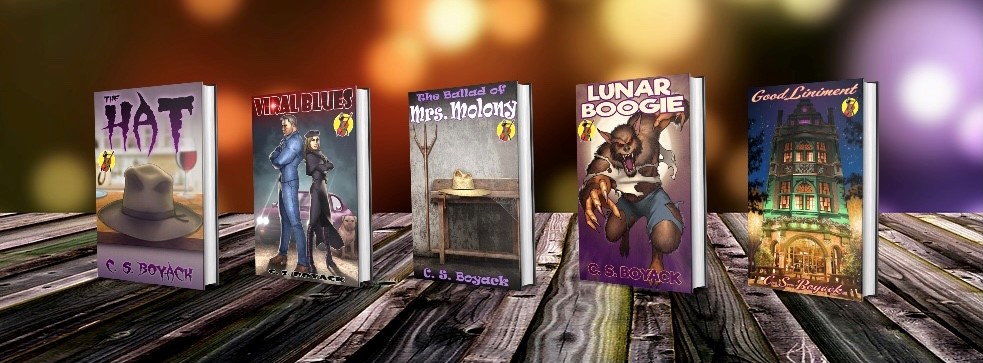
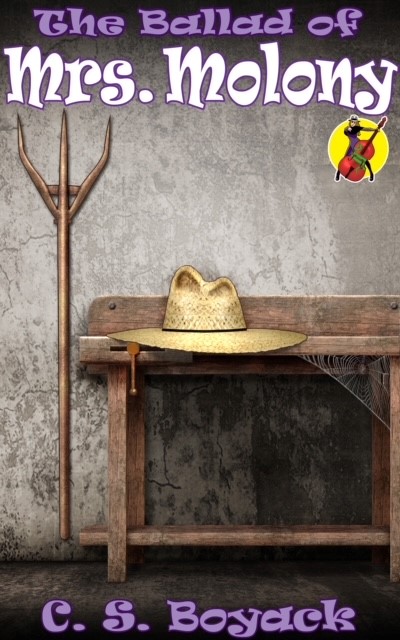
Thanks for having me back, Robbie. This is kind of exciting, because I’ve never been able to do a series tour before. Now that I have enough volumes, I thought I’d give it a try. The goal is to discuss one volume per week. Here on week three it’s all about The Ballad of Mrs. Molony.
The Hat Series involve short novels you can read in an afternoon. I’ve also worked to make sure readers can tackle them out of order. If you pick up any volume, I don’t think you’ll feel lost.
In The Ballad of Mrs. Molony, the duo are hunting vampires. I designed my vamps after predators. I’ll use an African example to make my point. Lions tend to hang out in plain sight. Various herbivores seem to wander past with no worries. It’s when the lions aren’t in sight that the prey species need to worry.
Most of my vampires hide among the street people. We notice them, but try not to look as we go out for an evening. In this story, I took them to another level. I placed them among the rodeo circuit. These events have a lot of parties going on, and someone is going to drink a bit too much, or wander off alone for a smoke.
I also worked on the concept that vampires were people before the big change. I made some less threatening, but the targets of this story were monsters before they became vampires.
Good thing Lizzie and the hat have a small cover band. This gets them into the right places to stalk the killers. They just have to adapt to a different kind of music than they usually play. I worked some of this for humor, because it’s a new style for them.
It’s actually a vampire that tells Lizzie all about the current problem. Kevin Mugford has to be the worst vamp of all time. He has gnarly teeth to the point of deformity, a speech impediment, and is pretty cowardly. He needs Lizzie, because the vampires have taken his sister to use as livestock. They feed off her on slow nights when hunting hasn’t been productive.
Since this series is supposed to be somewhat comical, the hat doesn’t trust him. It could be a setup to jump Lizzie as she’s about to move in on them. Maybe the sister is a vampire, too. It leads to a few fun interactions between Lizzie and the hat.
The Ballad of Mrs. Molony is free today, and will be for a couple of days. You can’t beat that deal. Check out a fun supernatural romp during October, on me.
The Hat Series is my opportunity to have a little fun, and readers seem to be enjoying themselves, too. The series fits into a variety of pigeonholes as all stories do. If you’re looking for supernatural, paranormal, or urban fantasy, with a dose of dark humor, this might be the series you’re looking for.
Lizzie St. Laurent is a hard working twenty-something. She’s struggling with the issues of being a young adult, but also dealing with the supernatural world. After her grandmother died, she tried to get a memento from the estate. Her greedy uncle refused to share, so in desperation, she stole a box from the moving van.
Her treasure turned out to be an old hat that belonged to her grandfather. Not exactly the knickknack she was hoping for. This isn’t any ordinary hat. He’s actually a being from another dimension who was brought here by witchcraft. He has a few magical skills, but also some more ordinary ones. He can transport her to a cabin, deep in the forest, among other things. A bit more ordinary is his ability to play the upright bass, but only if he has a human host to manipulate. He’s also a shapeshifter, but is limited to always being a hat of some kind.
The hat has been in Lizzie’s family for centuries, and all of his partners have been monster hunters. Their symbiotic relationship also created an additional income stream for Lizzie. They formed a small cover band, which tends gets them out at night when monster hunting is more productive.
I put all kinds of strange things into these stories to make them fun. My section breaks have all been replaced with a series of bass clefs. I also include silly graphics in various locations to enhance the tales. You’ll find tons of snark mixed in with your blood and adventure.
These are short novels, designed for a single afternoon. While it is a series, they can be read as stand-alone tales. If one of the other volumes is your entry-point, I don’t think you’ll feel lost.
If this sounds like something to make your October complete, I’d appreciate you checking it out.
The Hat by C.S. Boyack is such a great read. The main characters are a young girl, Lizzie St Laurent, a twenty-one-year-old college dropout whose grandmother has died and who has been left to fend for herself in a city far from home and the Hat. Lizzie is working a couple of jobs to pay the bills and keep a roof over her head. She also has a deal with the landlord whereby she keeps the garden tidy and trim in return for free utilities. Lizzie is struggling and when her uncle doesn’t want to give her a keepsake from her grandmother’s estate, she helps herself to one from the back of the removal van. Boy, does she make a good choice. She ends up acquiring a hat that can communicate with her, transform its shape, transfer her to a “safe house’ built by her grandfather and teach her how to play a musical instrument. What is even better is that the Hat is magically bound to Lizzie’s family and is there to assist her out of tight spots in life. When the baby of a friend of Lizzie’s is stolen, the Hat is right there by her side to help her rescue the babies form a band of ruthless kidnappers.
Along the way, Lizzie will have some fun experimenting with great fashion items and meeting some interesting musicians. The Hat is a fast-paced novella which will keep you turning the pages, giving you lots of laughs along the way.
Viral Blues is a thrilling and fun second book in The Hat series. Someone or something evil has contaminated all the vaccinations being administered in the USA, with the result that horrible epidemics are breaking out in towns throughout the continent. Gupta and Gina Greybill are determined to find out who is behind the outbreaks and why. The gather a group of unusual heroes together to help them figure it all out, including, Lizzie and her paranormal hat, Clovid and his dog, Justine, a voodoo practitioner, Jason Fogg who can shape-change into fog, and Lisa, a robot girl.
This unlikely crew quickly realise that something malevolent and sinister is afoot and it involves zombies, the mafia, and unscrupulous scientists. The group must set aside their differences and utilise their different strengths to overcome the evil force behind the scheme.
C.S. Boyack is an author of unusual originality and his fantastic heroes are highly entertaining. Each character has useful talents but also has a weakness which needs to be overcome in order for the group to keep making progress in solving the case. The author also threads some excellent humour throughout his novel which makes for an even more entertaining and enthralling read.
This is my personal favourite of C.S. Boyack’s books.
I have read a few of Craig Boyack’s books and I really enjoy his writing. I found this story particularly enjoyable.
The nameless hero of the story wakes up in the middle of a desert with a bullet in his head and no memory of what happened to him and how he got there. He is rescued by a talking Yak who is there to help him learn to become a useful part of society. Our unusual hero has lived a life of laziness and has spent his days sponging off his friends and anyone else who comes along.
Our hero sets off on an usual journey in a post apocalyptic world where war has destroyed the sophisticated and technologically advanced societies that lived there previously. The hero meets a prototype, a human like creature that teaches him a lot about the art of survival such as identifying edible plants and other useful natural resources. The prototypes salvage food and other recyclable materials from the remains of the destroyed cities, villages, aeroplanes and vehicles that scatter the country side. The prototype also teaches the hero the importance of reflection and thinking about what you want from life and how your individual actions impact on the natural world.
When the hero reaches a point in his emotional development where he is ready to re-join his own kind, the Yak reappears and they set off together to find one or other of the survivals who have formed themselves into rival groups. The hero still has lessons to learn about love, loyalty and teamwork.
I really enjoyed the hero and found his personal journey from a selfish and spoilt man-child to a reliable and resourceful man very interesting. The story was fast paced and entertaining and I enjoyed the fantasy world that the writer created.
Thank you very much to author and poet, Annette Rochelle Aben, for hosting the final day of my A Ghost and His Gold blog tour. This posts discusses poltergeists and is perfect for Halloween. Annette has a lovely blog so do take a look around while you are there.
Thank you to author, Karen Black, for hosting this post about the gun used by the Boers during the Second Anglo Boer War. Thank you to 4Wills Publications for organising my A Ghost and His Gold tour.
For those who don’t know her, I am delighted to introduce Roberta Eaton Cheadle and her latest novel, A GHOST AND HIS GOLD. Roberta combines history with fiction and weaves a story that is educational as well as entertaining. Leave a comment below for a chance to win one of four copies of this historical fiction.
A Ghost and His Gold
The gun used by the Boers during the Second Anglo Boer War
Mauser Model 93/95
Prior to the Second Anglo Boer War, Imperial Germany supplied the two Boer Republics with tens of thousands of modern Mauser rifles. The most common of these was the Mauser Model 93/95 chambered for the 7x57mm cartridge.
This is how Tactical Life Magazine describes the Mauser Model 93/95:
“Paul Mauser’s first smokeless-powder, bolt-action, charger-loaded, magazine-fed rifle featured a tubular receiver that held a one-piece both with dual front-locking lugs. The bolt was drilled out…




















![The Hat by [C. S. Boyack]](https://m.media-amazon.com/images/I/41ttPYmy6PL.jpg)
![Viral Blues (The Hat Book 2) by [C. S. Boyack]](https://m.media-amazon.com/images/I/51zY8pGB5yL.jpg)
![The Yak Guy Project by [C. S. Boyack]](https://m.media-amazon.com/images/I/51-i6o4afUL.jpg)




 roberta-writes.com