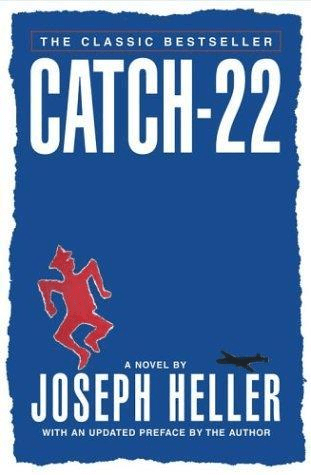
I heard about this novel from my oldest son who read it during his final year of high school. I obtained, and read, a summarised version of the book at the beginning of last year. Not knowing much about the book at the time I read the summary, I didn’t realise it wasn’t the unabridged version until some time later. I was sufficiently interested to purchase, and read, the unabridged version at the end of 2022.
This is a most unusual book, a deeply satirical look at American politics and bureaucracy during World War II at the front (or close enough to it to be an active participant). Admittedly, as a reader of predominantly British authors, I was rather shocked at the disrespect and ridicule directed towards the top military personnel. Most of the war books I’ve read have treated the military leadership, especially officers involved in active duty, with great respect and as heroes and men of bravery and action. It was rather disconcerting initially to make the mind shift to this different attitude and viewpoint. In essence, Catch 22 claims, through the actions of the various characters, that war and military life and behaviours are absurd.
Catch 22 largely follows of the life of antihero, Captain John Yossarian, a bombardier for the US Army Air Force. Yossarian and his friends are stationed on the fictional island of Pianosa in the Mediterranean Sea west of Italy. The novel chronicles Yossarian’s efforts to not be killed through his own eyes and through those of a number of other characters in the book. During his time in Pianosa, Yossarian has transitioned from an eager eyed young man keen to do his duty for his country into a cynic who is convinced that his own military leadership are trying to send him to an early death by forcing him to fly more combat missions that he should. Every time the men in Yossarian’s squadron read the target number of missions flown and prepare to return home, the number is raised by the greedy and ambitious Colonel Cathcart, who is always trying to gain recognition in an effort to be promoted.
The main event around which the novel is structured is the death of a radio-gunner, Snowden, during a raid on Avignon, France. Yossarian is the bombardier and tries desperately to save Snowden who is injured as a result of a struggle between co-pilot Dobbs and Huple, the 15-year old pilot, when Dobbs becomes overwhelmed with fear. Yossarian is horrified by Snowden’s gruesome death and becomes aware of his own mortality. He sets out to do everything he can to avoid flying any more missions. Yossarian believes that Snowden’s death reveals Snowden’s secret hidden in his entrails, that “man was matter” and that “Drop him out of a window and he’ll fall. Set fire to him and he’ll burn. Bury him and he’ll rot, like other kinds of garbage.”
Themes of Catch 22 and supporting extracts
Paradox and Impossibility
Catch 22 means a paradoxical situation from which an individual cannot escape because of contradictory rules or limitations.
Yossarian attempts to feign madness to avoid dangerous combat missions, but his desire to avoid them is taken to prove his sanity.
The following quote illustrates this theme:
“There was only one catch and that was Catch-22, which specified that a concern for one’s safety in the face of dangers that were real and immediate was the process of a rational mind. Orr was crazy and could be grounded. All he had to do was ask; and as soon as he did, he would no longer be crazy and would have to fly more missions. Orr would be crazy to fly more missions and sane if he didn’t, but if he was sane he had to fly them. If he flew them he was crazy and didn’t have to; but if he didn’t want to he was sane and had to. Yossarian was moved very deeply by the absolute simplicity of this clause of Catch-22 and let out a respectful whistle.
“That’s some catch, that Catch-22,” he observed.
“It’s the best there is,” Doc Daneeka agreed.”
War and bureaucracy
The novel initially paints a picture of the military bureaucracy as being absurd but as the novel progresses, the tragedy of the system that allows selfish, greedy, and narrow-minded men who only care about their own promotions and ambition to jeopardise the lives of the young men in their command and even civilians.
An example of absurdity: “Under Colonel Korn’s rule, the only people permitted to ask questions were those who never did. Soon the only people attending were those who never asked questions, and the sessions were discontinued altogether, since Clevinger, the corporal and Colonel Korn agreed that it was neither possible nor necessary to educate people who never questioned anything.”
An example of tragedy: “Colonel Cathcart had courage and never hesitated to volunteer his men for any target available.”
Loss of Religious Faith
Many of the officer and men have either lost their faith in God or doubt their faith. Even the chaplain begins to doubt his faith by the end of the book due to Colonel Cathcart’s selfish efforts to use religion to get himself in the public eye.
Yossarian has come to believe that there cannot be a God or there would not be so many dreadful and horrifying ways for men to die. However, his loss of faith does not render him moral-less. Yossarian reverts to making his own morals, as does the chaplain.
“There’s nothing mysterious about it, He’s not working at all. He’s playing. Or else He’s forgotten all about us. That’s the kind of God you people talk about, a country bumpkin, a clumsy, bungling, brainless, conceited, uncouth hayseed. Good God, how much reverence can you have for a Supreme Being who finds it necessary to include such phenomena as phlegm and tooth decay in His divine system of Creation? What in the world was running through that warped, evil, scatological mind of His when He robbed old people of the power to control their bowel movements? Why in the world did He ever create pain?”
“So many things were testing his faith. There was the Bible, of course, but the Bible was a book, and so were Bleak House, Treasure Island, Ethan Frome and The Last of the Mohicans. Did it then seem probable, as he had once overheard Dunbar ask, that the answers to riddles of creation would be supplied by people too ignorant to understand the mechanics of rainfall? Had Almighty God, in all His infinite wisdom, really been afraid that men six thousand years ago would succeed in building a tower to heaven?”
The impotence of language
When faced with the imminent possibility of a horrible death, Yossarian finds himself unable to derive any comfort from words whether in a written form or in a spoken form. Words are impotent in the face of death. Yossarian discovers this when Snowden dies and he can only say “There, there” in the way of comforting words.
In addition, the military bureaucracy takes all the power out of words and oral communications.
“There was no telling what people might find out once they felt free to ask whatever questions they wanted to.”
“I’m cold,’ Snowden said softly, ‘I’m cold.’
‘You’re going to be all right, kid,’ Yossarian reassured him with a grin. ‘You’re going to be all right.’
‘I’m cold,’ Snowden said again in a frail, childlike voice. ‘I’m cold.’
‘There, there,’ Yossarian said, because he did not know what else to say. ‘There, there.’
‘I’m cold,’ Snowden whimpered. ‘I’m cold.’
‘There, there. There, there.”
The inevitability of death
Yossarian has one goal and that is to stay alive. He does not, however, believe he can stay alive. He believes his death is inevitable and he is horrified by the vast number of ways in which a person can die. He has come to see the real vulnerability of the human body in the face of a bullet, a knife, or disease.
Yossarian’s obsession with death is not all morbid. Dwelling on death has given him a huge will to live and a capacity to enjoy the good things in life.
“He was never without misery, and never without hope.”
“He had decided to live forever or die in the attempt.”
You can purchase Catch 22 here: https://www.amazon.com/gp/product/0684833395
It is available as an audio book, paperback, and ebook.



















 roberta-writes.com