My blogging friend Rebecca Budd is currently participating in a #KaramazovReadalong, you can read about it here: https://ontheroadbookclub.com/2021/07/27/karamazovreadalong-day-1-who-is-fyodor/.
The reading group are reading one chapter a day of this book and it inspired me to tackle Divine Comedy by Dante Alighieri in the same manner.
Dante and Virgil descend into the Second Circle of Hell and the Reader starts to get an idea of what Hell is all about.
They see the monster, Minos, standing in front of a seemingly endless line of sinners and assigning them their eternal punishment. The sinners confess their sins and Minos then wraps his tail around himself a certain number of times thereby indicating the circle to which they must go. Minos says that Dante may not enter as he is a living soul, but Virgil explains the circumstances and they are allowed to pass into a dark place where torrential rains fall continuously and gales of wind tear through the air.
The souls in this Second Circle of Hell are guilt of being lustful and committing sins of the flesh. In Hell they are punished by being endlessly blown about by stormy winds.
Virgil identifies the souls of Helen of Troy and Cleopatra among those swirling past.
Dante calls out to the souls and he is answered by a lady called Francesca. She tells Dante how, in life, she was married to an elderly deformed man. She falls in love with her husband’s younger brother, Paolo da Rimini. One day while they are sitting reading the story of King Arthur, they read a particularly romantic piece and cannot resist kissing. The book is forgotten and “We read no more that day.”
Dante is again overwhelmed with pity and he faints.
It is quite interesting that some of the adulterers are also suicides and yet they are not sent to the circle deeper in Hell that is reserved for suicides. The reason for this is that in Dante’s description of Hell, a person is judged by the standards of the time period during which he/she lived. Suicide wasn’t considered a sin during classical times but adultery was. Those adulterers from this time who committed suicide are condemned for their adultery only.
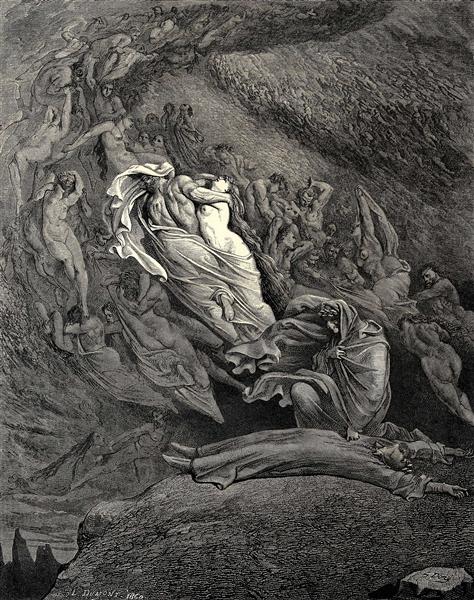
Here is a quote from Canto 5:
“The next is she who killed herself through love,
and to Sichaeus’ ashes broke her faith;
the lustful Cleopatra follows her.
See Helen, for whose sake so long a time
of guilt rolled by, and great Achilles see,
who fought with love when at the end of life.
Paris and Tristan see;” and then he showed me,
and pointed out by name, a thousand shades
and more, whom love had from our life cut off.
When I had heard my Leader speak the names
of ladies and their knights of olden times,
pity o’ercame me, and I almost swooned.”






















![The Ferryman and the Sea Witch by [D. Wallace Peach]](https://m.media-amazon.com/images/I/416I1Q87TdS.jpg)