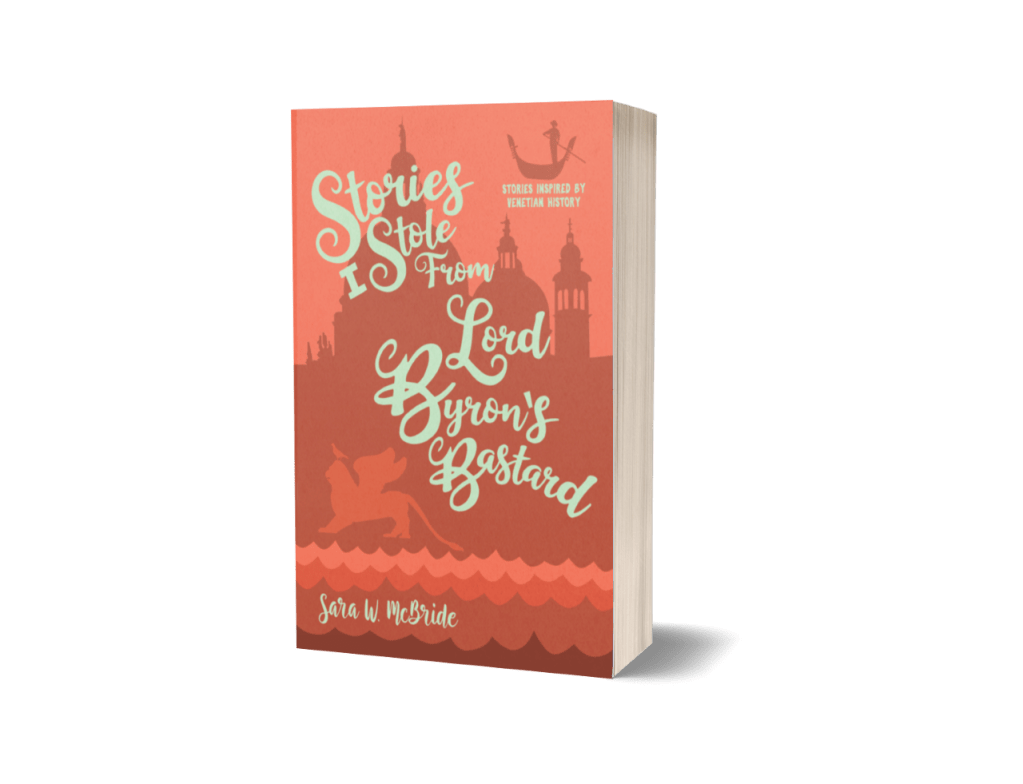
Stories I Stole from Lord Byron’s Bastard is a collection inspired by Venetian history. The fictional character, Alexis Lynn, wrote these stories in the novel Will Write for Wine by Sara W. McBride, but they are fun stand-alone adventures to be enjoyed with an excellent glass of Italian wine.
https://www.puckpublishing.com
Giveaway
In addidtion, to the awesome guests posts, interview, and reviews at each tour stop, Sara is offerin a chance to win a digital copy of each book, Will Write For Wine & Stories I Stole From Lord Byron’s Bastard. Leave a comment and click on the link below to enter for a chance to win:
http://www.rafflecopter.com/rafl/display/d9280cae1/?
Inspiration for the story ‘The Secret Vault’ – Guest post by author Sara W. McBride

Credit: Photo by Michael Martinelli on Unsplash
What inspired the story, “The Secret Vault?”
The story, “The Secret Vault,” was inspired by Venice’s Jewish Ghetto. But how did I get from the elevated ramparts of Soave castle to Venice’s Jewish Ghetto? The history behind this short story spans decades, but the story takes place in less than 72 hours. This was definitely the most challenging story to write in the collection and it also had the double duty of leading to an argument between the two main characters in the novel Will Write for Wine, where Alexis Lynn is the “author” of these stories.
On my first visit to Venice in 2005, I was shocked by the fact that the leading cosmopolitan trading city of the Renaissance, with its extreme religious tolerance—by 16th century standards—established the first Jewish ghetto. Actually, the first was in Frankfurt, Germany, but the second was in Venice, and the Venetian ghetto became the template for all other ghetto’s around the world. The word “ghetto” was founded by Venice, as ghèto was the word for the copper foundry that originally stood on the small seven acre island in the Cannaregio district, which in 1516, became the Gheto Novo, or New Ghetto.
In the 15th and 16th century, Venice was a safe haven for Jewish refugees escaping many parts of Europe, including other regions of Italy. Jews were allowed to operate businesses in Venice, but were not allowed to reside in Venice. Why?
In this story, I speculated that the patricians, the noble families of Venice, often led by Francesco Cornaro’s father, Giorgio Cornaro (1452-1527, aka: Corner), might have had personal financial reasons for suppressing Jewish freedom. The wealth of the Cornaro/Corner family was created by their money-lending practices, amongst other pursuits. I speculated that if Giorgio Cornaro’s son, Francesco, returned with a story of military loss and murder, orchestrated by a Jew, then it might persuade the other members in the Council of Ten to continue their suppression of Jews and oppose residency.
However, in 1516, the Jewish community in Venice negotiated for residency within the city of Venice, and the Senate designated the old copper foundry, the ghèto, as a Jewish residence, and the bridge gates surrounding the island were locked each night. It was an interesting way to simultaneously include and exclude the Jews from Venetian society. After only twelve short years, the Jews felt secure enough in their new residence to build synagogues, so even if they had to wear a yellow insignia or hat to distinguish themselves from Christians, Jews embraced their city residence. Their community grew, and they created more living spaces by building upwards on their small prison island.
I speculated that the old Venetian Patrician families were not anti-Semitic, but felt financially threatened by some of the Jewish merchants and moneylenders. Many of the Patrician families owned and operated banks. Several other powerful families had amassed enormous debts, and some were indebted to Jews. Suppressing the Jews meant maintaining power within the wealthy Patrician class.
So how does Soave Castle fit into this and does it really have secret tunnels?
The fabulous Castle of Soave really did have a tunnel connecting its main keep to a wine vault. Whether an additional tunnel led from the vault, under the city wall, and eventually opened in a monastery a half mile away, is speculative based on other European castles where such escape tunnels existed.
The general outline of the events in this story is true. Maximillian I, who the Warrior Pope, Julius II (Papal reign 1503-13–the Pope who tortured Michelangelo under a famous ceiling), declared as the Holy Roman Emperor without a proper church coronation, led the League of Cambria, essentially armies gathered from Europe, against Northern Italy. Soave Castle was a stronghold protecting the Veneto region and Venice from invasion. The castle is a gorgeous sight to behold, especially at sunrise or sunset. You should check it out and partake in some excellent wine tasting within the walled city of Soave.
From the history page of the castle’s website:
https://www.castellodisoave.it/en
It was the year 1509 when the army of the Lega di Cambrai, led by imperor Massimiliano I° d’Asburgo, defeated the fortress resistance.
Short after, the castle was regained by Venetians guided by Paolo Gradenigo, but just until the spring of 1510, when the imperial troops reconquered it.
In September of the same year, Soave’s people, led by Antonio Marogna, revolted and after, as chronicle states, ‘having chopped to pieces’ the imperial guards they handed over the fortress to the Venetians by opening its doors.
Massimiliano I, d’Asburgo (aka: Maximillian I of the house of Habsburg) passed the “Imperial Confiscation Mandate,” which ordered the destruction of all Jewish literature apart from the Bible. So, did a Jew really work for him? Yes!
The character of Abraham is a real figure from history. Abraham ben Moses Jaffe of Bohemia (1450-1535) was a prominent 16th century Bohemian Jewish banker and money lender and lent money to European and German royalty and nobility—like the House of Habsburg—in exchange for social privileges. He is known to have leant money to Maximilian I during the League of Cambria wars. It is also true that Abraham’s mother, Margolioth bat Samuel HaLevi, was considered an extremely educated woman, and so respected in the Jewish community that some of her descendants, like Abraham’s brother, adopted the second surname Margolioth.
Instead of following his mother’s example of studied wisdom, in 1512 he persuaded the King of Poland to pronounce him Prefect over the Jewish community and to become the tax collector for the Jewish poll tax in Poland. This enriched both the King and Abraham. The Jewish community of Kraków was so disgusted by Abraham’s mistreatment of his own people, they banned him from their society.
For the story, I speculated that Abraham was a man who solely protected his own self-interest and not that of the Jewish community, as his historical actions demonstrated shortly after the battle at Soave in 1510.
While visiting Venice or Northern Italy, I highly recommend a day trip to Soave. The landscape is breathtaking and the wine is delicious. And perhaps you’ll meet a ghost from one of the many bloody battles fought within Castello di Soave.
Stories I Stole From Lord Byron’s Bastard
“If you’re wondering about the story that made Manu so angry he banished me from Venice, it’s in here.” –Alexis Lynn
Get ready for a fun evening of stories inspired by Venetian history. Thrill to the adventures of money-laundering plague nuns, a pregnant Renaissance man, a demonic Doge at the Devil’s Bridge, and other tales of ghosts, art, and love.
Following in the footsteps of Lord Byron’s obsession with Venetian history, Alexis Lynn wrote these stories in the novel, Will Write for Wine. We proudly share these standalone stories with you over the objection of her paramour Manu, a modern-day Casanova and illegitimate descendent of Lord Byron himself.
So, pour yourself a glass of your favorite vino, let your dog or cat curl up at your feet (or let your cat do whatever it wants), and settle into these mostly … partly … somewhat true tales.
In vino est fictio.
Purchase Link:https://www.amazon.com/Stories-Stole-Lord-Byrons-Bastard-ebook/dp/B0B27TS5GL
Will Write For Wine

Alexis Lynn is tired of living for others. She chucks her twenty year scientific career, and possibly her marriage, to write full time in Venice, Italy. But when Alexis gets involved with a flirtatious Venetian, a man who champions her writing, events spiral out of control. The old Alexis knows she should salvage her marriage, but the new Alexis is quickly falling for the charms of this modern day Casanova. And she doesn’t know which Alexis will prevail. This is going to require a whole lot of wine.
Purchase Link: https://www.amazon.com/Will-Write-Wine-Alexis-Novel/dp/0990767043
About Sara W. McBride
Sara W. McBride, like many modern-day biological researchers, invents new swear words to sling at million-dollar machines while locked in a dark hole of a decaying academic hall. This has caused her to witness ghosts and create a romantic fantasy life within her head, which she now puts down on very non-technological paper with her favorite Jane Austen style quill pen.
Her first novel in the Alexis Lynn series, Will Write for Wine, and the companion short story collection, Stories I Stole from Lord Byron’s Bastard, both set in Venice, Italy, were recently released by Puck Publishing. She’s hard at work on the second Alexis Lynn novel, a Regency mystery series, and a haunted play. She strongly feels the world needs more haunted plays.

Blog Tour Schedule
Monday, June 27 – Opening Day Post – Writing to be Read – Guest Post: Inspiration for the Devil’s Bridge” & Review of Stories I Stole From Lord Byron’s Bastard
Tuesday, June 28 – Showers of Blessings – Guest Post: Inspiration for “Stealing Georgione’s Mistress”
Wednesday June 29 – Carla Loves to Read – Guest Post: Inspiration for “The Masked Kiss”
Thursday, June 30 – Writing to be Read – Guest Post: Inspiration for “A Dowry for Safron” & Interview with Sara W. McBride
Friday, July 1 – Zigler’s News – Guest Post: Inspiration for “The Pregnant Man” & Review of Stories I Stole From Lord Byron’s Bastard
Saturday, July 2 – Annette Rochelle Aben– – Guest Post: Inspiration for “The Haunted Palazzo”
Sunday, July 3 – Roberta Writes – Guest Post: Inspiration for “The Secret Vault”
Monday, July 4 – Wrap-Up Post – Writing to be Read – Guest Post: Inspiration for Will Write for Wine & Review of Will Write for Wine