Welcome to Thursday Doors, a weekly feature allowing door lovers to come together to admire and share their favorite door photos from around the world. Feel free to join in on the fun by creating your own Thursday Doors post each week and then sharing your link in the comments below, anytime between 12:01 am Thursday morning and Saturday noon (North American eastern time).
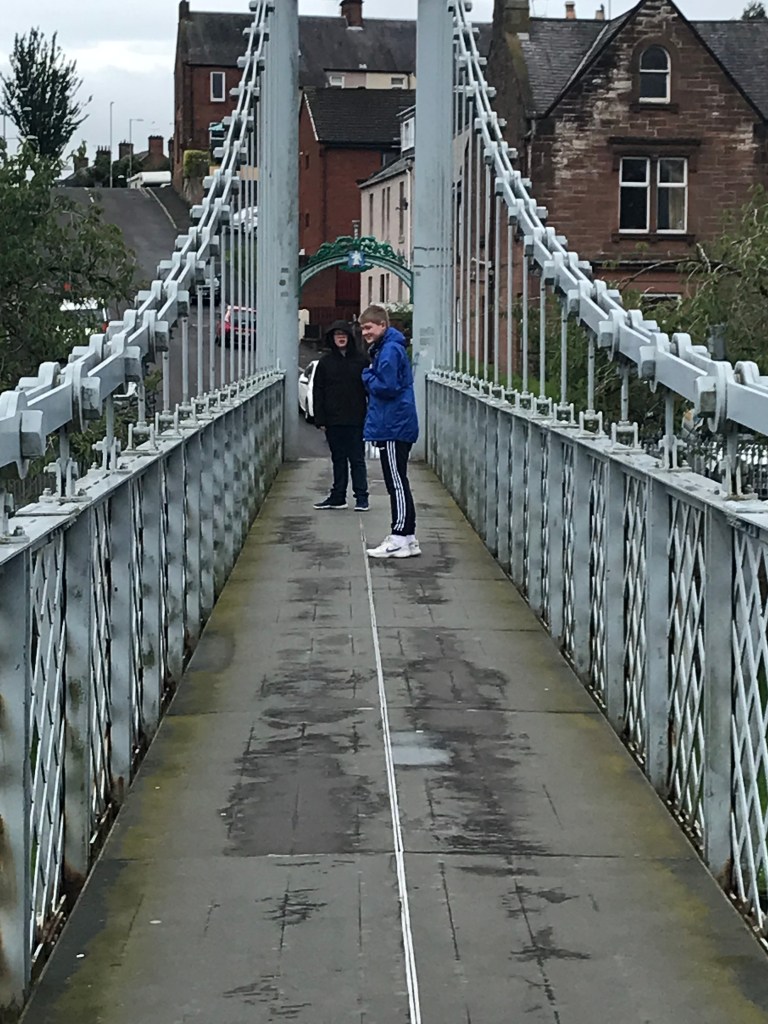
During our 2019 trip to Scotland, we visited Dumfries to meet fellow author and blogger, Mary Smith. Mary kindly showed us around her lovely town and I took a few pictures of some interesting doors.
This is what Wikipedia says about Dumfries:
“Dumfries is a market town and former royal burgh within the Dumfries and Galloway council area of Scotland, which in turn is part of the United Kingdom. It is located near the mouth of the River Nith into the Solway Firth about 25 miles by road from the Anglo-Scottish border and just 15 miles away from Cumbria by air.”
I thought this painted door was rather beautiful
Some pretty doors that caught my eye in Dumfries
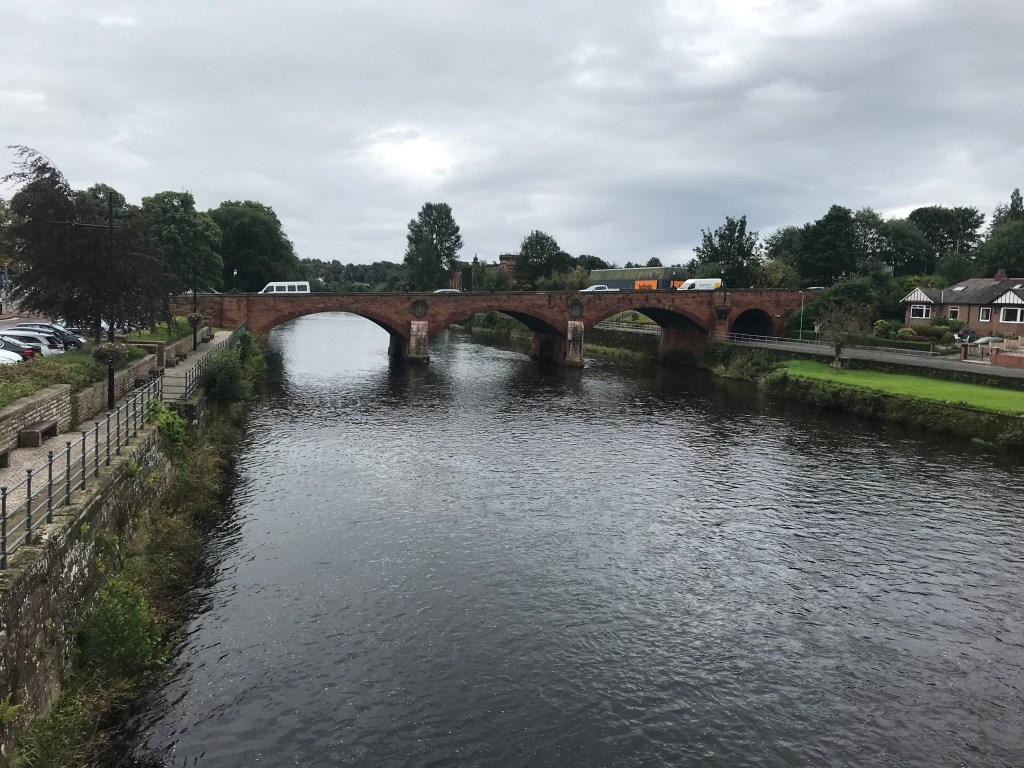
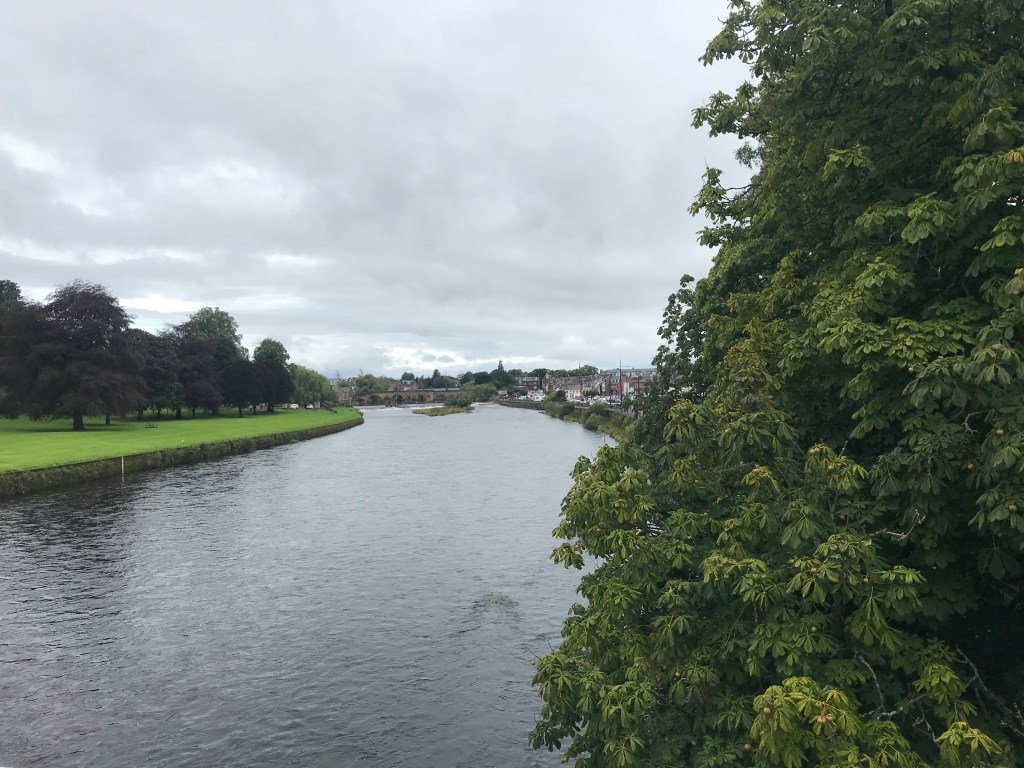
River Nith and the bridge across the river
Dumfries has a number of interesting museums and is famed for its connection with Scotland’s National Bard, Robert Burns. More about all these places next week. There is no Thursday Doors next week so my post will be a tour of Dumfries with no focus on doors.
One famous person I must mention in this post is Robert the Bruce.
“Robert the Bruce was one of the most famous warriors of his generation and eventually led Scotland during the First War of Scottish Independence against England. He fought successfully during his reign to regain Scotland’s place as an independent country and is now revered in Scotland as a national hero.”
In 1306, Robert was involved in the murder of John Comyn, his chief rival for the throne. This led to him being excommunicated by Pope Clement V (although he received absolution from Robert Wishart, Bishop of Glasgow).
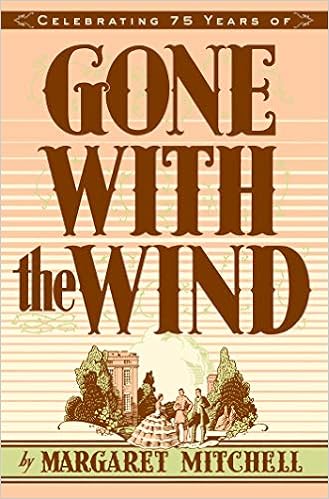
Since its original publication in 1936, Gone With the Wind—winner of the Pulitzer Prize and one of the bestselling novels of all time—has been heralded by readers everywhere as The Great American Novel.
Widely considered The Great American Novel, and often remembered for its epic film version, Gone With the Wind explores the depth of human passions with an intensity as bold as its setting in the red hills of Georgia. A superb piece of storytelling, it vividly depicts the drama of the Civil War and Reconstruction.
This is the tale of Scarlett O’Hara, the spoiled, manipulative daughter of a wealthy plantation owner, who arrives at young womanhood just in time to see the Civil War forever change her way of life. A sweeping story of tangled passion and courage, in the pages of Gone With the Wind, Margaret Mitchell brings to life the unforgettable characters that have captured readers for over seventy years.
My review
Gone with the Wind is a historical romance set in Georgia in the USA and covers a 12 year period starting in 1861 when the main character, Scarlett O’Hara, is only 16 years old and ends in Atlanta when she is 28.
The novel opens on the porch of Tara, a cotton plantation owned by Scarlett’s father, Gerald, who owns 100 slaves and is a wealthy man. Scarlett is entertaining the handsome Tarleton twins, Stuart and Brett, who have just been expelled from their latest University and have returned home to face the wrath of their mother. The twins are irresponsible and carefree and don’t care about their recent disgrace at all. They do fear their mother’s anger and are hiding out at Tara hoping to return home after she has retired to bed. The twins are full of mixture of small talk about their expectations of a war with the Yankees, their friends and acquaintances and a barbacue that is being held the following day at the neighbouring Wilkes plantation.
The first chapters of the novel highlight the relaxed and comfortable life led by the plantation owners and their complete lack of understanding as to what a war means. The attitudes of the Southern gentlemen towards the impending war is almost childlike in its simple idealism.
During the barbeque, Scarlett’s favourite boyfriend and the man she is angling to marry, Ashley Wilkes, announces his engagement to his cousin, the meek and delicate, Melanie Hamilton. Scarlett makes a bit of a fool out of herself by declaring her love to Ashley while the other ladies are resting. Ashley confesses that he returns her love but that he is better suited to Melanie as “she is like him.” The conversation is overhead by the disgraced social outcaste, Rhett Butler, who is at the party as the guest of one of the other gentleman. Scarlett is devastated and in a fit of spite she becomes engaged to Melanie’s brother, Charles.
During the afternoon, notice that war has been declared arrives at the Wilkes’ plantation and all the young men rush off in a spirit of enthusiasm to join the war effort. Within a 6 week period Scarlett is married, widowed and discovers she is pregnant.
After Scarlett’s son, Wade Hampton, is born, she moves to Atlanta to live with Charles’ aunt and Melanie. Ashely is away fighting in the war. The novel goes into great detail about life for civilians in Atlanta during the war and how the living circumstances of people quickly degenerated due to the Yankees blockading the port. This part of the story is very sad and dramatic as many of the young men Scarlett grew up with are killed on the battlefields including the fun loving Tarleton twins and their two brothers. Rhett does not volunteer to fight and becomes a blockade runner, bringing much needed food and other goods into Atlanta and profiteering hugely for this trouble. He pops up continuously in Scarlett’s life bringing her small gifts and making life more pleasant and bearable.
After the war ends, the story follows the path of Scarlett’s life as she struggles to survive in a state devastated by war and Sherman’s burned earth policy. Scarlett and her family suffer starvation, cold, illness, and also unfairness at the hands of the Yankee victors who demand unreasonable taxes on the land.
While the blighted romances between Scarlett and Ashely, who both spend years imagining they are in love with each other when they are both really clinging to memories of the past, and Scarlett and Rhett, who are well suited but unable to communicate, are central to the story, it is Scarlett’s strength of character and ability to overcome adversity by willpower alone that make this book such a good read. Scarlett turns her back on all the old fashioned ideas about women of her conservative and cossetted childhood and strikes out on her own to make money and support her family and friends. Her decision to place making money above everything else and her preparedness to tolerate the Yankees in order to gain their business, makes her the town pariah, along with Rhett Butler who has long occupied this unenviable position.
Although Scarlett shows some undesirable characteristics due to her complete lack of understanding of other people, their feelings and emotions, I found her to be an admirable and formidable lady. She has an excellent head for business and maths and is also a leader. Despite her faults, she shows remarkable loyalty and stays with the heavily pregnant Melanie when Atlanta falls to the Yankees despite her own fear. She delivers Melanie’s baby and manages to transport them all home to Tara.
Scarlett is very conflicted because she wants to be a great lady like her mother, but she must do unladylike things to obtain security and wealth. She is a peculiar mixture of the Old pre-war South and the New post-war South. Scarlett holds on to her love for Ashley as he embodies the spirit of the Old South for her and her girlhood memories are pleasant and he features at their centre. At the same time she lets go of virtues like honour and kindness in order to achieve wealth and success. She is unable to see that her love for Ashley is merely a teenage dream and doesn’t have any solid foundation. She is totally unsuited to Ashley and is perfectly suited to Rhett, who is a scoundrel just like her. Her stubborn inability to see the truth about the men in her life ends up ruining her relationship with Rhett.
Gone with the Wind has three main themes as follows:
The transformation of Southern culture
A relevant extract: “Throughout the South for fifty years there would be bitter-eyed women who looked backwards, to dead times, to dead men, evoking memories that hurt and were futile, bearing poverty with bitter pride because they had those memories. But Scarlett was never to look back.”
Overcoming adversity with willpower
“Hunger gnawed at her empty stomach again and she said aloud: “As God is my witness, as God is my witness, the Yankees aren’t going to lick me. I’m going to live through this, and when it’s over, I’m never going to be hungry again. No, nor any of my folks. If I have to steal or kill – as God is my witness, I’m never going to be hungry again.”
The importance of land
“The clay was cold in her hand and she looked at it again.
“Yes,” she said, “I’ve still got this.”
At first, the words meant nothing and the clay was only red clay. Bud unbidden came the thought of the sea of read dirt which surrounded Tara and how very dear it was and how hard she had fought to keep it – how hard she was going to have to fight if she wished to keep it hereafter.”
Have you read Gone with the Wind? Did you enjoy it?
Erin Robertson asked me about South African poets and while I do read some South African poetry, I am not very good at remembering the names of the poets. I felt rather embarrassed that I wasn’t able to remember any names and felt I’d missed an opportunity to showcase some of South Africa’s talent.
I reflected on this conversation and decided that I would share a few South African poets and their poems on my blog.
The first poem I am sharing is The Marble Eye by Mbuyiseni Oswald Mtshali. A short, but powerful, poem.
The Marble Eye
The marble eye is an ornament coldly carved by a craftsman to fill an empty socket as a corpse fills a coffin.
It sheds no tear, it warms to no love, it glowers with no anger, it burns with no hate.
Blind it is to all colours. Around it there is no evil to be whisked away with the tail of a horse like a pestering fly.
Oh! the marble eye – if only my eyes were made of marble!
The extended metaphor used by the poet to portray his desire for “a marble eye” to help him escape the harsh reality of his life has stayed with me ever since I first read this poem.
The poet is caught in a world of pain, anger, prejudice, and hatred from which he is unable to escape, even though he wishes to “whisk” away the evil he sees around him.
The final stanza and the exclamation Oh! emphasis the fact that the poet is unable to escape as he does not have a marble eye but rather real eyes that see everything all to clearly.
You can listen to my short recording of this poem here:
About Mbuyiseni Oswald Mtshali
Mbuyiseni Oswald Mtshali was born in Kwabhanya (Vryheid), KwaZulu-Natal in 1940. After completing secondary school in he went to Soweto hoping to study social work. Apartheid legislation prevented his enrolment but he studied via correspondence, obtaining a diploma with Premier School of Journalism and Authorship, affiliated to London University. He worked as a messenger in Johannesburg, drawing on his observations of the city to write the poems that became his first collection, Sounds of a Cowhide Drum. Published by Lionel Abrahams of Renoster in 1971, with a foreword written by Nadine Gordimer, this book went on to become the best-selling poetry book in South African history.
Welcome to Thursday Doors, a weekly feature allowing door lovers to come together to admire and share their favorite door photos from around the world. Feel free to join in on the fun by creating your own Thursday Doors post each week and then sharing your link in the comments below, anytime between 12:01 am Thursday morning and Saturday noon (North American eastern time).
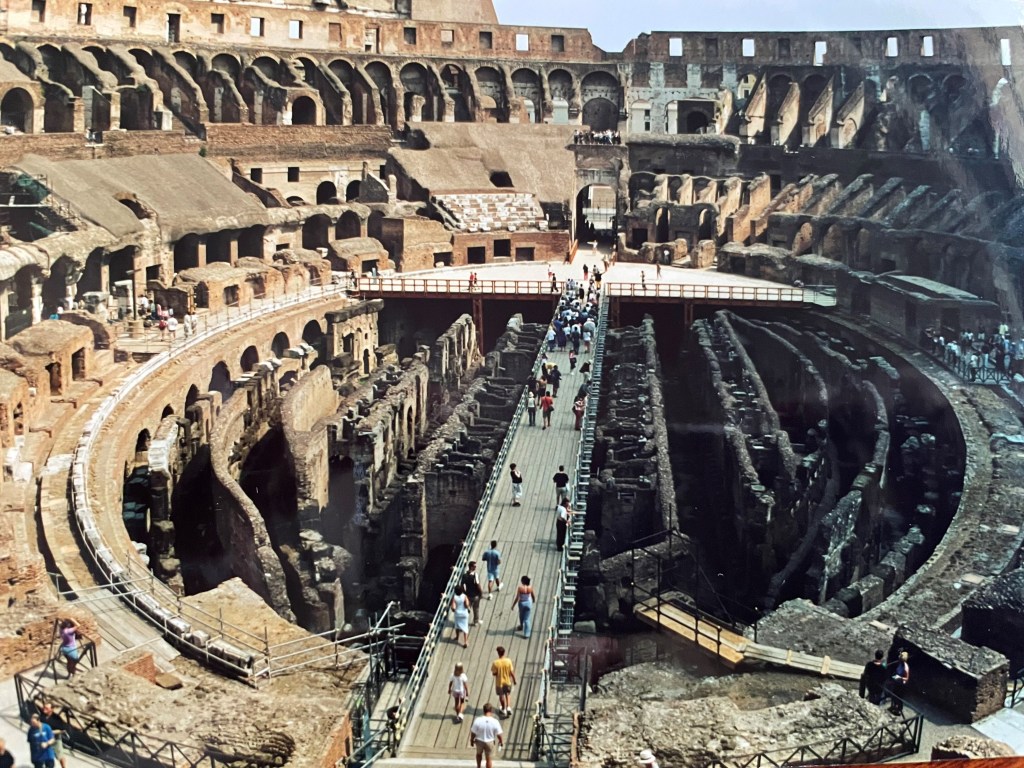
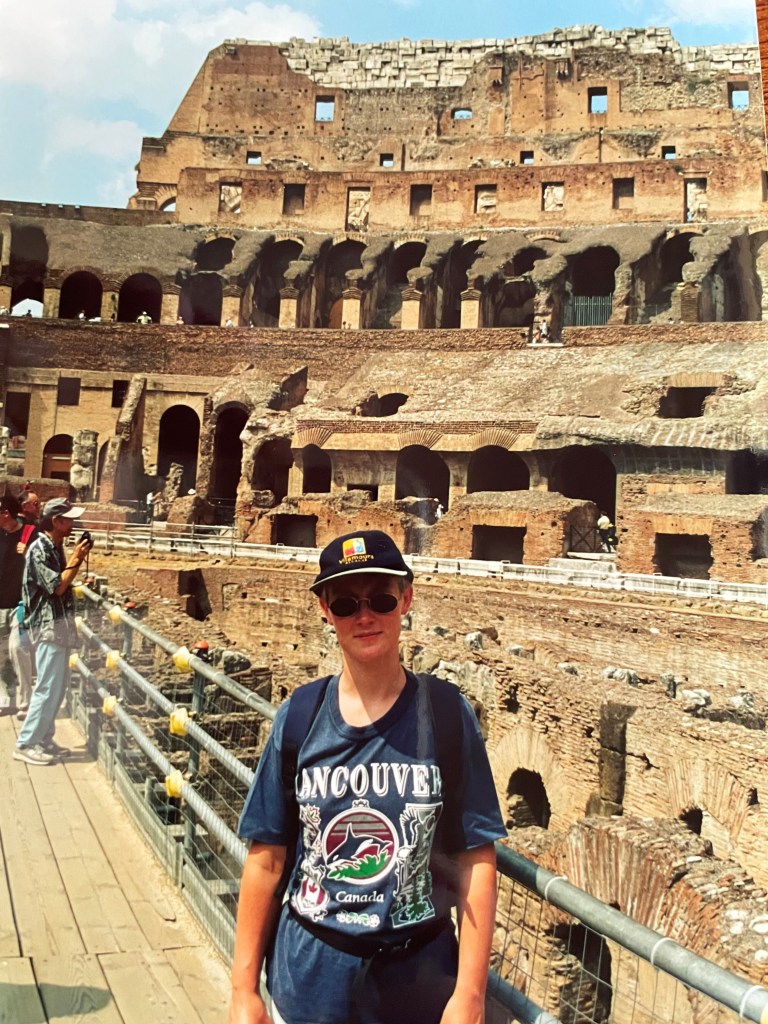
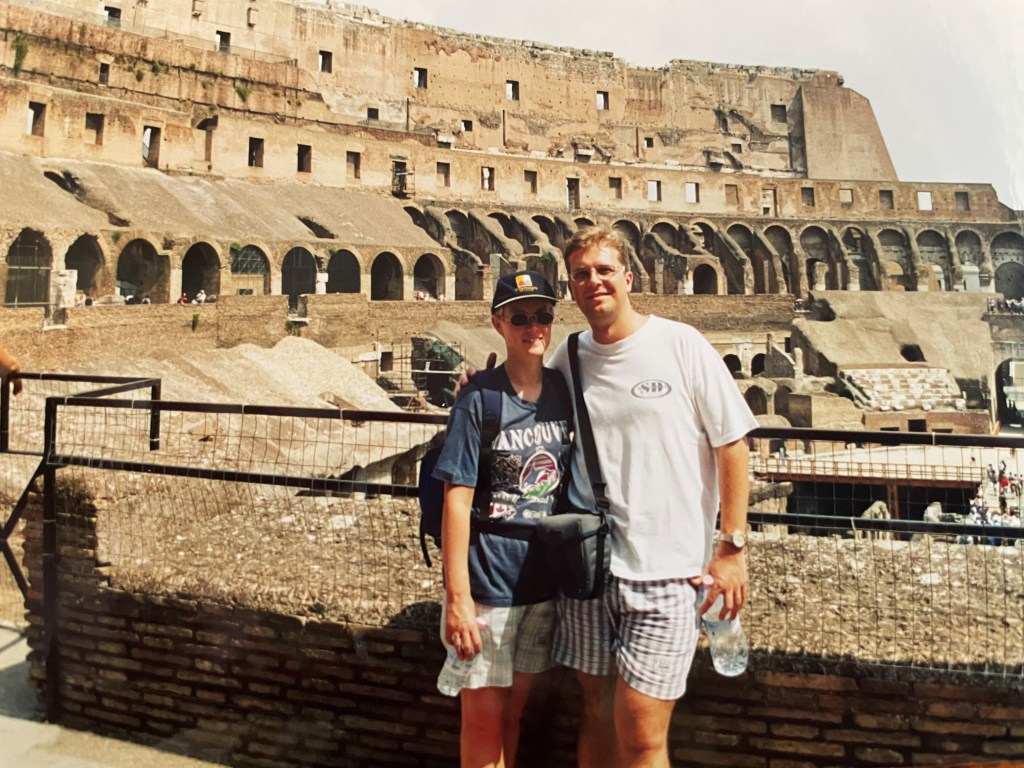
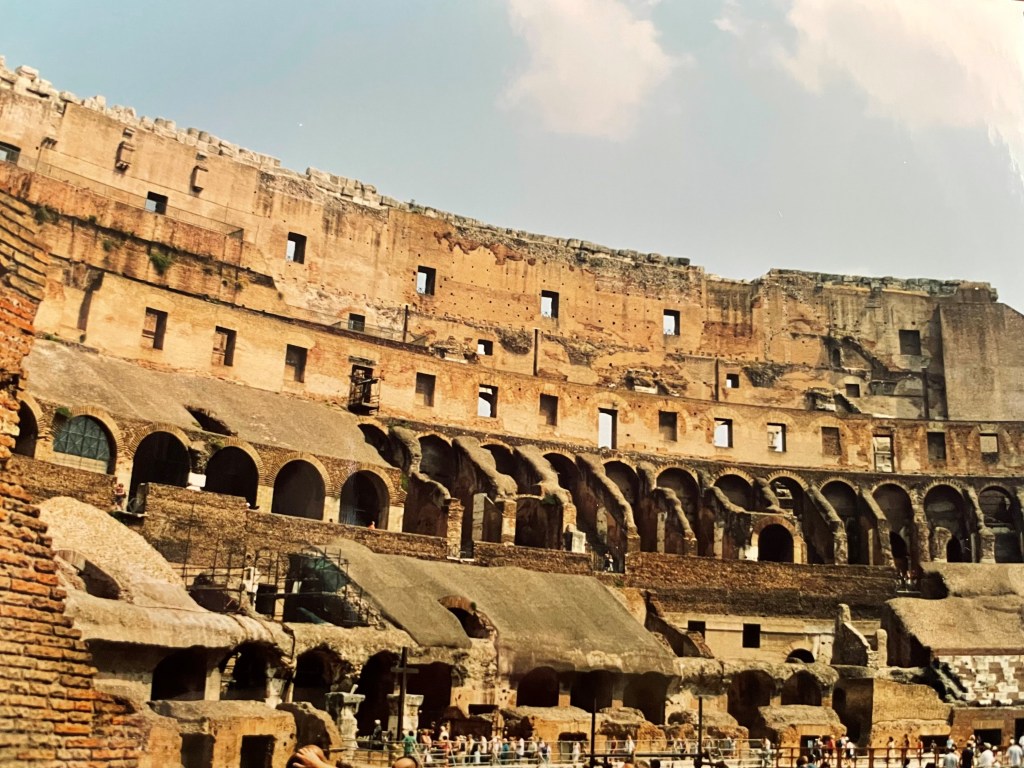
Terence and I went to Italy for our honeymoon in August 2001. We went on a tour for people over 25 years old and visited some marvelous places. These pictures were taken the old fashioned way with a camera that took film. I took picture of my photographs for this post. I should scan them but it takes ever so long so pictures of pictures had to do.
The Colosseum is an oval amphitheatre in the middle of Rome, Italy just east of the Roman Forum. It is the largest ancient amphitheatre every built and was completed in 80 AD during the reign of emperor Titus. According to Wikipedia, it was used for gladiatorial contests and public spectacles including animal hunts, executions, re-enactments of famous battles, and dramas based on Roman mythology, and briefly mock sea battles.
Are audiobooks the future of book sales? Do you have your stories on audio?
I am an audiobook fan. I buy at least 4 audiobooks a month and always have one on the go. I as buy audiobooks for Michael and encourage him to listen to them every day. He is my slower reader and audiobooks allow him to read more books than he would manage on his own. It takes Michael about one month to read one of his Rick Riordan books.
Greg, on the other hand, is a fast reader and will read several books during his holidays, galloping through them in a few hours or days, depending on their length and complexity.
So far this year, I’ve listened to Collected Stories and Poems by Edgar Allan Poe, The Invisible Man, To the Last Man, A Farewell to Arms, A Gentleman in Moscow, All Quiet on the Western Front, and Sunwielder. I am currently 85% of the way through Gone with the Wind and already have The Divine Comedy lined up as my next read, followed by Why by Daniel Kemp.
I love being read to almost as much as I love reading. I like to listen to classic books, in case you hadn’t noticed, as I listen slower than I read so I enjoy them more. Some more complex modern books are also better appreciated, in my opinion, as audiobooks and if they are available on Audible I buy them.
My own books are not available as audiobooks. This is purely because my publisher does not offer audiobooks and I like her very much so I am prepared to accept her view on this matter. Maybe one day I will have audiobooks as well as ebooks and paperback books.
Now to the question, are audiobooks the future of book sales? I don’t think so. I think audiobooks have their place in the literary world and I know people who also listen to audiobooks while they exercise, do housework, and other mundane tasks including driving. These people are not, however, the majority of the readers I know. Most readers seem to prefer paperbacks and ebooks. This may be a cost thing as audiobooks are a lot more expensive.
Luckily for me, my husband gifts me three Audible credits a month. Sometimes I run out and then I buy three more credits at approximately US$11 each. Most audio books are well over US$20 so it works out quite reasonably.
I gift my mom a lot of audiobooks too. She rests every afternoon and she likes to listen to audiobooks. Sometimes we share books but usually I buy her different books to the ones I like. She likes books like the Wheel of Time series and Game of Thrones, which I will never listen too. They are lovely and long and keep her entertained for a good few weeks.
As for the youth [meaning teenagers], well, they don’t really like any kind of traditional book. They like computer game stories. The games my sons play are very sophisticated and are scripted with complex plots, music, and lots of reading. They are almost like interactive books. I think these sorts of gaming stories will be a large part of the future of books.
There will, however, always be traditional books and readers in my opinion. The readers of the world have always been the minority of the population as reading doesn’t appeal to everyone. Like research, writing, playing a musical instrument, dancing, singing, sports, and acting, reading is not everyone’s cup of tea and that’s okay. It takes all kinds of people to make a world.
Rules:
Link your blog to this hop.
Notify your following that you are participating in this blog hop.
Promise to visit/leave a comment on all participants’ blogs.
Tweet/or share each person’s blog post. Use #OpenBook when tweeting.
Put a banner on your blog that you are participating.
Welcome to Thursday Doors, a weekly feature allowing door lovers to come together to admire and share their favorite door photos from around the world. Feel free to join in on the fun by creating your own Thursday Doors post each week and then sharing your link in the comments below, anytime between 12:01 am Thursday morning and Saturday noon (North American eastern time).
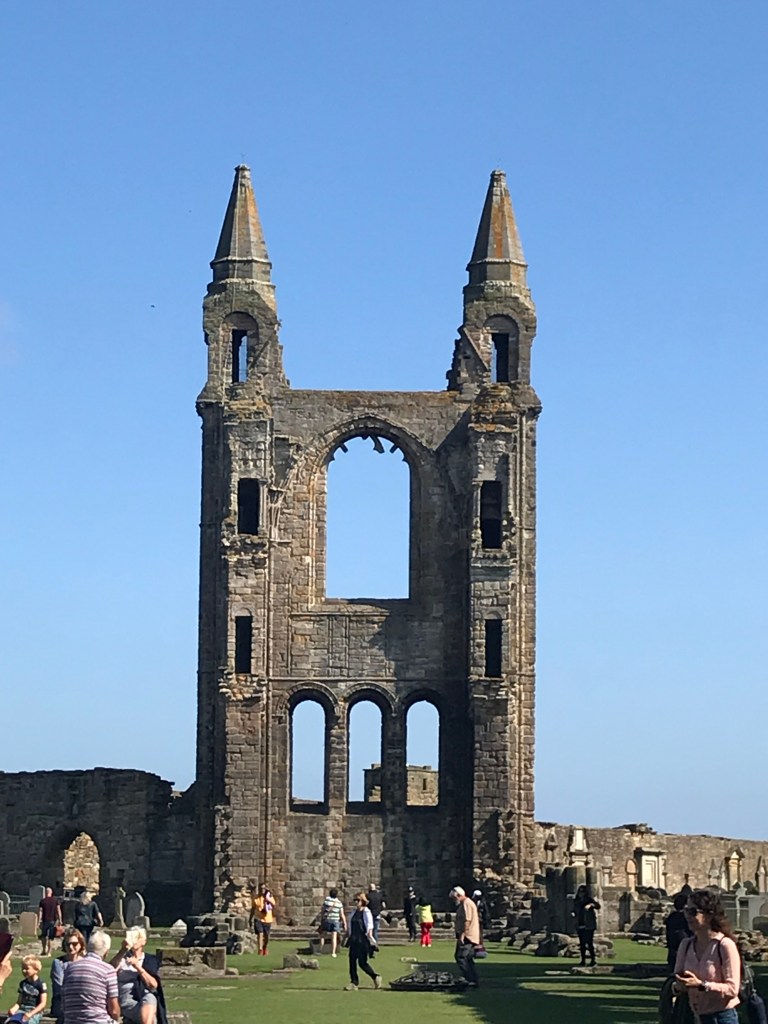
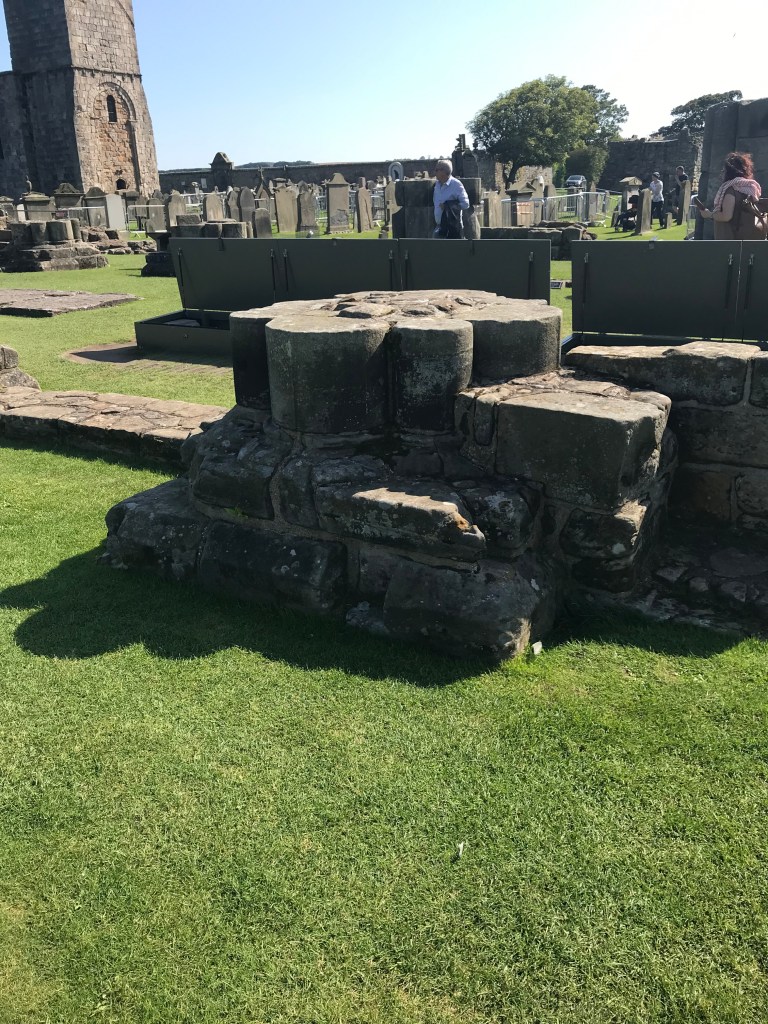
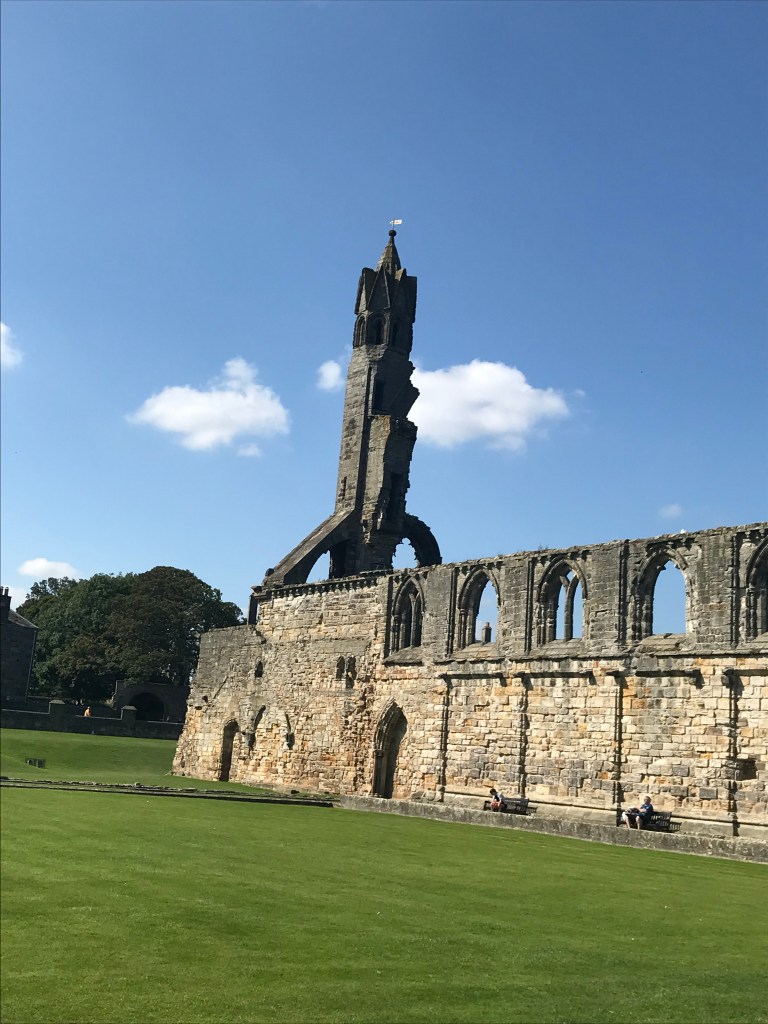
This week, I am going to share my pictures of the ruined St Andrews Cathedral.
According to Wikipedia, “[St Andrews Cathedral was built in 1158 and became the centre of the Medieval Catholic Church in Scotland as the seat of the Archdiocese of St Andrews and the Bishops and Archbishops of St Andrews. It fell into disuse and ruin after Catholic mass was outlawed during the 16th-century Scottish Reformation. It is currently a monument in the custody of Historic Environment Scotland. The ruins indicate that the building was approximately 119 m (390 ft) long, and is the largest church to have been built in Scotland.”
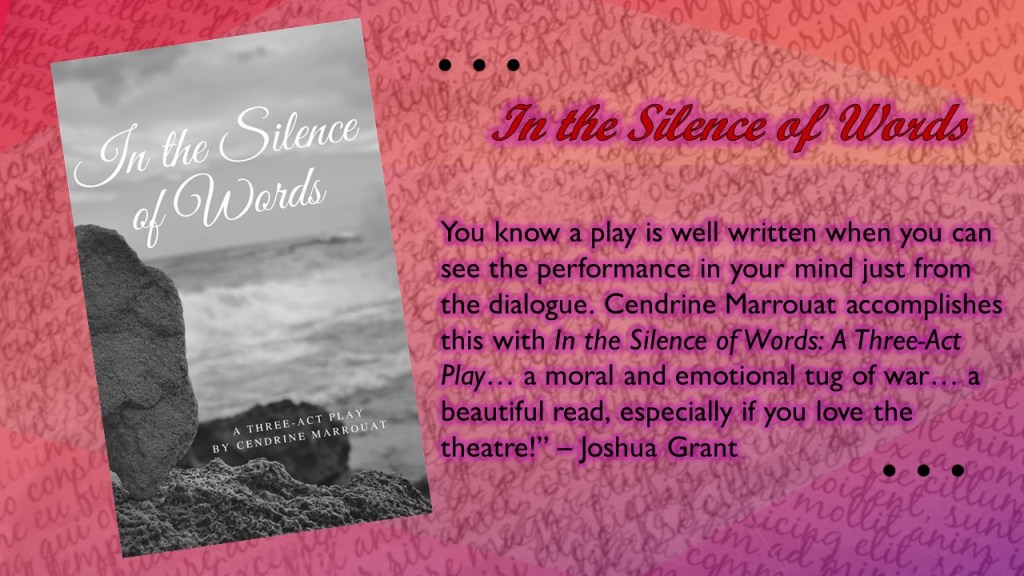
‘In the Silence of Words’: A Behind-the-Scene Look by Cendrine Marrouat
When I started my artistic career in 2005, I knew I wanted to be more than just a poet.
Theatre has always fascinated me. I studied many plays in high school and at university. One of the first things I realized is that theatre is an excellent genre to delve into difficult topics. The best playwrights have mastered the “show, not tell” approach. They sprinkle clues everywhere and force you to pay attention to details, so you can read between the lines and infer the overall meaning when needed.
In 2006, I was in the middle of my very painful depression. Poetry had started helping me heal, but I felt that a play would force me to reach deep within my soul to find the key to full healing. Further, I had never focused on a project for a prolonged period of time. It would be an interesting experiment for sure.
I wanted the play to be (very) loosely based on some major events in my life, including my mother’s suicide, so I could build a meaningful story and inspire those who might be in similar shoes. The storyline, topics, and title were already in my head. All I needed was to get started.
However, I wanted to do everything right. For several months, I read guides on playwriting, re-read several of my favorite plays, and did research into names. In the process, I became interested in using movement as a way to further the plot.
The first draft of In the Silence of Words took me seven months to write. It was an exhilarating experience: I lived every scene as though I was there. It felt like an out-of-body experience, allowing me to fully grasp my own journey and understand how to embrace my depression.
I showed the play to a couple of trusted friends. They too could picture everything in their minds. They could almost touch the characters! Their excellent feedback allowed me to make the story more impactful. A couple of rewrites later, the whole thing looked exactly the way I had envisioned it.
Since 2007, I have read In the Silence of Words once a year. The goal is to remind myself of my journey as a writer and as a depression-free person for more than ten years. I am very proud of this project, which has been instrumental in awaking my interest in other art forms since then.
There is a little of Cassandra Philip, the main character, in most of us. We spend years wondering what the world wants from us. Until one day, a series of events forces us to face our fears in a painful, but liberating way…
I hope you will enjoy In the Silence of Words and cannot wait to read your feedback!
Book details
In the Silence of Words: A Three-Act Play
Formats: ebook and paperback
Release date: 2018 (second edition 2021)
Availability: Everywhere books are sold, including Amazon, Kobo, Apple, Chapters-Indigo, Barnes & Noble, and FNAC. Readers are encouraged to support independent bookstores: https://creativeramblings.com/books/.
It’s the beginning of September. 30-year-old Cassandra Philip has just lost her mother. The secret she uncovers shortly after the funeral resurrects the ghosts of the past, while threatening the present and shattering her pre-conceived notions of what the future is supposed to hold…
In the Silence of Words is not just a story of loss. It also questions the validity of personal sacrifice in a world that seeks to preserve the status quo over the needs of the soul.
Author bio
Cendrine Marrouat is a French-born Canadian photographer, poet, and the multi-genre author of more than 30 books. In 2019, she founded the PoArtMo Collective and co-founded Auroras & Blossoms with David Ellis. A year later, they launched PoArtMo (Positive Art Month and Positive Art Moves) and created the Kindku and Pareiku, two forms of poetry.
Cendrine is also the creator of the Sixku, the Flashku, and the Reminigram. Cendrine writes both in French and English and has worked in many different fields in her 17-year career, including translation, language instruction, journalism, art reviews, and social media.
I listed to the audio book of the Collected Stories & Poems by Edgar Allan Poe. I was drawn to listen to his works for the following reasons:
Poe is regarded in literary histories and handbooks as the architect of the modern short story and his story, The Murders in the Rue Morgue, is considered to be the first modern detective story;
Poe was the principal forerunner of the “art for art’s sake” movement in 19th-century European literature; and
Poe wrote tales of mystery and the macabre which is a genre I particularly enjoy.
The stories and poems included in this collection are: “The Raven”, “The Cask of Amontillado”, “The Tell-Tale Heart”, “The Black Cat”, “The Bells”, The Fall of the House of Usher”, “Manuscript Found in a Bottle”, “The Sleeper”, “The Man of the Crowd”, “The Pit and the Pendulum”, “Annabel Lee”, “The Man That Was Used Up”, “The System of Doctor Tarr and Professor Fether”, “The Oval Portrait”, “Eleonora”, “The Facts in the Case of Monsieur Valdemar”, “Berenice”, and “The Murders in the Rue Morgue”.
In this review, I am going to comment on the stories that I had not heard of before listening to this collection.
The Cask of Amontillado is a story of revenge and secret murder featuring two characters, Montresor and Fortunato. Montresor is the narrator of the story and starts by explaining that a man called Fortunato has wronged him numerous times but that his recent insult is the last straw that has driven him to make a vow of revenge.
Fortunato is a wine connoisseur and Montresor comes across him at a carnival. Fortunato is dressed as a jester and is very drunk. He is also pleased to see Montresor and does not suspect that he is plotting to kill him. Montresor entices Fortunato to come home with him and see a barrel of wine he has acquired. Fortunato agrees to accompany him and they enter the catacombs underneath Montresor’s home where his ancestors are buried.
The story is beautifully plotted and told and full of little details that fill the reader with horror as Montresor’s evil plan becomes more obvious. I enjoyed the auditory descriptions of the bells on Fortunato’s jester costume ringing and the clanking of his chains in the darkness of the crypt.
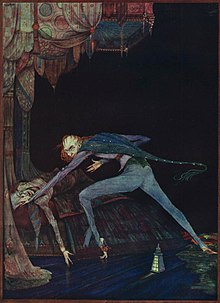
Illustration by Harry Clarke, 1919
The Tell-Tale Heart was my favourite story in this collection because of the psychology of the murderer. I am fascinated by what goes on in the minds of serial killers and other murderers and how they justify their actions in their own heads.
The story starts with an unnamed narrator stating that he is nervous, but that he believes he is not mad. He says he is going to tell a story in which he will confess to murder but which will prove his sanity. The narrator is terribly afraid on the pale blue eye of an old man he knows. Every night he spies on the old man while he is sleeping. A week later, the narrator decides to kill the old man and rid himself of the watching eye.
When the narrator arrives to commit the murder, the old man hears him and is very afraid. The narrator fancies he can hear the old man’s heart beating. Fearful that the old man’s neighbour’s can also hear the beating sound, he attacks and kills the old man. He then dismembers him and buries him beneath the floorboards.
A short while later the police arrive after being summonsed by a neighbour who hear the old man cry out before he died. The narrator leads the police all over the house but when he shows them into the old man’s bedroom, where his body lies beneath the floor, the sound of a beating heart fills his ears getting louder and louder.
Poe’s ability to demonstrate the disintegration of the narrator’s mind in such a few number of words is quite incredible and he shows himself to be a master story tale. This story was particularly unnerving and creepy for me.
Illustration by Harry Clarke, 1919
The system of Doctor Tarr and Professor Fether is a darkly satirical tale about a young doctor who chances to pass a famous mental asylum and decides to stop and enquire about the famous ‘soothing system’ implemented by the asylum’s director. In terms of this system, patients are not punished for misconduct and are given extensive freedom to wander the premises. They are also allowed to wear customary clothing and not hospital garb.
The young doctor meets the proprietor of the psychiatric hospital, Monsieur Maillard, and his niece. The narrator initially thinks the young woman might be a patient of the hospital but Monsieur Maillard rectifies his thinking and tells him that the soothing system has been abandoned as a failure. Maillard does not tell him what system has replaced the soothing system but rather invites him to dinner at 6pm. During the dinner, Maillard confides to the narrator that they asylum is now using a system of Tarr and Fether, which is much stricter than the old soothing system.
I enjoyed this story and the use of the extended metaphor relating to Tarr and Fether. As a reader, it quickly became apparent that the narrator was being completely conned by Maillard and the other dinner guests, but he just cannot see it. The ending is not unexpected to the reader the the actions of the narrator are mystifying.
This collection also includes some of Poe’s best poems, including my favourite, The Sleeper.
You can listen to my recital of The Sleeper here:
Purchase Collected Stories & Poems by Edgar Allan Poe from Amazon US
Have you read Poe’s works? Which is your favourite?
If your character wanted to wear adisguise, how wouldthey dress?
This is a bit of a tricky question for my characters as many of them are historical and would not have had the opportunity to change their style of dress.
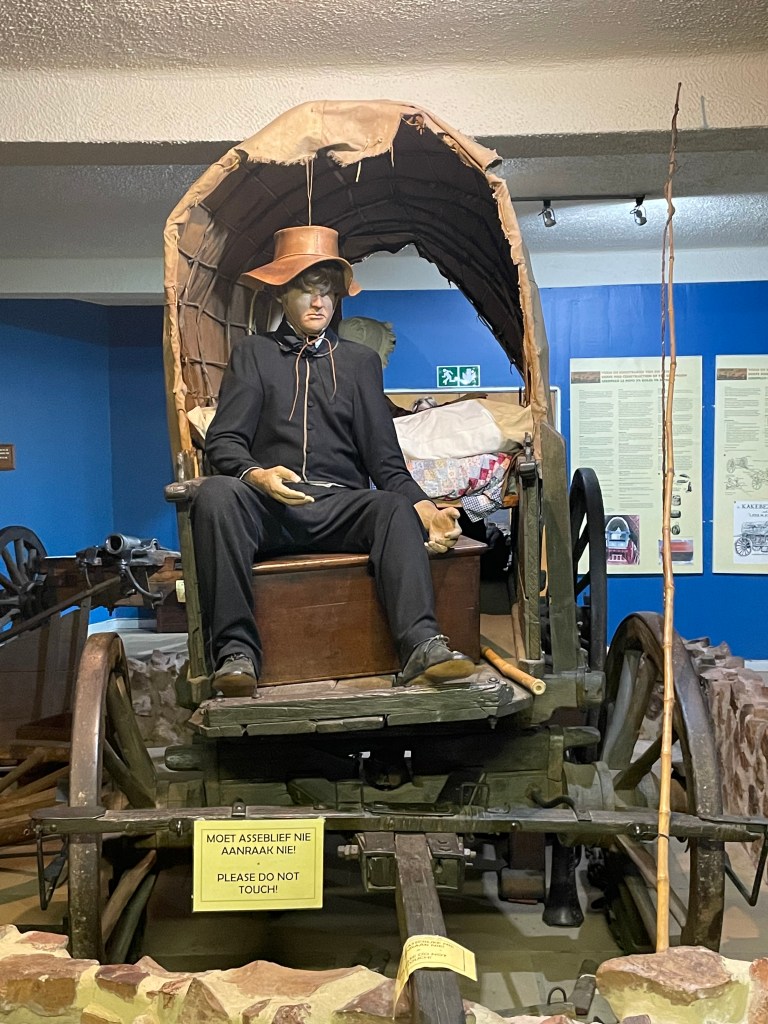
In A Ghost and His Gold, Pieter the Boer (farmer) and Estelle the Boer Meisie (farm girl) would have dressed in the traditional clothing of the time which would have been made by Marta, Pieter’s wife, and his daughters, including Estelle.
Typical everyday dress for Boer men consisted of flaptrousers of skin or moleskin with a waistband or a pair of braces, a cotton or woolen shirt, a waistcoat of cotton or wool, a neckcloth, a jacket of moleskin, velskoens (skin shoes) without socks and a broad rimmed hat.
Men’s Sunday church outfits comprised of velvet flap-trousers, a shirt of fine white linen, a waistcoat of velvet, brocade, silk or satin, a cloth frock-coat or velvet jacket, bow-tie, socks and velskoens as well as a top hat.
This was the attire everyone wore so the disguise would have been in looking just the same as all the other Boers and fitting in if you were an infiltrator. Of course, a British soldier would have also needed to speak Afrikaans without an English accent…
Women and girls wore dresses with a narrow bodice and wide skirt of flowered, striped or checked chintz, an apron, a neckcloth of silk or silk tafetta, mittens and a linen bonnet. Their shoes, usually worn without socks, were made of goat or sheep skin.
Girls dresses were a little shorter than their mothers.
Women’s Sunday church outfits consisted of a dress of silk, satin or velvet with a cashmir shawl. Older women wore mantlets (a woman’s short, loose sleeveless cloak or shawl). White cotton socks were worn with their shoes and a bonnet or hat of silk, velvet or straw.
Girls often went barefoot.
Picture of a Boer driving his wagonPicture of a Boer Vrou in the back of the wagon
Rules: 1. Link your blog to this hop. 2. Notify your following that you are participating in this blog hop. 3. Promise to visit/leave a comment on all participants’ blogs. 4. Tweet/or share each person’s blog post. Use #OpenBook when tweeting. 5. Put a banner on your blog that you are participating.
Welcome to Thursday Doors, a weekly feature allowing door lovers to come together to admire and share their favorite door photos from around the world. Feel free to join in on the fun by creating your own Thursday Doors post each week and then sharing your link in the comments below, anytime between 12:01 am Thursday morning and Saturday noon (North American eastern time).
St Andrew’s is a town near Edinburgh in Scotland. The town is famous for the University of St Andrews and is known as the worldwide ‘home of golf’.
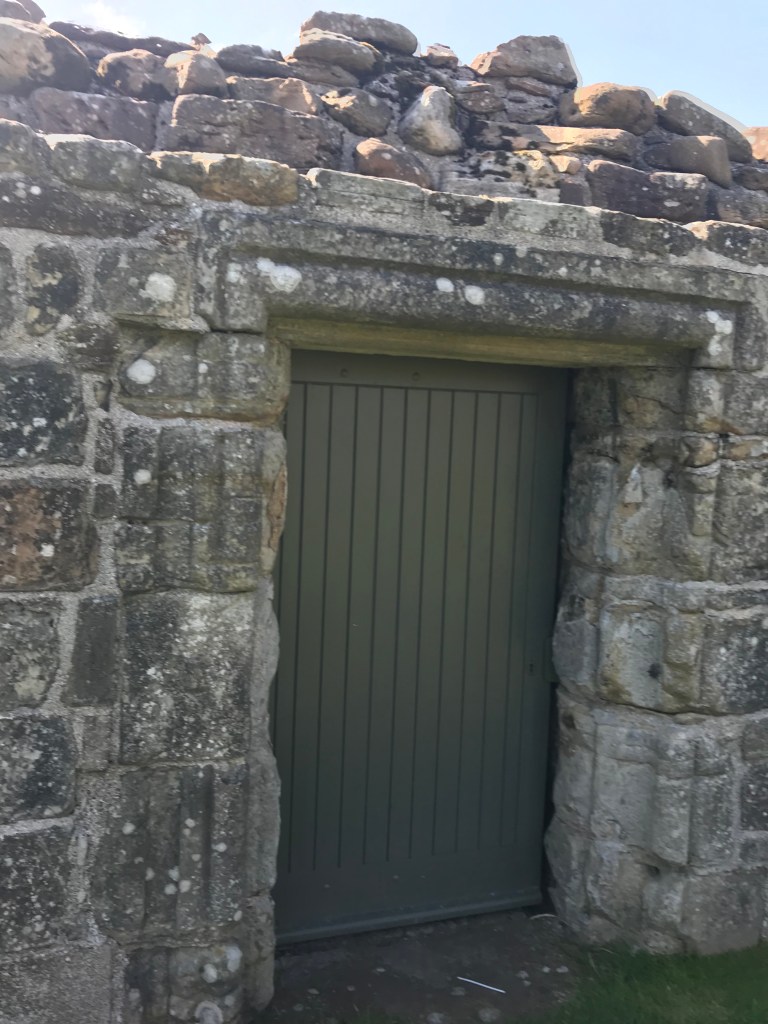
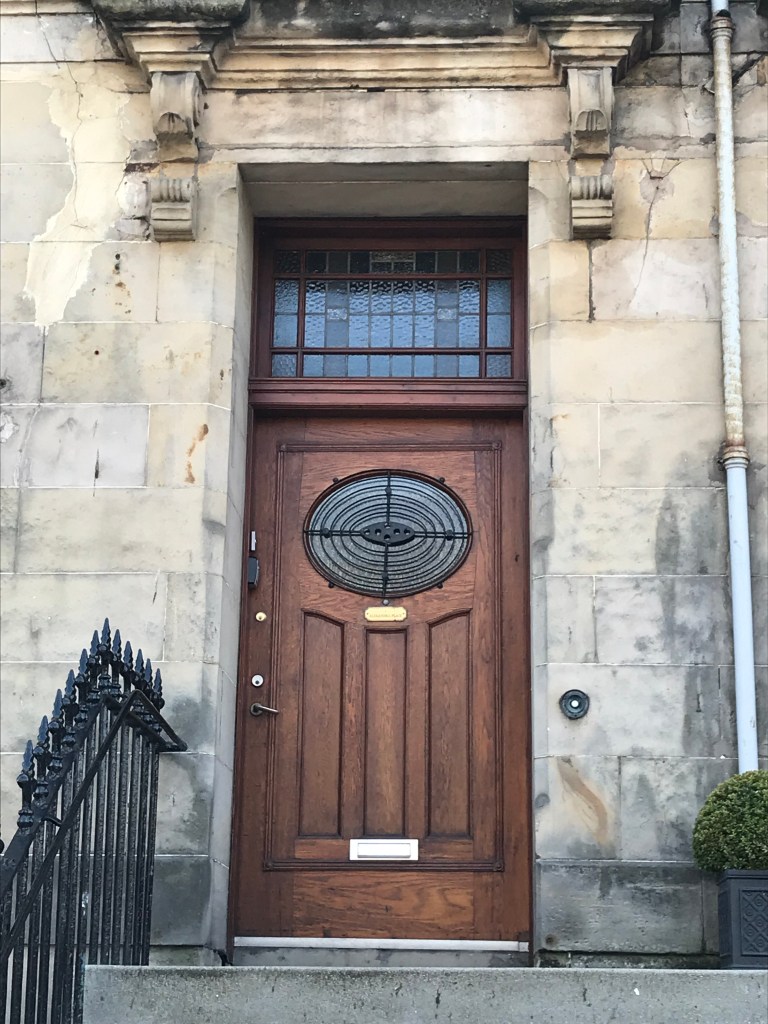
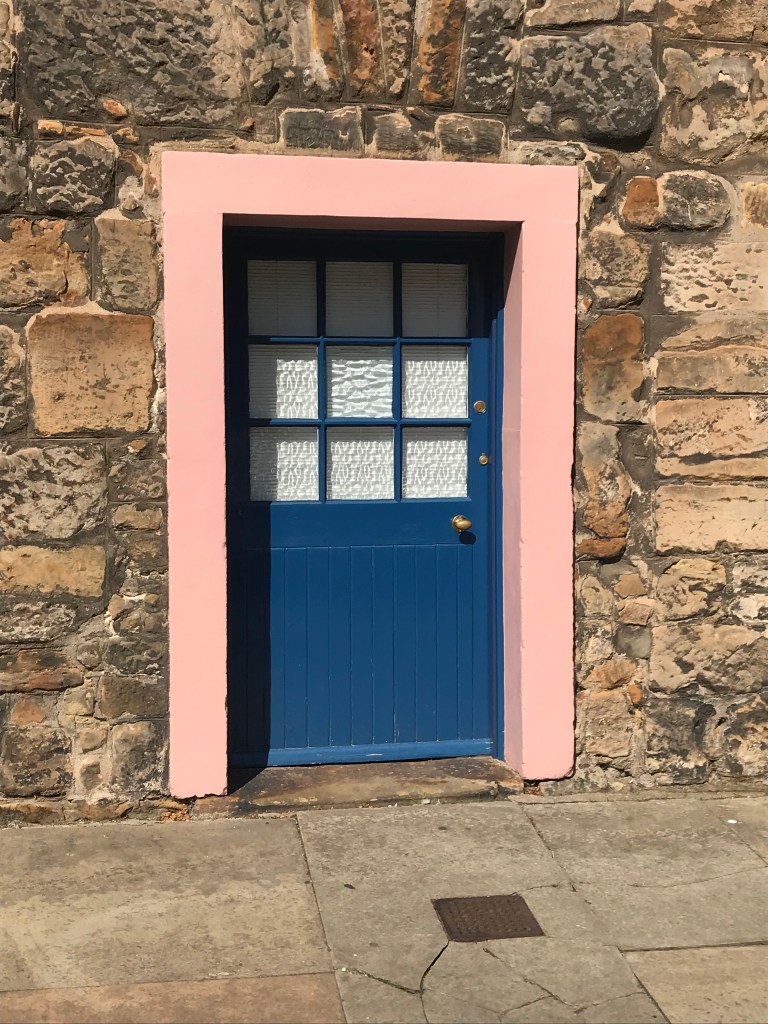
Here are a few pictures of the doors around St Andrews town:
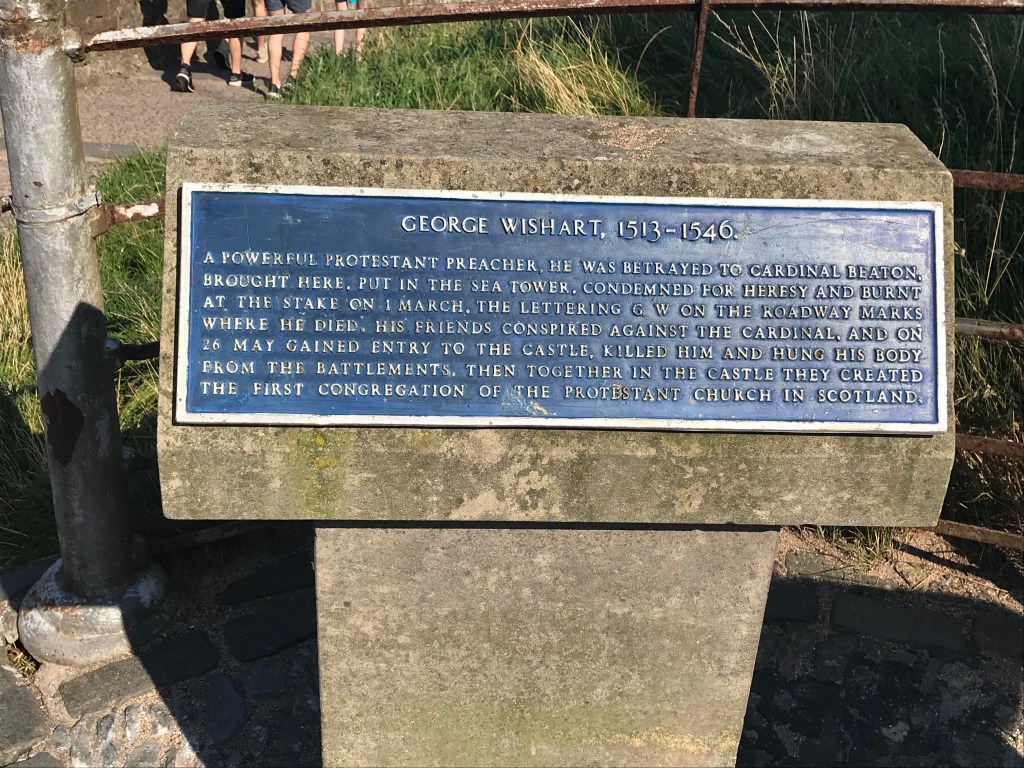
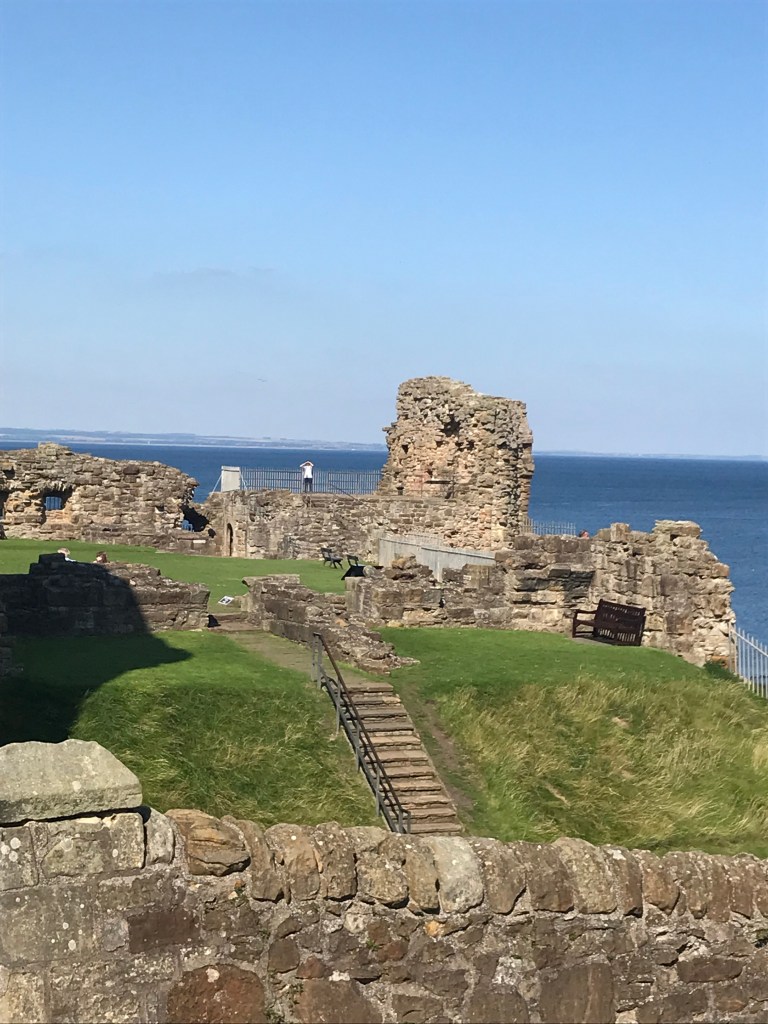
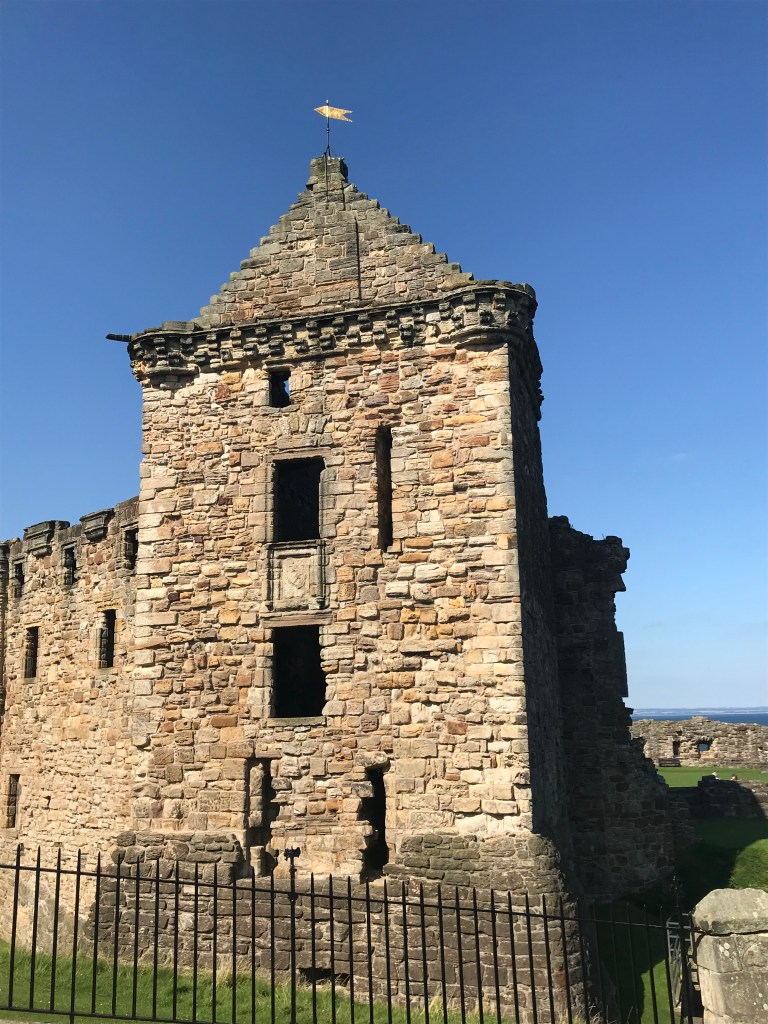
St Andrews Castle
Wikepedia says:
The ruins of St Andrews Castle are situated on a cliff-top to the north of the town. The castle was first erected around 1200 as the residence, prison and fortress of the bishops of the diocese. Several reconstructions occurred in subsequent centuries, most notably due to damage incurred in the Wars of Scottish Independence.
The castle was occupied, besieged and stormed during The Rough Wooing and was severely damaged in the process.
The majority of the castle seen today dates to between 1549 and 1571. The work was commissioned by John Hamilton (archbishop of St Andrews) in a renaissance style which made the building a comfortable, palatial residence while still remaining well-fortified. After the Reformation, the castle passed to several owners, who could not maintain its structure and the building deteriorated into a ruin. The castle is now a scheduled monument administered by Historic Environment Scotland.





















 roberta-writes.com
