Today I have a real treat for you. An interview with ultra talented fashion designer, artist, and photographer, Resa McConaghy.
Resa has kindly shared some of her drawing and art secrets and a myriad of her amazing drawings and fashion designs.
Thank you, Resa, for this amazing interview.
Resa is also a talented writer and her book, Nine Black Lives, is available for free download on her blog here: https://graffitiluxandmurals.com/artists/
You can find Resa on her art and murals blog here: https://graffitiluxandmurals.com/
AND
on her amazing Art Gowns blog here: https://artgowns.com/
You have a great talent for drawing figurines and portraits. What attracts you to this particular subject matter?
This begins with my background in fashion design. The college course I took was in Design and Technology, not illustration. However, a tiny part of the course was dedicated to fashion illustration.
During my time in film, I utilized drawing to explain to directors what I was up to. The drawings were only okay, but they got the design across.
It was blog pal, Holly (House of Heart), who got me drawing fictitious characters for fun, via gagging around in comments.
It started with Boogapony Holly, a character who did a Go-Go dance in front of street art and graffiti, then became a new age Love Child.
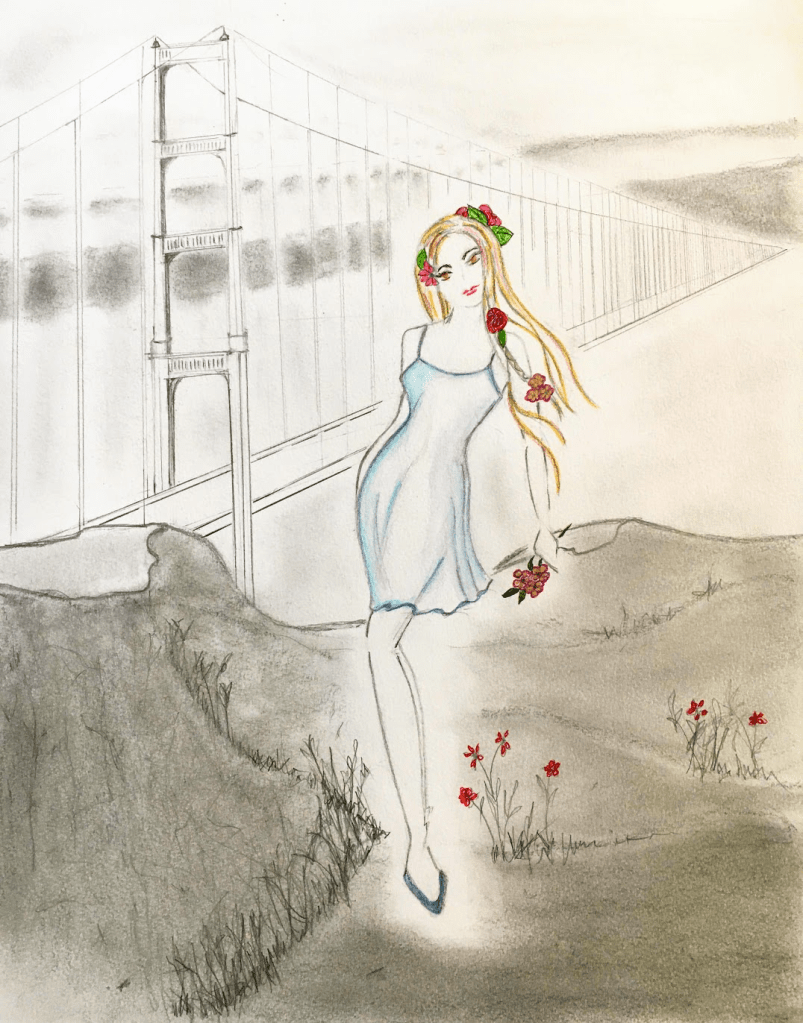
Above: Boogapony as a Love Child by the Golden Gate Bridge.
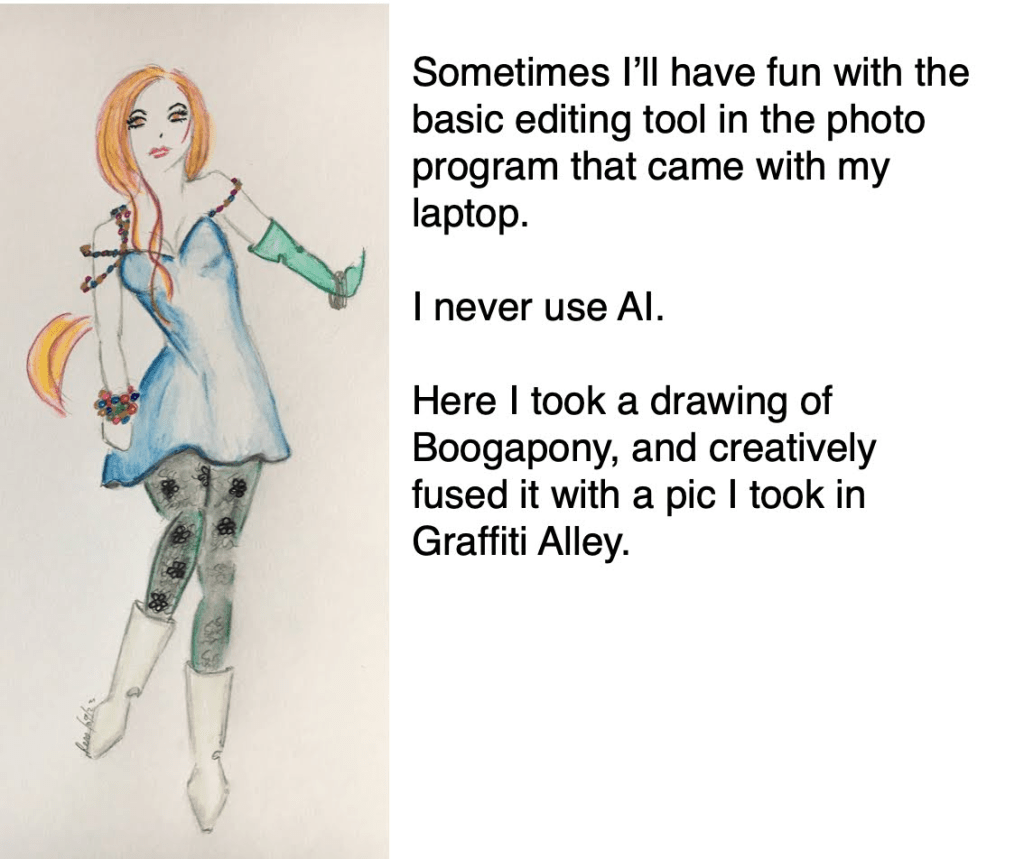
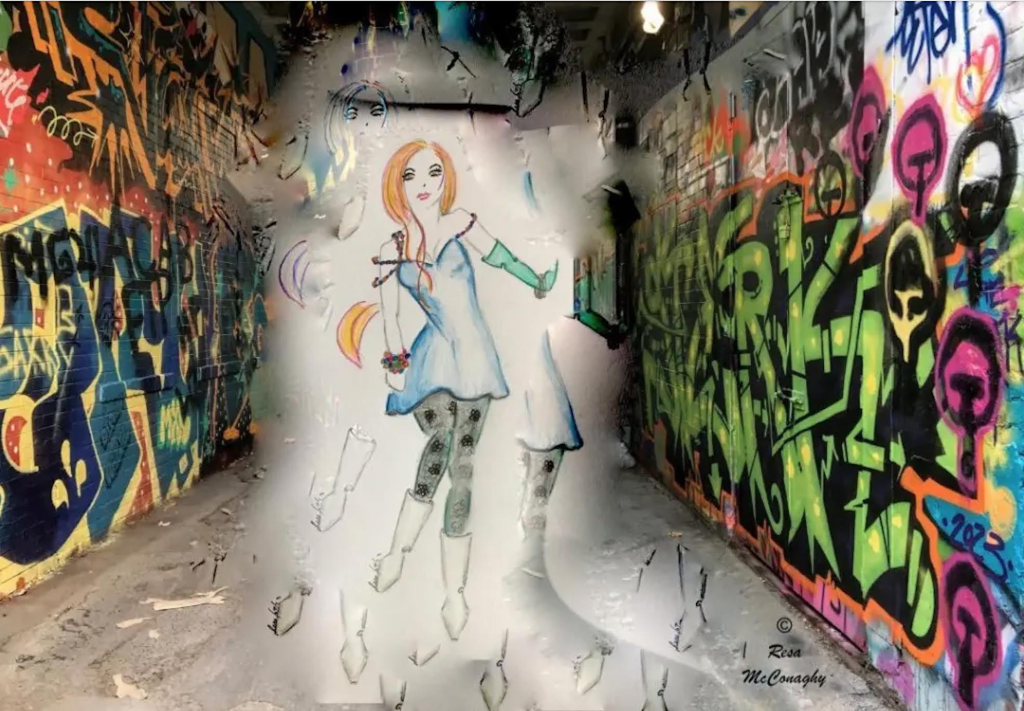
From there, Holly and I created a Super Hero – Princess Blue Holly. Drawing had become a lot of fun at this point.

Above – First Princess Blue Holly drawing – 2019 and More recently PBH dominates an evil puppet. PBH changes outfits for each “Gowntoon” mission. Then I began drawing Art Gowns on some blog pals, to become part of the stories.
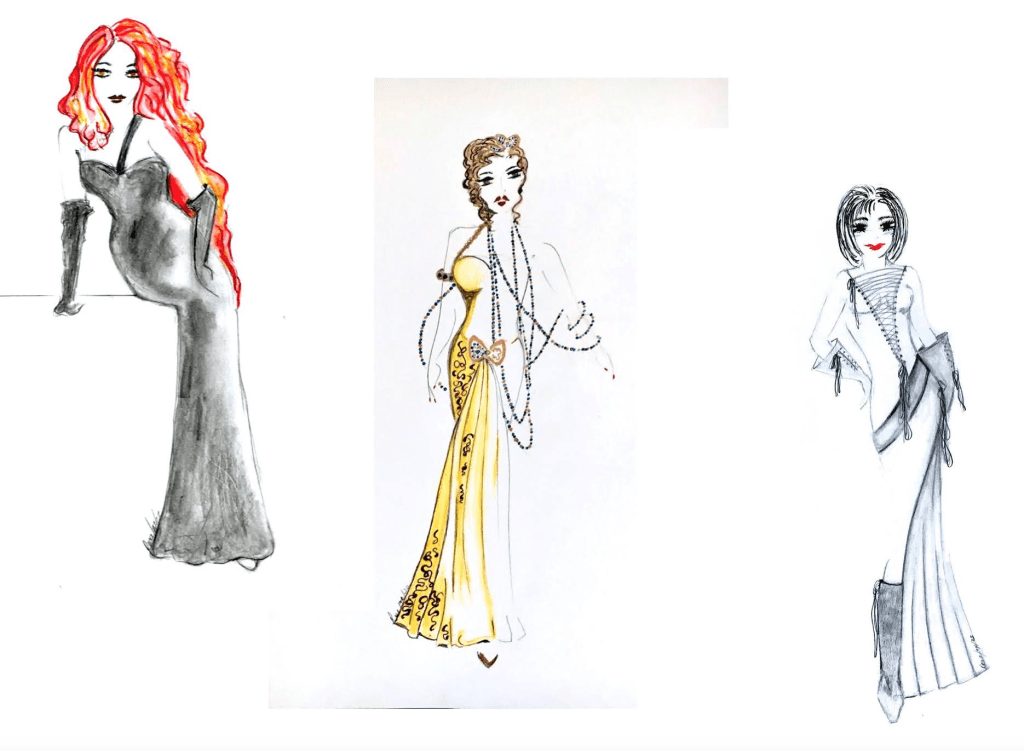
Above: Models Holly (as RR) Shey and Dale
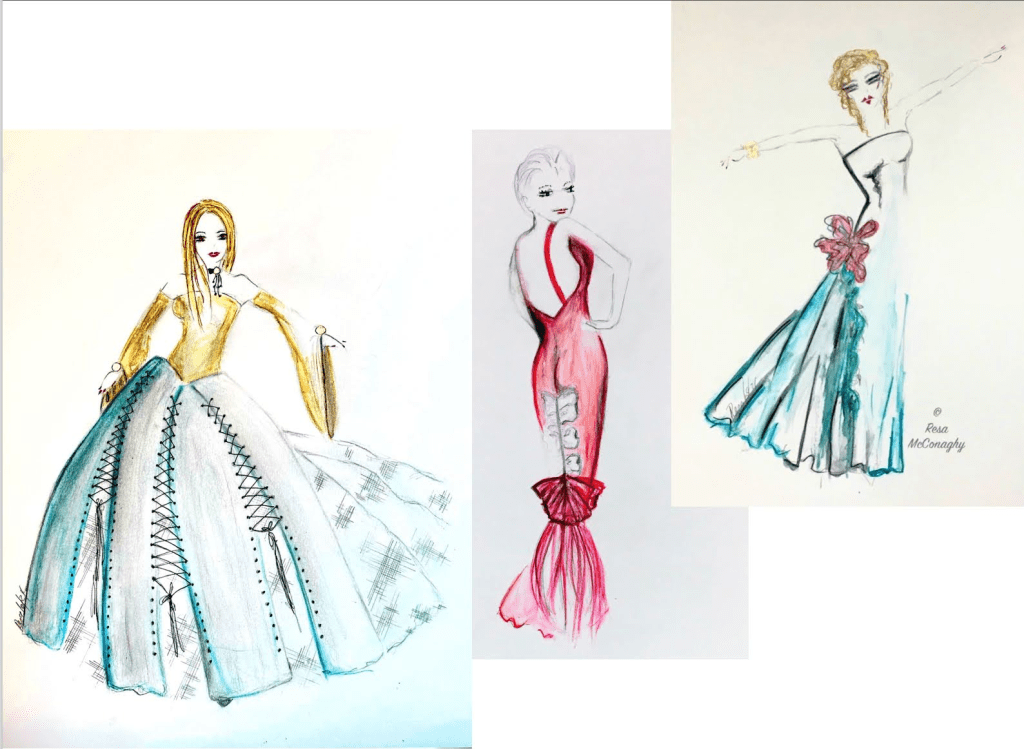
Above Models – Holly, Gigi and Marina
Do you have a particular method you use for drawing figures? Do you start with any particular body part? Do you complete the outline of the entire figure and then add the details?
Yes!
I start with an oval for the head. Then, it’s the gesture. I do a few swooping lines to capture how the body feels as it poses.
If the feeling is cool, then I do a few lines for shoulders, bust, waist, hips and feet.
If I haven’t ruined the feeling of the gesture a this point, I continue with details. If I lose the feel, I usually stop.
You clothe many of your figures in intricate and detailed dresses, some of which are period designs. How do you go about researching clothing from particular period? I have tried to research clothing for both men and women from varying time periods and have found it quite difficult to get good details and pictures.
So, the study of Fashion Design & Technology included “Fashion History”. So, how did they get the clothes to look like that, in any era? Well, that’s where the technology comes in.
Example: The Renaissance – pattern cutting was not a thing, clothes were draped. So, we learn about “how” they made clothes fit. Lacing up a square over a flowy under piece makes something fit. A corset is laced to make you fit it. The idea of a cup to fit a breast did not come about until the early 20th century.
Many types of pleats, gathers, tucks, etc. were use to make clothes drape over/fit body shapes. With the advent of patterns in the 1800’s, came darts to make clothing fit.
Once the newly formed middle class Victorians got their hands on patterns, they used the patterns over and over. That, along with the invention of the sewing machine, gave them time to go wild with embellishments: embroidery, trapunto, ruffles, flounces, beading, dying, appliqué, etc. Sure, all that was around before, but it was for the rich, only.
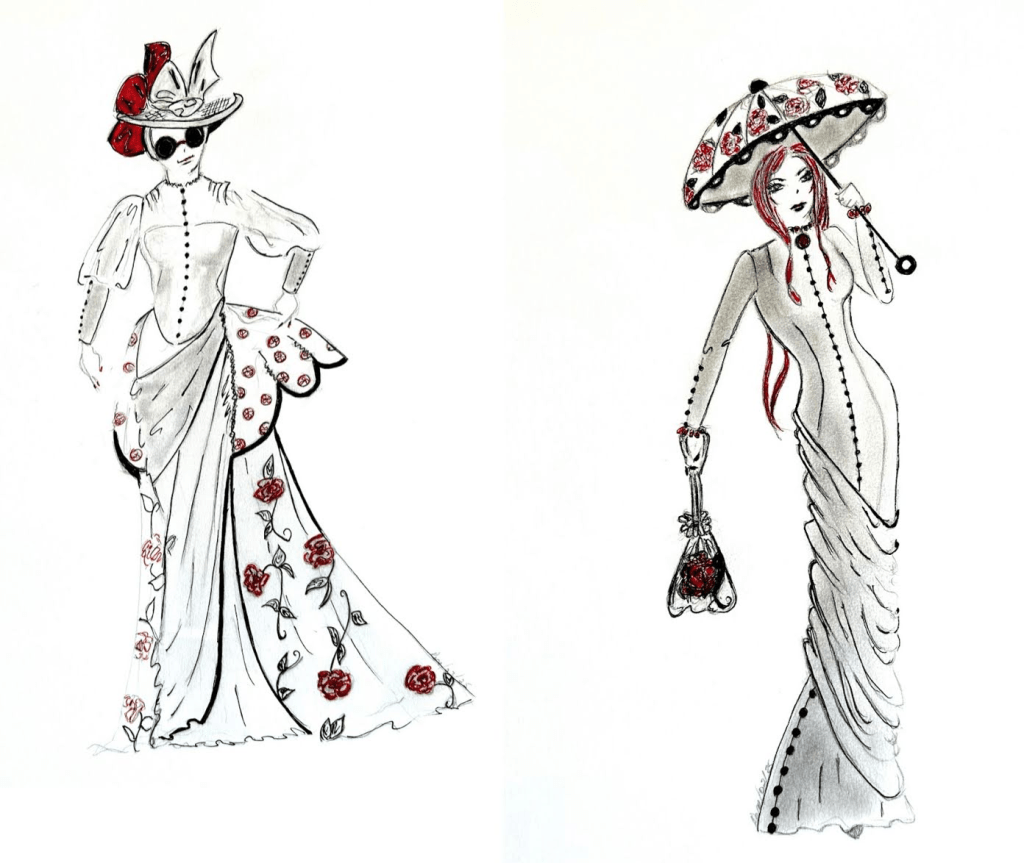
Above: Rebeca Budd (Art Gowns’ Gowntoons Art Director & Holly as RR, in Victorian outfits.
Also, Victorian times saw the advent of synthetic dyes, creating eras of popular colours going forth. Until then dyes were naturally derived from mollusk shells, beets, onion skins and various other plants and lifeforms.
Point is when you understand all of this, you can look at a painting from any era and know how they constructed that garment, therefore you can draw it. You can also design and draw whatever you want, from any era.
Portraits
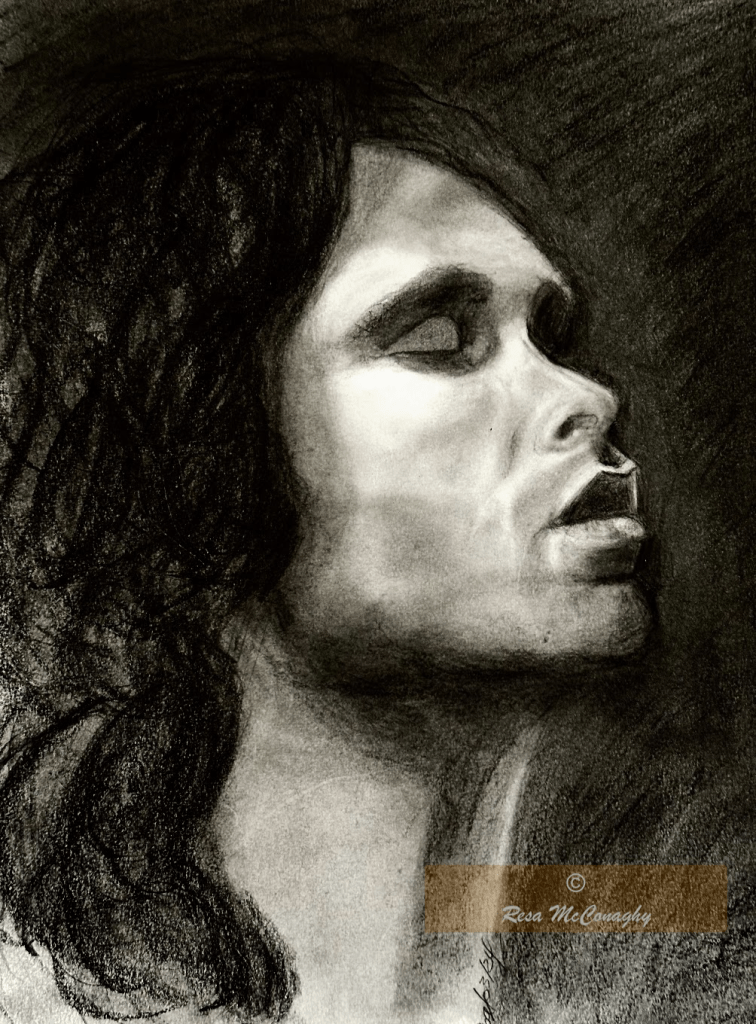
Above: Jim Morrison
I start with a photo of the person, and crop off the head to what I want. I print that out on 8 x10 paper. I draw crosshairs through the photo of the face. I do the same on a page of 11 x 14 drawing paper.
I begin where the crosshairs meet. That is usually where an eye, between the eyes or top of the bridge of the nose is, and rough that in. From there I rough in the rest of the eyes, brows, nose, top of head, lips and chin. I tried using a grid, but that never works for me. I lose the feel of the face, the expression. Without feel the portrait does not become the person.
Then it’s a series of refinements.
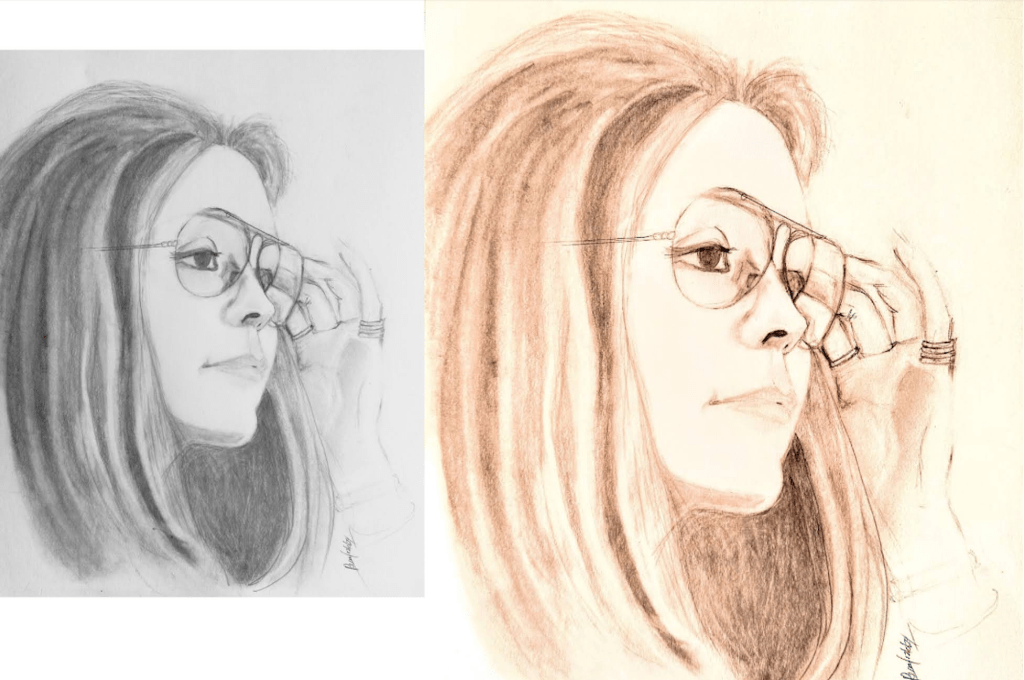
Above: Gloria Steinem pencil drawing, photographed with & without & a warm filter.
Most of my portraits are all lead pencil. I use a full range of leads, smudging sticks, facial tissue and various erasers. I did Janis Joplin with water colour pencils, as her days in pop music were a colourful period.
Below is my first full figure portrait. Tina Turner – Pencil sketch photographed & then edited on basic Mac Photos that comes with the laptop.
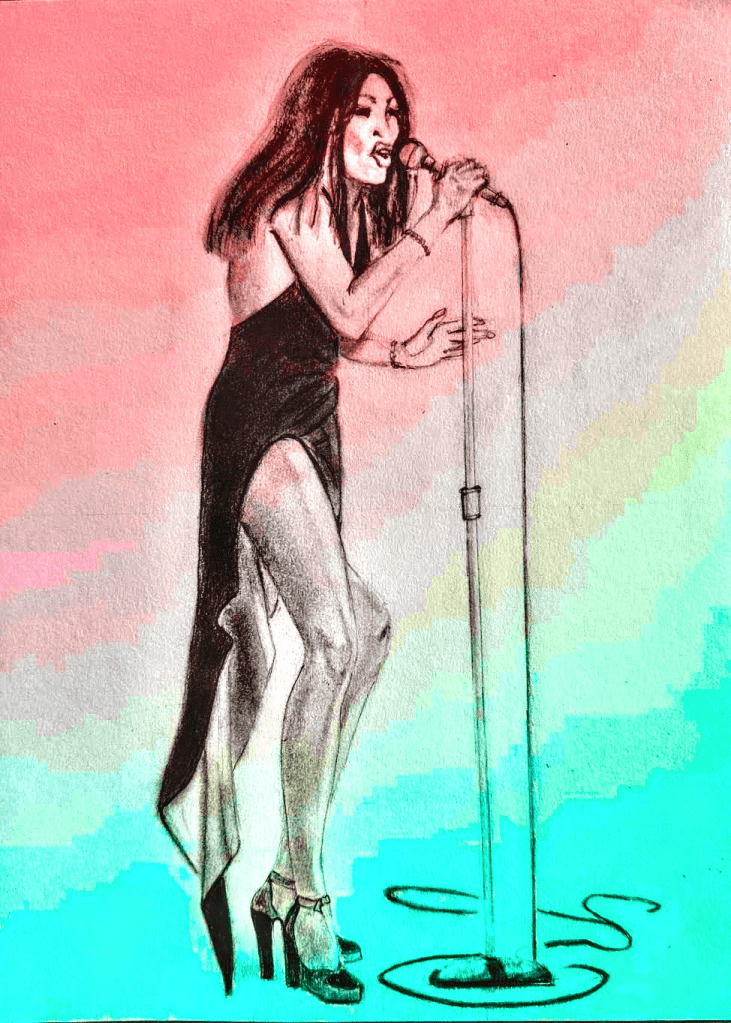
Does a particular subject matter call to you when you get an idea or see something you want to draw? I find that certain pictures really attract me as an artist and I really want to draw and paint them. Not all ideas attract me as strongly and I only proceed with the projects that call the loudest.
Definitely, I am inspired by various things. The Art Gowns Models or Boogapony drawings are inspired by ideas Holly and I toss around. IE: What would they wear in Miami? Or if they were movie stars in the 1940’s.
When I saw the Tissot exhibit at the AGO, I was wildly inspired to do faux Tissot style Victorian gowns.
Pop culture figures inspire me. Imagining characters from books inspires me.
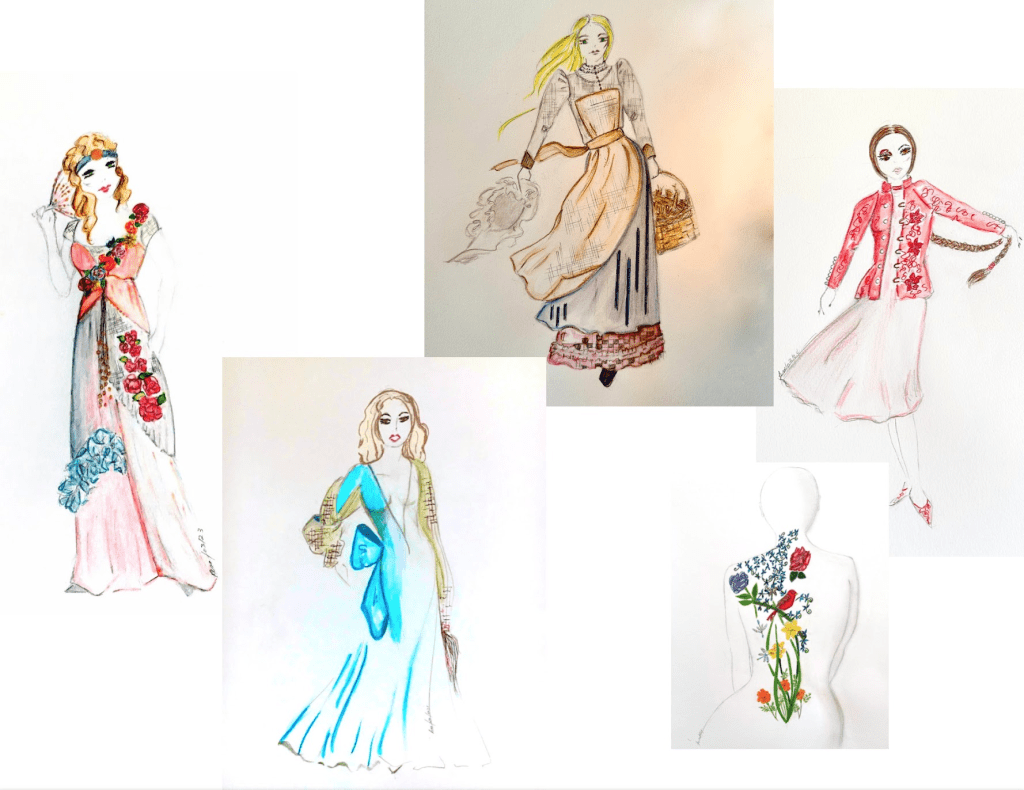
Above from left to right: Sam from John W. Howell’s Eternal Road series — Lady Kara from Shehanne Moore’s book His Judas Bride — Estelle from Roberta Eaton Cheadle’s book A Ghost and his Gold — Catling (as a teen & with her tattoos) from D. Wallace Peach’s book Catling’s Bane (the Rose Shield series).
Right now I’m working on some drawings inspired by a series of poems Holly writes called – The Sad Café. This will be the second collection. In this collection I expand into full scene drawing.
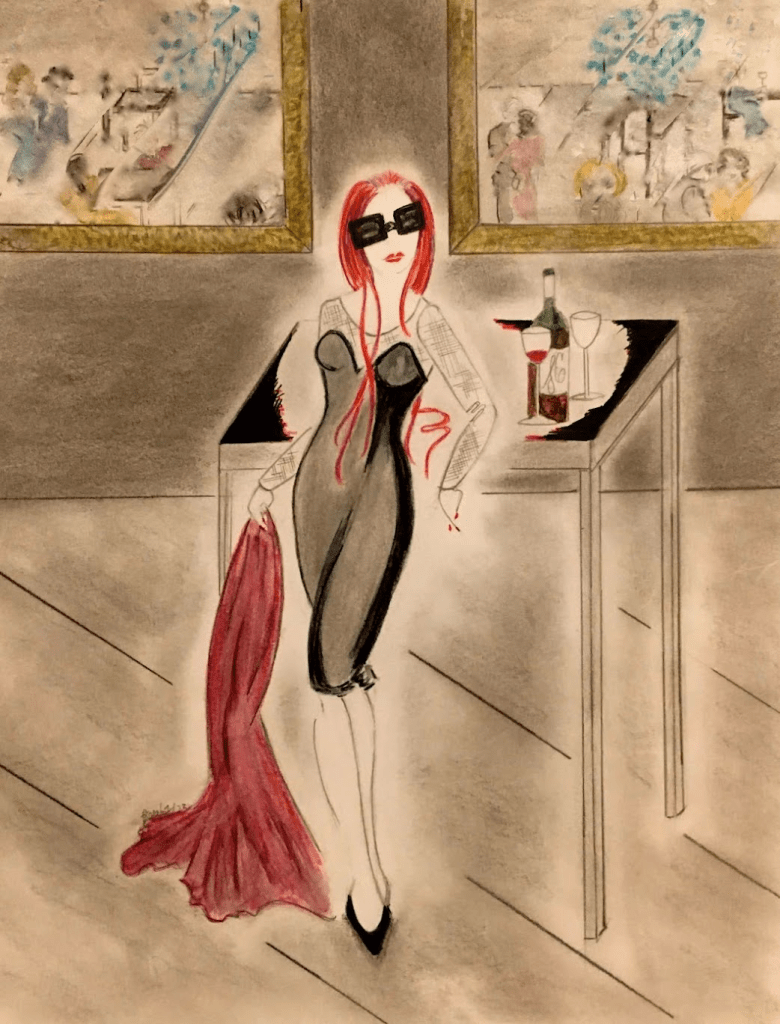
Above: from the first Sad Café series
 roberta-writes.com