Friday is Remembrance Day 2022. In anticipation, I thought I would share quotes from four famous war novels for this week’s literary quiz.
Do you know the author or the title of these four novels, or both? I’ve given a few clues this week.
Book 1 – American author – American civil war
“It was not well to drive men into final corners; at those moments they could all develop teeth and claws.”
“Since he had turned his back upon the fight his fears had been wondrously magnified. Death about to thrust him between the shoulder blades was far more dreadful than death about to smite him between the eyes. When he thought of it later, he conceived the impression that it is better to view the appalling than to be merely within hearing.”
“Thoughts of his comrades came to him. The brittle blue line had withstood the blows and won. He grew bitter over it. It seemed that the blind ignorance and stupidity of those little pieces had betrayed him. He had been overturned and crushed by their lack of sense in holding the position, when intelligent deliberation would have convinced them that it was impossible. He, the enlightened man who looks afar in the dark, had fled because of his superior perceptions and knowledge. He felt a great anger against his comrades. He knew it could be proved that they had been fools.”
“The slaves toiling in the temple of this god began to feel rebellion at his harsh tasks.”
Book 2 – German author – WW1
“He lies there for a while without a word. Then he says, ‘You can take my flying boots for Müller.’ I nod and try to think of something to say that will cheer him up. His lips are pallid, his mouth has got bigger and his teeth look very prominent, as if they were made of chalk. His flesh is melting away, his forehead is higher, his cheekbones more pronounced. The skeleton is working its way to the surface. His eyes are sinking already. In a few hours it will all be over.”
“I am young, I am twenty years old; yet I know nothing of life but despair, death, fear, and fatuous superficiality cast over an abyss of sorrow. I see how peoples are set against one another, and in silence, unknowingly, foolishly, obediently, innocently slay one another.”
“We came to realise – first with astonishment, then bitterness, and finally with indifference – that intellect apparently wasn’t the most important thing…not ideas, but the system; not freedom, but drill. We had joined up with enthusiasm and with good will; but they did everything to knock that out of us.”
“We’re no longer young men. We’ve lost any desire to conquer the world. We are refugees. We are fleeing from ourselves. From our lives. We were eighteen years old, and we had just begun to love the world and to love being in it; but we had to shoot at it. The first shell to land went straight for our hearts. We’ve been cut off from real action, from getting on, from progress. We don’t believe in those things any more; we believe in the war.”
Book 3 – American author – WW1
“If people bring so much courage to this world the world has to kill them to break them, so of course it kills them. The world breaks every one and afterward many are strong at the broken places. But those that will not break it kills. It kills the very good and the very gentle and the very brave impartially. If you are none of these you can be sure it will kill you too but there will be no special hurry.”
“God knows I had not wanted to fall in love with her. I had not wanted to fall in love with any one. But God knows I had and I lay on the bed in the room of the hospital in Milan and all sorts of things went through my head but I felt wonderful…”
“It could be worse,’ Passini said respectfully. “There is nothing worse than war.” Defeat is worse.” I do not believe it,” Passini said still respectfully. “What is defeat? You go home.”
“Cowards die a thousand deaths, but the brave only die once.”
Book 4 – British author – WW1 poetry
“Dark clouds are smouldering into red
While down the craters morning burns.
The dying soldier shifts his head
To watch the glory that returns:
He lifts his fingers toward the skies
Where holy brightness breaks in flame;
Radiance reflected in his eyes,
And on his lips a whispered name.”
***
“Raved at the bleeding war, his rampant grief
Moaned, shouted, sobbed, and choked, while he was kneeling
Half-naked on the floor. In my belief
Such men have lost all patriotic feeling.”
***
“Three hours ago he blundered up the trench,
Sliding and poising, groping with his boots;
Sometimes he tripped and lurched against the walls
With hands that pawed the sodden bags of chalk.”
Last but not least – Quotes from a war book about the Anglo Boer War by a South African author [big wink]
“Moving backwards, lugging the heavy body, was immeasurably hard. My overtaxed leg and back muscles trembled, and my sweat slicked hands slipped and slid under the captain’s arms. I expelled a huge sigh of relief when William and I were finally able to lay our burden down at a designated spot near to the stranded armoured train. My legs refused to hold me up any longer and I sank to my knees.”
“The trucks exploded with a tremendous whirr-rump sound. The enormous noise rolled across the barren countryside like thunder. The two balls of flame that had been the trucks, burned with a brightness that Robert couldn’t look at. Dark, oily fumes rose in the air, fanning out into a huge mushroom cloud that hovered above the veld like a malevolent genie in a children’s storybook.”
“Leaping to his feet, Pieter moved in the direction of the noise. There was a bright moon, but also some thick dark clouds which drifted across its face. For a minute, Pieter’s world was completely black and then the cloud passed, and he could see the armoured train, its engine leaning drunkenly to one side where it had left the tracks.”
“Over the past months, fear has eaten into his mind’s core like a malevolent caterpillar. Fear of the future. Fear of the soldiers. Fear of losing his farm. It’s been there, rotting his brain matter, ever since the declaration of war in October the previous year.”
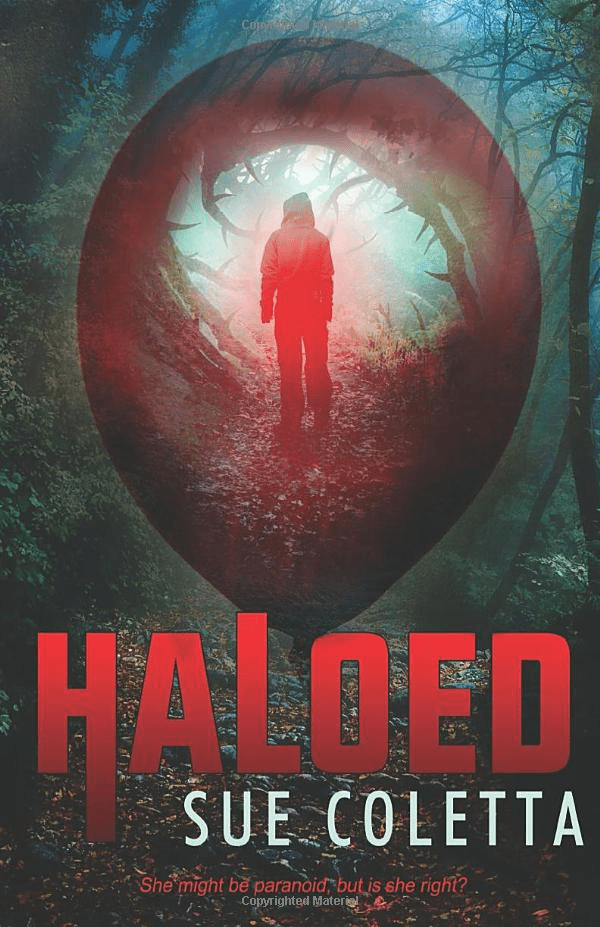
A string of gruesome murders rocks the small town of Alexandria, New Hampshire, with all the victims staged to resemble dead angels, and strange red and pink balloons appearing out of nowhere.
All the clues point to the Romeo Killer’s return. Except one: he died eight years ago.
Paranoid and on edge, Sage’s theory makes no sense. Dead serial killers don’t rise from the grave. Yet she swears he’s here, hungering for the only angel to slip through his grasp—Sage.
With only hours left to live, how can Sage convince her Sheriff husband before the sand in her hourglass runs out?
My review
I reviewed this book in my capacity as a member of Rosie’s Book Review Team. If you would like your book reviewed, you can contact Rosie Amber here: http://rosieamber.wordpress.com/.
Sage Quintano shouldn’t still be fearful. The trauma of her near death at the hands of a serial killer, called the Romeo Killer, would naturally be difficult to overcome, but he was dead and Sage had no reason to believe she was a target. But she was fearful and she did believe she was a target. Sage has seen signs and indicators that force her to believe that somehow, her nemeses has returned to claim the ‘angel’ that got away.
Before the Romeo Killer comes for Sage, however, he intends to torment her. Playing games with his victims is what he does best. And no-one believes Sage’s claim that she is being stalked by a dead man, least of all her own husband, Niko, the local Sheriff.
Sage is an interesting character and is strong in many ways, overcoming significant health problems and protecting her young son. Her behaviour is a bit erratic and slightly hysterical which is why her husband puts her observations down to trauma from the past. Some of Sage’s behaviours were a little hard for me to believe in the circumstances, but the story was interesting and exciting and the author’s knowledge of serial killers and their thought processes is well researched and believable.
Part of the story was told through the eyes of the stalker and it was interesting to consider the action from that perspective. Despite this, the book is not overly gory and there are no detailed descriptions of the murders, only the state of the bodies afterwards. That is preferable for me.
The story was fast paced and the details all tied up well which is essential for me when reading a crime thriller. Readers of this genre will not be disappointed by this book.
Purchase Haloed: Grafton County Series, #5 by Sue Colletta
Welcome to Thursday Doors, a weekly feature allowing door lovers to come together to admire and share their favorite door photos from around the world. Feel free to join in on the fun by creating your own Thursday Doors post each week and then sharing your link in the comments below, anytime between 12:01 am Thursday morning and Saturday noon (North American eastern time).
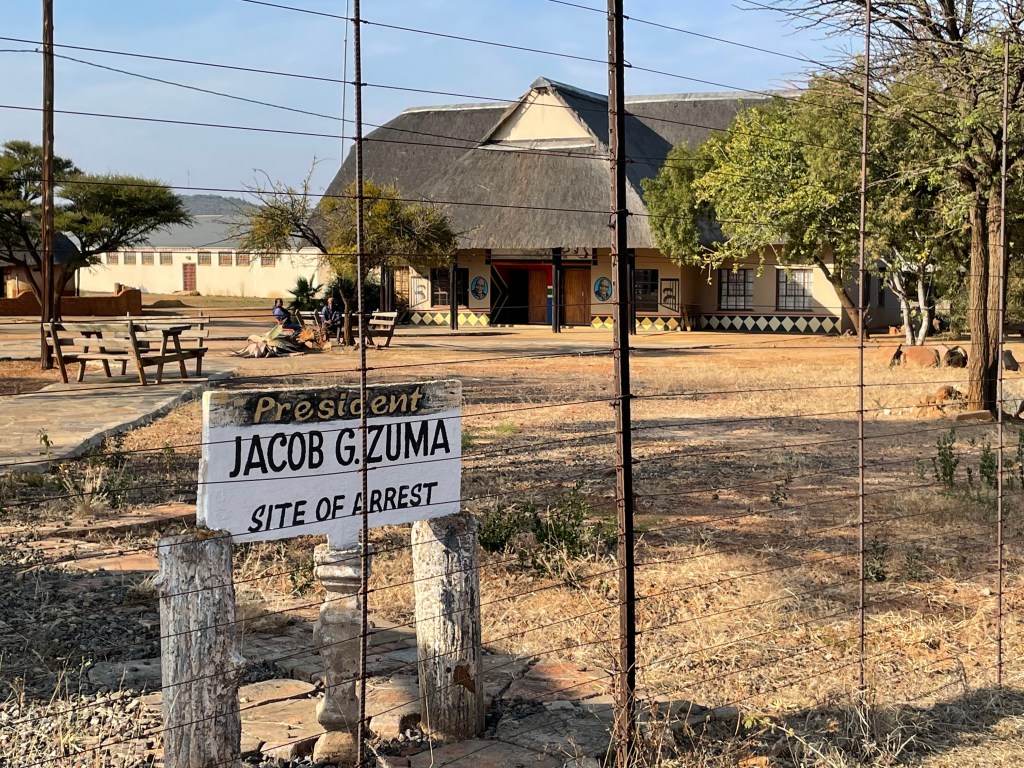
During our recent trip to Groot Marico, I spotted this heritage site with a sign stating that Jacob Zuma had been arrested at this spot. I didn’t know about this, so I looked up the outline of the story.
Jacob Zuma was arrested, along with 50 other freedom fighters, in the small town of Groot Marico in 1963. He was 21 years old at the time. He and his comrades were on their way to Botswana to join the armed wing of the ANC, which was banned in South Africa, when they were intercepted by apartheid police. Zuma received a 12-year prison sentence and served ten years on Robben Island (alongside Nelson Mandela) before his release in 1973.
Recent history (Wikipedia): Jacob Gedleyihlekisa Zuma served as the fourth president of South Africa from 2009 to 2018. He is also referred to by his initials JZ and his clan name Msholozi. A former anti-apartheid activist and member of Umkhonto we Sizwe, he was also the president of the African National Congress (ANC) between 2007 and 2017.
Below are my pictures of the Jacob Zuma arrest site, including the door.
Last weeks post featured book characters who are more famous than their creators. The four books and characters featured were as follows: Pinocchio, Hawkeye from The Last of the Mohicans, Paddington, and Scrooge from A Christmas Carol. Well done to everyone who got some of these titles correct. I didn’t make it easy by giving the most recognised quotes in the books.
Yesterday was Halloween so I decided to do quotes form some horror/scary novels today.
Book 1 – this is my favourite horror novel
“Do you not think that there are things which you cannot understand, and yet which are; that some people see things that others cannot? But there are things old and new which must not be contemplate by men´s eyes, because they know -or think they know- some things which other men have told them. Ah, it is the fault of our science that it wants to explain all; and if it explain not, then it says there is nothing to explain.”
“It is a strange world, a sad world, a world full of miseries, and woes, and troubles. And yet when King Laugh come, he make them all dance to the tune he play. Bleeding hearts, and dry bones of the churchyard, and tears that burn as they fall, all dance together to the music that he make with that smileless mouth of him. Ah, we men and women are like ropes drawn tight with strain that pull us different ways. Then tears come, and like the rain on the ropes, they brace us up, until perhaps the strain become too great, and we break. But King Laugh he come like the sunshine, and he ease off the strain again, and we bear to go on with our labor, what it may be.”
“Sweet it was in one sense, honey-sweet, and sent the same tingling through the nerves as her voice, but with a bitter underlying the sweet, a bitter offensiveness, as one smells in blood.”
Book 2 – the ending of this book has been criticised
“It’s offense you maybe can’t live with because it opens up a crack inside your thinking, and if you look down into it you see there are evil things down there, and they have little yellow eyes that don’t blink, and there’s a stink down there in that dark and after a while you think maybe there’s a whole other universe where a square moon rises in the sky, and the stars laugh in cold voices, and some of the triangles have four sides, and some have five, and some have five raised to the fifth power of sides. In this universe there might grow roses which sing. Everything leads to everything, he would have told them if he could. Go to your church and listen to your stories about Jesus walking on the water, but if I saw a guy doing that I’d scream and scream and scream. Because it wouldn’t look like a miracle to me. It would look like an offense.”
“The energy you drew on so extravagantly when you were a kid, the energy you thought would never exhaust itself – that slipped away somewhere between eighteen and twenty-four, to be replaced by something much duller, something as bogus as a coke high: purpose, maybe, or goals, or whatever rah-rah Junior Chamber of Commerce word you wanted to use. It was no big deal; it didn’t go all at once, with a bang. And maybe, Richie thought, that’s the scary part. How you didn’t stop being a kid all at once, with a big explosive bang, like one of that clown’s trick balloons. The kid in you just leaked out, like the air of a tire.”
“You pay for what you get, you own what you pay for… and sooner or later whatever you own comes back home to you.”
Short story – this is my favourite short horror story
“And then there stole into my fancy, like a rich musical note, the thought of what sweet rest there must be in the grave.”
“In the deepest slumber-no! In delirium-no! In a swoon-no! In death-no! even in the grave all is not lost.”
“…the agony of my soul found vent in one loud, long and final scream of despair.”
Book 4 – This book really, really scared me when I read it
“Like so many unhappinesses, this one had begun with silence in the place of honest open talk.”
“Anyone who needs more than one suitcase,” he said as he double-locked their door, “is a tourist, not a traveler.”
Despite October being an upside down month with Michael being ill and have major surgery, as well as work and two book tours, I have managed to squeeze in two Halloween reads.
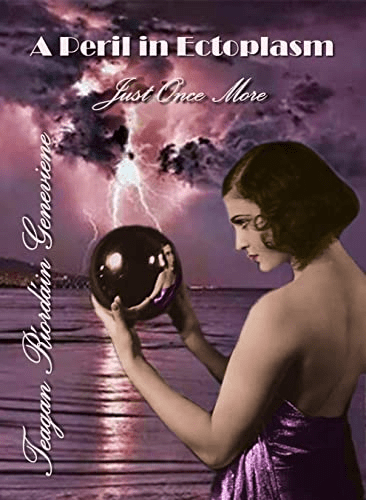
This is the first and, true to Teagan Riordain Geneviene’s magical writing style, was simply terrific.
n 1920s Florida, Spiritualism enjoys renewed interest. Daphne Moultrie, the most powerful medium of her time, receives a warning from the other side, “Find her, and keep her with you. Or you will die.” All Daphne knows about this girl is what her crystal ball showed her — a four-leaf clover, and each leaf had a human eye.
Meanwhile, Daphne’s fiancé has designs of his own. He pressures her to continue séances for a strange and very demanding woman. With each of those séances, Daphne becomes weaker and closer to death.
This novella captures the Roaring Twenties, as only acclaimed author, Teagan Ríordáin Geneviene can. Settings, descriptions, and language all come to vibrant life. The ensemble cast has a number of characters, including one you will love to hate. It’s a genre mash-up, part mystery, part suspense, with a dash of light horror.
My review
Teagan Geneviene has created the perfect Halloween tale, full of rich descriptions, interesting characters, and with a fast paced plot involving a frightening demon.
Daphne Moultrie is a gifted medium with a lot of empathy and a kind nature. Daphne was born to wealth and lives in a beautiful mansion with her aging housekeeper, Maisy, who has cared for her since the death of her parents many years before.
Recently engaged to the outwardly charming Crespo Irigoyen, a Cuban Count, Daphne has everything to be joyous about, but she is not thriving. Fatigued and wan, she is finding giving seances overwhelming, especially those for the demanding and selfish Mrs Smith. Daphne senses something evil in this foreboding woman and does not want to see her. Her determined fiancé is, however, determined that the relationship with, and seances for Mrs Smith, should continue.
Maisie is concerned and does not trust Crespo. She doesn’t know what to do until the spirit of a dead soldier manifests and gives Daphne a warning.
Is the dead soldier good or evil? Can the outcome he warns of be avoided? Does Crespo really love Daphne or is he a charlatan? Read the book to find out!
A few samples of Ms. Geneviene’s vivid writing:
“A gust of wind caused the tall palm trees to sway. The vivid sunrise faded to clear blue and the sky was dotted with fluffy white clouds. Yet there was something to the air that hinted of a storm in the distance.”
“Regardless, there were dark circles under Daphne’s eyes, and her complexion was ashen. The roses were gone from her cheeks. There was no bounce in her step. That morning the poor thing looked so fragile that Maisy wanted to telephone the doctor.”
“Her murky black aura extends to make a huge sphere around her. I’ve never seen an aura so large or so … revolting. I can feel an oil texture just looking at it,’ Daphne whispered with a shudder, but collected herself quickly.”
A fabulous and entertaining Halloween read.
Universal purchase links for Peril in Ectoplasm: Just Once More
I am over at Writing to be Read with this month’s Dark Origins post featuring the Sotho Tswana and the malevolent Tokoloshe. I have also shared a short story about the Tokoloshe … Thanks for hosting, Kaye Lynne Booth.
The Sotho-Tswana people of southern Africa comprise of the South Sotho (Basuto and Sotho), the West Sotho (Tswana) and the North Sotho (Pedi) people.
Most Sotho people were historically herders of cattle, goats and sheep and growers of grains and tobacco. The Sotho people were also recognised for their metal and leather work as well as their wood and ivory carving.
The Sotho people live largely in Lesotho and South Africa and as a combined group are the second largest ethnic group in South Africa.
Religious beliefs
The Sotho traditionally believe in Modimo who created the world and then withdrew to Heaven. He no longer concerns himself with life on earth. Modimo is not worshipped directly but though the ancestors.
The belief in ancestors is central to Sotho traditional religion. The ancestors are believed to have an influence over the daily lives of their direct descendants. Each family is under…
Last week, I had a little fun sharing quotes from some of the books I’ve read that I think are beautifully written. That post was prompted by a post on Dave Astor on Literature called More Premium Prose Practitioners. This week, Dave has shared a post about characters [from books] who are more famous than the authors who created them. You can read Dave’s post here: https://daveastoronliterature.com/2022/10/23/characters-who-are-more-famous-than-the-authors-who-created-them. I have decided to share some quotes from books I’ve read whose characters are more famous than the author of the book. The best part is you need to guess who the CHARACTER IS.
Book 1 – Italian author – Children’s book
“Woe to those who lead idle lives. Idleness is a dreadful illness and must be cured in childhood. If it is not cured then, it can never be cured.”
“A conscience is that still small voice that people won’t listen to.”
“Are you not afraid of death?’
I am not in the least afraid!… I would rather die than drink that bitter medicine.’
At that moment the door of the room flew open, and four rabbits as black as ink entered carrying on their shoulders a little bier.”
Hint: Created by a carpenter in Florence, this is believed to be the most widely known children’s tale in the world.
Book 2 – American author – Adult fiction
There is more than one famous character from this book so I’ll accept any of them.
“Your young white, who gathers his learning from books and can measure what he knows by the page, may conceit that his knowledge, like his legs, outruns that of his fathers’, but, where experience is the master, the scholar is made to know the value of years, and respects them accordingly.”
“In short, the magnifying influence of fear began to set at naught the calculations of reason, and to render those who should have remembered their manhood, the slaves of the basest passions.”
“You are young, and rich, and have friends, and at such an age I know it is hard to die!”
Hint: This author contributed to the creation of the American literature genre.
Book 3 – Children’s book – British author
“I’ll never be like other people, but that’s alright because I’m a bear”
“A wise bear always keeps a marmalade sandwich in his hat in case of emergency.”
“Things are always happening to me. I’m that sort of bear.”
Book 4 – British author – Adult fiction
“It is a fair, even-handed, noble adjustment of things, that while there is infection in disease and sorrow, there is nothing in the world so irresistibly contagious as laughter and good humour.”
“You may be an undigested bit of beef, a blot of mustard, a crumb of cheese, a fragment of underdone potato. There’s more of gravy than of grave about you, whatever you are!”
“There are some upon this earth of yours who lay claim to know us, and who do their deeds of passion, pride, ill-will, hatred, envy, bigotry, and selfishness in our name; who are as strange to us and all our kith and kin, as if they had never lived. Remember that, and charge their doings on themselves, not us.”
If you know who the famous characters are, let me know in the comments.
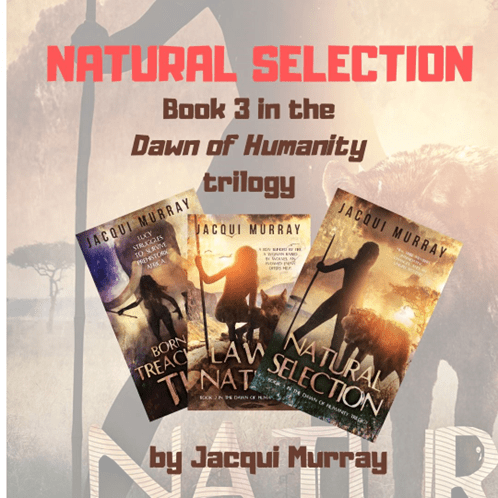
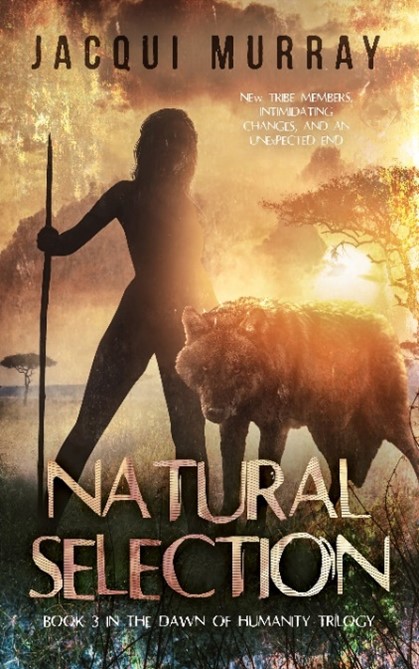
Today, I am delighted to welcome talented author, Jacqui Murray, to Roberta Writes with a fascinating post for the launch of her new book, Natural Selection, Dawn of Humanity Book 3.
A prehistoric day with Lucy
Lucy, Natural Selection’s main character, is representative of the first humans. She walks upright, solves problems with her big brain as much as instinct, and has daylight left over each day to do something other than eat, sleep, hunt, defend herself, and procreate. She doesn’t wear clothing, live in a shelter, believe in gods or God, cook, or use fire. She thinks animals are superior because they’re physically more powerful. She is a hunter-gatherer (pre-farming), will eat anything (she’s an omnivore). Her tribe is a small group of about ten with no leader. The attitude is to work as hard as they can for the good of the group.
Here’s her typical day:
Morning
Lucy wakes up in a tree nest like those built by chimpanzees (Natural Selection tells you how to do this in case you’d like your own). If she isn’t close to a forest, she’ll settle for huddling against a cliff, around a baobab, under a stone ledge, or in an abandoned Canis (a pre-wolf) den.
Lucy relieves her urine and waste in a spot well away from where her tribe sleeps, but uses her feces and urine as animals do, to mark the boundaries of her territory.
Lucy eats when food is available. This might be as she’s foraging, hunting, or migrating. There are many days she doesn’t eat at all.
The tribe is fairly safe in their home, called a ‘homebase’, the place where they gather during the day, but when scavenging or foraging, the world is dangerous so they move quietly and cautiously.
Late morning-afternoon
Lucy spends most of the day in activities that feed her. She might stay at the homebase to pummel roots and stems to an edible softness, travel to a grove of fruit trees to collect fruit before other animals find it, gather nuts and berries when available–eating as she collects–or scavenge the carcass of an animal killed by predators. She always travels in small groups because the land is dangerous. Many predators feast on her meat. She is small–under five feet–with no defenses against attack other than her growing brain. Her skin is thin, her nails aren’t the shearing claws of predators, and her teeth are worthless for offense with no tearing fangs. Plus, if chased, she doesn’t run fast. She can climb trees to escape or in some cases, outsmart enemies with a clever idea.
Evening
When hunting, foraging, and gathering is completed, Lucy returns to the homebase where she grooms her tribe members. This is when she cleans their hair of lice, bugs, twigs, and debris, much like chimpanzees do (details on how to do that in the book). That done, she will knap stone tools required for chopping and cutting. If she has managed to find a carcass left by a predator, she will disarticulate the meat from the bones and break them open to retrieve the marrow.
***
Lucy’s days are filled with danger, threats, and stress, but also the latent sense of family and community. The juxtaposition of these instinctive and emotional traits makes a story I think you’ll enjoy.
About Natural Selection
In this final book of the trilogy, Lucy and her tribe leave their good home to rescue captured tribemembers who are in grave danger. Since leaving her mate, Lucy created a tribe that includes an eclectic mix of species–a Canis, a Homotherium kit, and different iterations of early man. More will join and some will die but that is the nature of prehistoric life, when survival depends on a mix of man’s developing intellect and untiring will to live. Each brings unique skills to the task of saving Raza and his Group from sure death. Based on true events from 1.8 million years ago in Africa, Lucy and her band of early humans struggle against the harsh reality of a world ruled by nature, where predators stalk them and a violent new species of man threatens to destroy their world. Only by changing can they prevail. If you ever wondered how earliest man survived but couldn’t get through the academic discussions, this book is for you.
Prepare to see this violent and beautiful world in a way you never imagined.
The Canis’ packmates were all dead, each crumpled in a smeared puddle of blood, Upright killing sticks embedded where they should never be. His body shook, but he remembered his training. The killers’ scent filled the air. If they saw him—heard him—they would come for him, too, and he must survive. He was the last of his pack.
He padded quietly through the bodies, paused at his mate, broken, eyes open, tongue out, pup under her chest, his head crushed. A moan slipped from his muzzle and spread around him. He swallowed what remained in his mouth. Without a pack, silence was his only protection. He knew to be quiet, but today, now, failed.
To his horror, a departing Upright looked back, face covered in Canis blood, meaty shreds dripping from his mouth, the body of a dead pup slung over his shoulder. The Canis sank into the brittle grass and froze. The Upright scanned the massacre, saw the Canis’ lifeless body, thought him dead like the rest of the decimated pack. Satisfied, he turned away and rushed after his departing tribe. The Canis waited until the Upright was out of sight before cautiously rising and backing away from the onslaught, eyes on the vanished predators in case they changed their minds.
And fell.
He had planned to descend into the gully behind him. Sun’s shadows were already covering it in darkness which would hide him for the night, but he had gauged his position wrong. Suddenly, earth disappeared beneath his huge paws. He tried to scrabble to solid ground, but his weight and size worked against him and he tumbled down the steep slope. The loose gravel made gripping impossible, but he dug his claws in anyway, whining once when his shoulder slammed into a rock, and again when his head bounced off a tree stump. Pain tore through his ear as flesh ripped, dangling in shreds as it slapped the ground. He kept his legs as close as possible to his body and head tucked, thankful this hill ended in a flat field, not a river.
Or a cliff.
When it finally leveled out, he scrambled to his paws, managed to ignore the white-hot spikes shrieking through his head as he spread his legs wide. Blood wafted across his muzzle. He didn’t realize it was his until the tart globs dripped down his face and plopped to the ground beneath his quaking chest. The injured animal odor, raw flesh and fresh blood, drew predators. In a pack, his mate would purge it by licking the wound. She would pronounce him Ragged-ear, the survivor.
Ragged-ear is a strong name. A good one.
He panted, tail sweeping side to side, and his indomitable spirit re-emerged.
I live.
But no one else in his pack did.
Except, maybe, the female called White-streak. She often traveled alone, even when told not to. If she was away during the raid, she may have escaped. He would find her. Together, they would start over.
Ragged-ear shook, dislodging the grit and twigs from his now-grungy fur. That done, he sniffed out White-streak’s odor, discovered she had also descended here. His injuries forced him to limp and blood dripping from his tattered ear obstructed his sight. He stumbled trying to leap over a crack and fell into the fissure. Fire shot through his shoulder, exploded up his neck and down his chest. Normally, that jump was easy. He clambered up its crumbling far wall, breaking several of his yellowed claws.
All of that he ignored because it didn’t matter to his goal.
Daylight came and went as he followed White-streak, out of a forest onto dry savannah that was nothing like his homeland.
Why did she go here?
He embraced the tenderness that pulsed throughout his usually-limber body. It kept him angry and that made him vicious. He picked his way across streams stepping carefully on smooth stones, their damp surfaces slippery from the recent heavy rain, ignoring whoever hammered with a sharp rock inside his head. His thinking was fuzzy, but he didn’t slow. Survival was more important than comfort, or rest.
Ragged-ear stopped abruptly, nose up, sniffing. What had alerted him? Chest pounding, breathing shallow, he studied the forest that blocked his path, seeking anything that shouldn’t be there.
But the throbbing in his head made him miss Megantereon.
Ragged-ear padded forward, slowly, toward the first tree, leaving only the lightest of trails, the voice of Mother in his head.
Yes, your fur color matches the dry stalks, but the grass sways when you move. That gives away your location so always pay attention.
His hackles stiffened and he snarled, out of instinct, not because he saw Megantereon. Its shadowy hiding place was too dark for Ragged-ear’s still-fuzzy thinking. The She-cat should have waited for Ragged-ear to come closer, but she was hungry, or eager, or some other reason, and sprang. Her distance gave the Canis time to back pedal, protecting his soft underbelly from her attack. Ragged-ear was expert at escaping, but his stomach spasmed and he lurched to a stop with a yowl of pain. Megantereon’s next leap would land her on Ragged-ear, but to the Canis’ surprise, the She-cat staggered to a stop, and then howled.
While she had been stalking Ragged-ear, a giant Snake had been stalking her. When she prepared her death leap, Snake dropped to her back and began to wrap itself around her chest. With massive coils the size of Megantereon’s leg, trying to squirm away did no good.
Ragged-ear tried to run, but his legs buckled. Megantereon didn’t care because she now fought a rival that always won. The She-cat’s wails grew softer and then silent. Ragged-ear tasted her death as he dragged himself into a hole at the base of an old tree, as far as possible from scavengers who would be drawn to the feast.
He awoke with Sun’s light, tried to stand, but his legs again folded. Ragged-ear remained in the hole, eyes closed, curled around himself to protect his vulnerable stomach, his tail tickling his nose, comforting.
He survived the Upright’s assault because they deemed him dead. He would not allow them to be right.
Sun came and went. Ragged-ear consumed anything he could find, even eggs, offal, and long-dead carcasses his pack normally avoided. His legs improved until he could chase rats, fat round ground birds, and moles, a welcome addition to his diet. Sometimes, he vomited what he ate and swallowed it again. The day came he once again set out after what remained of his pack, his pace more sluggish than prior to the attack, but quick enough for safety.
Ragged-ear picked up the female’s scent again and tracked her to another den. He slept there for the night and repeated his hunt the next day and the next. When he couldn’t find her trace, instinct drove him and memories of the dying howls of his pack, from the adults who trusted their Alpha Ragged-ear to protect them to the whelps who didn’t understand the presence of evil in their bright world.
Everywhere he traveled, when he crossed paths with an Upright, it was their final battle.
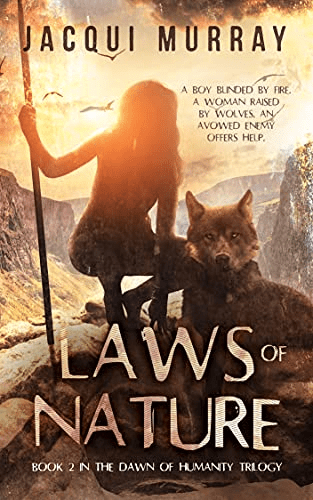
My review of Laws of Nature, Dawn of Humanity Book 2
I am very interested in pre-history and have visited the Cradle of Mankind, Sterkfontein Caves, and Maropeng exhibition several times as well as the paleontology department at the University of the Witwatersrand. As a result, I have a good knowledge of the time period in which this series is set, and how humanity lived, hunted and created tools. I have also read the Earth Children series of books by Jean M. Auel. When I came across the Dawn of Humanity series by Ms. Murray, I knew I had to read it.
I have not been disappointed by this, or any of Ms. Murray’s other pre-historical books. The attention to detail and research is impeccable and I not found any errors relating to the theories and research findings of the period. I particularly appreciate the authenticity of these books which I have not experienced to the same degree in the other pre-historical novels I have read.
Laws of Nature picks up where book 1 left off with Lucy and her small tribe of diverse members and personalities trying to find a new and safer home after their larger tribe was attacked and many members taken prisoner.
Lucy is of the Man Who Makes Tools tribe, a peace loving race of ‘uprights’ who prefer to live in harmony with the land and the animals which populate it. The advent of Man Who Preys, a more aggressive race of ‘uprights’ who attack and kill other tribes and also animals, has forced Lucy and many of her fellow tribesmen to flee to save their lives and reestablish their peaceable lifestyles somewhere else.
I enjoyed Lucy’s travel companions: Ump the Canis, Boah the Tree-Man, Garv, Lucy’s soul-mate, and Voi, Lucy’s son. My favourite, other than Lucy who represents a strong and innovative woman and leader, was Boah. He is a good natured and peaceable man with certain limitations that he tries hard to overcome in order to be useful to his small tribe.
The captured half of Lucy’s tribe are also determined to escape and find Lucy. There is also another man, an enemy of Man Who Makes Tools, who is seeking Lucy for his own purposes. The story is told from each of the three perspectives, Lucy’s tribe, the escapees, and the tracker, as it follows each of these primary story threads.
A superbly researched and exciting book with a fascinating pre-historical setting that will not disappoint.
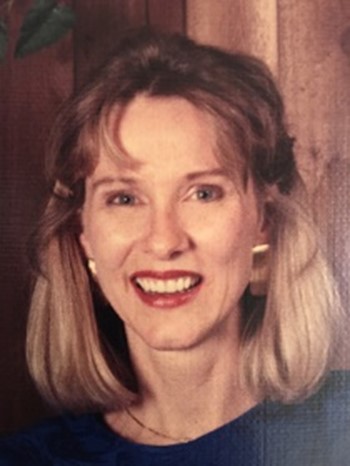
About Jacqui Murray
Jacqui Murray is the author of the popular prehistoric fiction saga, Man vs. Nature which explores seminal events in man’s evolution one trilogy at a time. She is also author of the Rowe-Delamagente thrillers and Building a Midshipman, the story of her daughter’s journey from high school to United States Naval Academy. Her non-fiction includes over a hundred books on integrating tech into education, reviews as an Amazon Vine Voice, a columnist for NEA Today, and a freelance journalist on tech ed topics.
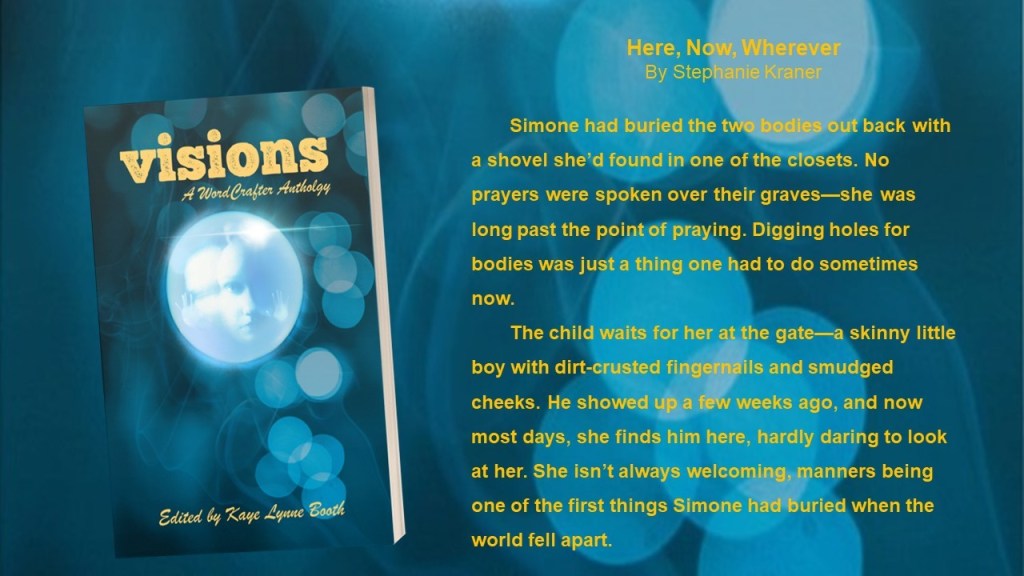
WordCrafter Press is proud to present Visions, a fantasy, science fiction, paranormal, and horror anthology.
Blurb
Fantasy, science fiction, paranormal, and horror stories that will keep you awake long into the night.
An author’s visions are revealed through their stories. Many authors have strange and unusual stories, indeed. Within these pages, you will find the stories of eighteen different authors, each unique and thought provoking. These are the fantasy, science fiction, paranormal, and horror stories that will keep you awake long into the night.
What happens when:
An inexplicable monster plagues a town for generations, taking people… and souvenirs?
A post-apocalyptic band of travelers finds their salvation in an archaic machine?
The prey turns out to be the predator for a band of human traffickers?
Someone chooses to be happy in a world where emotions are regulated and controlled?
A village girl is chosen to be the spider queen?
Grab your copy today and find out. Let authors such as W.T. Paterson, Joseph Carabis, Kaye Lynne Booth, Michaele Jordan, Stephanie Kraner, and others, including the author of the winning story in the WordCrafter 2022 Short Fiction Contest, Roberta Eaton Cheadle, tantalize your thoughts and share their Visions
From Kaye Lynne Booth, editor of Once Upon an Ever After: Modern Fairy Tales & Folklore,Refracted Reflections: Twisted Tales of Duality & Deception and Gilded Glass: Twisted Myths & Shattered Fairy Tales.
Here, Now, Wherever – and How on Earth I Got There by Stephanie Kraner
It all started with a cat, as so many things often do—at least in my house. This was supposed to be a story about a black cat named Levine who helped a woman survive in the post-apocalyptic remains of America. Levine was going to be a heroic and perhaps unnaturally wise feline who hunted game, shared it, and absolutely refused to let her chosen human give up and die regardless of how difficult things got. But, because the only thing I’m better at than writing outlines is ignoring them with the utmost disdain, as soon as I started writing, Levine became an accessory to a much different tale.
If you get Cormac McCarthy vibes from the setting, you’re certainly not wrong. That was on my mind as I wrote this, in a “Is this too similar to The Road such that I should stop writing right now?” kind of way. But given climate change and the fact that large portions of the United States are often on fire, I think I can be forgiven the similarity. Besides, Here, Now, Wherever is more like cottagecore with a post-apocalyptic twist. And—spoiler alert—there are no cannibals.
So, although this story includes zero roads whatsoever, does not feature even one single scene involving feasting on human flesh, and is not, in fact, a story about a cat, it is a story about motherhood and grief and the interminable human desire for connection and family. It was an intense story to write, and I hope you can feel that as you read it.
My review of Here, Now, Wherever
This is a dystopian short story about American society post a climate change event that causes horrific fires, air pollution, and destruction of civilization as we know it.
Simone is a survivor, but she has suffered massive emotional trauma. Her method of dealing with her trauma is to dissociate from everyone around her who has suffered similar loss and pain. Life and the human psyche do not work like that, however, and when Simone meets a young boy, cracks start appearing in her defensive armour.
A beautifully written story set in a disturbing future setting that was reminiscent for me of John Wyndham’s famous book, The Day of the Triffids.
About Stephanie Kraner
Stephanie is a short fiction author and coffee junkie living in the Pittsburgh area. Although she mostly writes science fiction and fantasy, from time to time she enjoys dabbling with her secret love—literary fiction. Her work has appeared in Apex Magazine and The Magazine of Fantasy and Science Fiction. Follow her on Twitter @StephKraner.
Welcome to Thursday Doors, a weekly feature allowing door lovers to come together to admire and share their favorite door photos from around the world. Feel free to join in on the fun by creating your own Thursday Doors post each week and then sharing your link in the comments below, anytime between 12:01 am Thursday morning and Saturday noon (North American eastern time). You can join in here: https://nofacilities.com/2022/10/20/still-driving-around-pittsburgh/
During our recent trip to Tau Game Reserve, we spent one night in the small town of Groot Marico. Our overnight residence was a cottage at Riverstill Guest Farm on the Marico River, about 7 kilometers away from the town. It was a beautiful and tranquil setting, but I could not relax because there were no locks on the external doors of the cottage. The permanent residents consider the area safe and locks unnecessary but I didn’t like it. I have to lock doors at night or I can’t sleep.
Gate to the guest farmDoors to the kitchen and the main bedroom, none of them locked. The arch led to the door into the second bedroom.First and second doors into the kitchen
The kitchen was old fashioned and still featured the old stone oven, pot hooks and kettle. There was an electric double plate set where the fire would have been. The kitchen had the original old glass window.
Some pictures of our walk along the Marico River.
Here is a short video of the small rapids on the river:
I am a little behind with blogging this week as my son, Michael, had major surgery on his sinuses again on Tuesday. The operation took three hours and involved a revision of the previous surgery (last year) and an expansion of what was done. Because of the risks involved, given Michael’s surgical history, he had a surgical navigator who plotted the surgery using the CT scan we had done the prior week. Michael was also hooked up to a machine that monitored his breathing and heart rate and how he was reacting to the anesthetic. This intervention was because he came out of the anesthetic last time and pulled the breathing tube out before he was ready to breath on his own. The tube was still inflated in his lungs so it was very dramatic and he stopped breathing and had to be put back under anesthetic to get the tube re-inserted. This unfortunate event caused a lot of pain and difficulty with his previous recovery.
This surgery was not drama free as he hemorrhaged again and the doctor had to insert a dissolvable sponge deep into his sinuses to stop the bleeding. Because of extensive scar tissue and damage from previous surgeries that hadn’t healed as well as they should have, they also had to fracture the bone in his nose to make space for tools to do the repair work. He stayed in hospital overnight as he needed oxygen and because his blood pressure dropped due to the bleeding and shock.
He came home on Wednesday afternoon and we were back at the hospital this morning because of a blockage. It was blood clots and other build ups called crusting which had to be suctioned out of the surgical site. It was pleasant and the poor chap was quite pale afterwards.
He has to go back on Wednesday next week to have the suctioning repeated. In the mean time we have to do a whole programme of steaming and douching. It is quite a process.
Hopefully, following Wednesday, he will be okay and nothing further will be required for some time. The surgery doesn’t fix his problems, it merely allows the antibiotics and other medications to enter the sinuses so they can do their job. Currently, there is no complete cure for his superbug, and biofilm, and chronic sinusitis, they can only control it. Hopefully some clever person will come up with something new in the future, but until then, this is the best we can do.










 roberta-writes.com