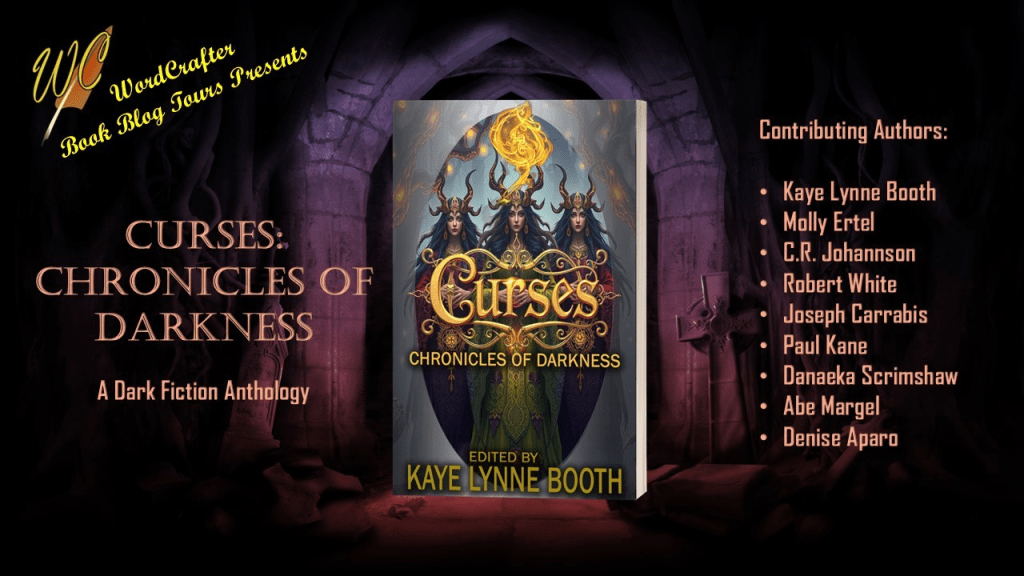
It’s Day 4 of the WordCrafter Curses Book Blog Tour and Robbie Cheadle is hosting today, here on Roberta Writes to help launch Curses: Chronicles of Darkness. Thank you so much for having us here, Robbie.
Today, you’ll get to meet contributing authors C.R. Johansson and Robert White and learn more about their stories in the Curses anthology. Plus, Robert shares a guest post about the inspiration for his story here, and on the second stop of the day, over at Undawnted, DL Mullan will share her interview with Robert. Don’t forget to leave questions and comments for both stops here to enter in today’s drawing for chance to win a digital copy Curses: Chronicles of Darkness.
Giveaway
We’re giving away 5 digital copies of Curses: Chronicles of Darkness.
All you have to do to enter is
follow the tour and leave a comment.
About Curses: Chronicles of Darkness
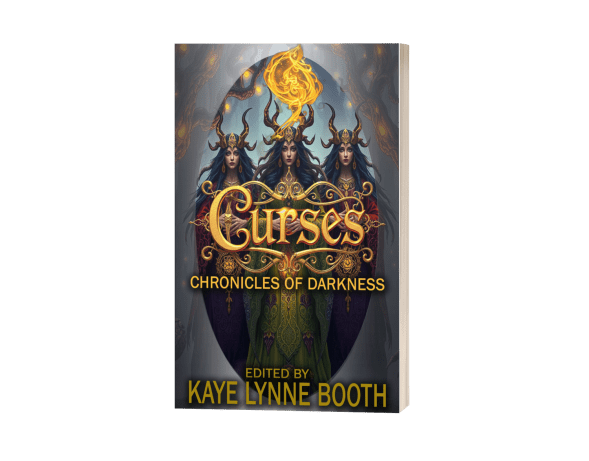
There are all types of curses.
Cursed places, cursed items, cursed people, cursed families.
Curses that last throughout time. Curses which can’t be broken. Curses which are brought upon ourselves. Curses that will kill you and those that will only make you wish you were dead.
Eleven tantalizing tales of curses and the cursed. Includes stories by Kaye Lynne Booth, Molly Ertel, C.R. Johansson, Robert White, Joseph Carrabis, Paul Kane, Danaeka Scrimshaw, Abe Margel, and Denise Aparo.
Pre-Order and Purchase Link: https://books2read.com/CursesChroniclesofDarkness
Inspiration for “The Longspeth Curse”
When I was eighteen and working as a stockboy in a family grocery store, a man came in asking for directions to the site of “the Ashtabula Bridge Disaster.” I had no idea what he was talking about and put it out of my mind—but never completely out.
Decades later, when I became curious enough to find that locale right under my nose, so to speak, I discovered the history of what had been in its time the greatest train wreck in the United States and remains so in the nineteenth century. All the big papers and magazines of the day covered it in their lush, purple prose and indeed that coverage was warranted. Over ninety people died, many horribly, I was to learn, when the Pacific Express with its passenger cars, plunged into the gulf a thousand feet past the train station that it roared by in a blinding blizzard on a Friday of December 29, 1876. When iron truss bridge collapsed into the gulf below right after the lead locomotive, The Socrates, crossed it. All the cars behind it went into the gulf below from a height of seventy feet, including the three luxurious sleeping cars with their individual names: The Yokohama, The Palatine, The City of Buffalo.
Many who survived the fall drowned in the river. Other who survived the bridge collapse and avoided drowning, were severely wounded and froze to death on the riverbank, owing to the ongoing blizzard on that frigid day. The most tragic details of the deaths, however, came from the fact that the kerosene lamps in the passenger cars set fire to the coal cars behind the diesels. Those poor souls trapped in the wreckage, including parents and their children, died a cruel death and could not save themselves from the fire—a fire that burned in the twisted metal and wood long after the blizzard stopped. A ghastly way to die.
The genesis of my story—namely, the “dark man” and the curse he inflicted on the males of the Longspeth line—came from the fact that the early reports of the fire described how many of my town’s citizens answered the call of distress and went down the snowbanks to assist the survivors.
Others, however, a very few, did not. They came down the riverbank to steal from the dying and wounded: money, gold watches, jewelry. These were the worst kind of thieves, the scum of the earth. Some were named and jailed, according to archived copies of the Ashtabula Telegraph, long defunct. The incompetent fire chief of the time was another who failed to do anything to rescue people (rumor of the day had it that he was an alcoholic).
One of the many accounts published in the days and weeks afterward is from a Miss Marian Shepherd from Ripon, Wisconsin, who was one of the fortunate ones to escape death. She said: “From the burning heap came shrieks and the most piteous cries for help. I could hear far above me the clangor of bells, alarming the citizens. We climbed up the deep side of the gorge, floundering in snow two feet deep.”
One of our local cemeteries which I’ve passed hundreds of times has a mass grave marker dedicated to the deceased who could not be identified.
One of my characters in the story leaves a bar as the train rushes past, soon to fall to its doom. He hears the desperate, short blasts of the train whistle of the lead diesel, which had just made it across the bridge. He is Adam Longspeth, the original victim of the curse of the “Dark Man,” whose description I borrowed from one of the better known victims of the disaster: P.P. Bliss, a well-known psalmist and author of the hymns “Hold the Fort,” “Almost Persuaded,” and “Hallelujah, What a Savior!” I made him turn up at each subsequent male Longspeth from Adam on to the present narrating Longspeth, but all their fates are predetermined.
The narrator of my story only recently discovers what darkness he has inherited on his twenty-first birthday when his father presents him with a leather-bound journal kept by the Longspeth men who record their encounters with the Dark Man.
If there’s no actual curse from the real tragedy, perhaps there ought to be. The bridge’s designer, Amasa Stone, committed suicide. He insisted the bridge be built entirely of iron rather than wood and iron. The jury report found that was one of several faults that contributed to the failure of the bridge to support a live load (i.e., moving trains). Mark Twain, never one to miss an opportunity to display his wit, commented famously that “[a]pparently nothing pleases the Almighty like the picturesque,” referring to Stone’s ignominious backside hanging over the edge of the tub after he inflicted his fatal wound.
Charles Collins, chief engineer for the railroad company, was later found dead in his bedroom of a gunshot wound to the head. It was deemed a suicide—except that two official autopsies in 1878 concluded he was murdered.
The train depot today is gone, the town having failed to save it, and the railroad company tore it down. Its historical significance was also included in my story because in the summer of 1892 many farm boys met there at dawn one day, all drawn by the Pinkerton Detective Company’s advertisements around the county of munificent $5 a day wages to break up strike at the Carnegie steel mills in Pittsburgh. They met with horror down there—irate steel workers who vastly outnumbered them, beat and spat upon them, and dragged them into an empty warehouse as their hostages. After their release and return back to Ashtabula on another train, one depressed young man threw himself off the train to his death.
Sometimes, as is often said, truth is stranger than fiction, but I tried to be factually faithful to the details of the bridge disaster. It seemed wrong, not to.




 roberta-writes.com
Awesome post thanks 🙏
LikeLiked by 2 people
Thank you
LikeLiked by 1 person
Sounds like an amazing must read story…
LikeLiked by 1 person
Thank you. I am looking forward to reading this collection.
LikeLiked by 2 people
Fascinating story.
It sort of reminded me of a train wreck Charles Dickens was in. He barely escaped because the car he was in was left hanging. He would pass away five years later on the day of the wreck. It’s called the Staplehurst rail crash.
LikeLiked by 1 person
HI Andrew, that is very interesting. I looked it up and it was a close call for Charles Dickens.
LikeLiked by 2 people
I first heard about it on a documentary called Charles Dickens’s England, which was hosted by Derek Jacobi. Some critics didn’t like it, but I thought it was great for anyone wanting to learn about the author’s life as well as the places still around that inspired him.
It even said he went back into the train to retrieve a manuscript he had.
LikeLiked by 1 person
Thank you for hosting this lovely stop Robbie. You’ve done a fabulous job introducing the authors and their stories. 🙂
LikeLike
❤️
LikeLiked by 2 people
Great to read about the inspiration behind it. Thanks, Robbie, and congratulations to Kaye 🤗
LikeLiked by 2 people
Thank you, Esther. Your support is appreciated. 🙂
LikeLiked by 1 person
I’m left shaken by the description of that train wreck. Those poor people! I could easily imagine a curse arising out of that incident. All the best to Kaye and the contributors for a successful launch. Sharing!
LikeLiked by 2 people
Thank you, Liz. Your support is greatly appreciated. 🙂
Knowing about the train wreck is a bit rattling. I have to agree.
LikeLiked by 1 person
You’re welcome, Kaye.
LikeLike
Thanks for sharing this intriguing book, Robbie!
LikeLiked by 1 person
Thanks for sharing, Robbie. I’m intrigued. 🙂
LikeLiked by 1 person
I’m pleased to know that, Jan.
LikeLiked by 2 people
This story is so poignant and interesting! Thanks for sharing this book Robbie. Congratulations to all the contributing authors.
LikeLiked by 1 person
Thank you, Balroop.
LikeLiked by 2 people
Thank you, Balroop. 🙂
LikeLiked by 1 person
💜
LikeLiked by 1 person
Fascinating, Robbie. Thank you for sharing. 😊
LikeLiked by 1 person
My pleasure, Gwen, I’m glad you enjoyed this post.
LikeLiked by 3 people
It sounds like an interesting collection, Robbie!
LikeLiked by 1 person
Thanks for visiting, Merril
LikeLiked by 2 people
You’re welcome, Robbie.
LikeLiked by 1 person
“The Longspeth Curse” has an interesting origin, and it sounds like a great story in a wonderful anthology!
LikeLike
Thanks for visiting, Priscilla. This sounds like a great collection.
LikeLiked by 2 people
What an interesting project. Chronicles of Darkness is making a perfect debut. After all, it will be All Hallow’s Eve soon.
Congratulations to C.R. Johansson and Robert White! And to the very busy Kaye Lynne, editing and writing, you are amazing.
Thank you Robbie! I enjoyed this tour stop.
LikeLike
Hi Resa, I am delighted you enjoyed this post. Thanks for visiting.
LikeLike